Showing posts with label Cannabis. Show all posts

Monday, February 3, 2020

CANNABIS AND TIME PERCEPTION - A brain network called the thalamo-cortico-striatal circuit is integral to our perception of time. When THC from cannabis floods the brain, it could disrupt the normal functioning of these receptors, resulting in distorted time perception. Frequent consumers experienced no significant repercussions on their time perception regardless of the amount of THC in their systems. They were immune to cannabis’s time-twisting effects. Thus, those who use cannabis consistently may eventually develop a biological tolerance to the drug’s effects on time perception. Regular users might have learned that cannabis tends to have this effect on their sense of time and consequently “re-calibrated” their internal clocks accordingly. While the distorting effects of cannabis may seem trivial and might just be used as a creative strategy to squeeze some extra time out of your day, there could be significant hazards associated with a slightly altered time perception. A disrupted internal clock while driving or operating heavy machinery might result in impaired decision-making that could have life or death consequences.


.................................................................................................................................................................

marijuana dose, medical hemp Cannabis And Time Perception
Why Does Cannabis Slow Down Our Time Perception?
Adam Hoffman


Young Woman Profile Close upCannabis consumers may experience distortions in their perception of time, often reporting how minutes can feel like they stretch to hours on end — an unsettling experience, to say the least.
But to what degree is this a scientifically proven phenomenon?
Researchers have been curious about this question as well, and have conducted several investigations over the years probing cannabis’ strange time-altering properties.
Many of these experiments have corroborated individual reports that time slows down while high, though this has largely been on the scale of seconds or minutes, not hours.
Research on Marijuana and Time Perception
“One of the most commonly reported effects of cannabis by users is to distort the perception of time,” says Zerrin Atakan, a London-based psychiatrist who surveyed all known studies of cannabis and time distortion in 2012.
“Our review of papers on the topic showed that 70% of studies found that users experienced over-estimation of time. In other words, users felt using cannabis made them feel as if the time was longer than the actual time.”
Yet, many of these studies have been rife with limitations — small sample sizes, failure to consider the effects of previous cannabis exposure, and use of delivery methods such as inhalation and oral administration that produce wide variation in THC’s effects over time, to name a few.
Later that year, a team at Yale School of Medicine sought to address these shortcomings and clear the smoke surrounding the connection between cannabis and time tripping.
“I was fascinated by the observation that some drugs can distort the experience of passing time, and that the phenomenon was not well understood,” says Deepak D’Souza, a professor of psychiatry at Yale and leader of the investigation.
“I was particularly intrigued by the observation that in some individuals who found the effects of cannabis unpleasant and also experienced time dilation, the overall experience was even more unpleasant.”
In their study, 44 individuals who had varied experience with marijuana were brought into the lab and asked to complete two time perception tests before, during, and after either a THC dosage ranging from 0.015 mg/kg to 0.05 mg/kg (delivered through an IV) or a 0 mg/kg placebo.
In the first test, called the time estimation task, participants were repeatedly asked to approximate how much time had passed (ranging from 5 to 30 seconds) while they completed a distraction task that prevented them from actively counting to themselves (e.g. count the number of “B’s” that appear amongst a random assortment of letters on a computer screen).
In the second test, called the time production task, participants were given the same distracting assignment, but had to hold a computer key down to produce a given amount of time.
The results showed that participants who were high overestimated time by as much as 25 percent and underproduced time by up to 15 percent when compared with their sober baseline levels.
Meanwhile, those who received a placebo showed no significant difference in time estimation or production as compared with their own baseline levels.
“Marijuana dilates time — that is, five minutes is experienced as ten minutes,” says D’Souza.
“So, the subjective experience is that time is passing slowly — but that feeling can only occur if the internal clock is speeded up.”
In summary, those with THC in their system experienced a speeding up of their internal, subjective time — making them feel as if external, objective time passed more slowly.
After they sobered up, however, these effects disappeared.
These clock-accelerating effects of THC have also been mirrored in animal experiments.
In a 2001 study, for example, rats who were given chemicals that activated their cannabinoid receptors showed time underproduction similar to behavior seen in humans, while rodents that received a chemical blocking these receptors showed time overproduction.
Similar results have been observed in monkeys, as well.
What Factors Influence Time Dilation?
How exactly does cannabis press the accelerator on our internal clocks?
“This is quite a mystery,” and any hypotheses about a precise mechanism are speculative, says D’Souza.
However, previous studies have shown that a brain network called the thalamo-cortico-striatal circuit is integral to our perception of time.
This collection of brain areas is also known to contain a large number of cannabinoid receptors.
So, when THC from cannabis floods the brain, it could disrupt the normal functioning of these receptors, resulting in distorted time perception.
Do these effects vary based on how frequently you consume cannabis?
Further analyses from D’Souza and his team revealed that these time-distorting effects were particularly strong amongst those who rarely consumed, with medium and high doses leading to temporal overestimation and all doses resulting in temporal underproduction.
Meanwhile, frequent consumers (2 to 3 times a week or more) experienced no significant repercussions on their time perception regardless of the amount of THC in their systems.
They were immune to cannabis’s time-twisting effects.
The researchers have offered several potential explanations for these results.
Although frequent users don’t develop a tolerance to the euphoric effects of THC, previous studies have shown that regular use can blunt THC’s perception-altering effects as well the sensitivity of our body’s receptors to the chemical.
Thus, those who use cannabis consistently may eventually develop a biological tolerance to the drug’s effects on time perception.
Another possibility is that regular users might have learned that cannabis tends to have this effect on their sense of time and consequently “re-calibrated” their internal clocks accordingly.
Yet, an individual would likely have to spend more time under the influence than not in order to produce these effects.
They would also demonstrate abnormal timekeeping when sober, which the subjects in the 2012 study did not show.
What Implications Do These Effects Have?
But if cannabis only warps time by a few seconds, what’s the big deal?
“Given that timing is everything, there is no action or behavior which does not require precision of timing,” says Atakan.
“So, if timing is disrupted via cannabis use, this may have important implications on normal functioning.”
“Many basic human behaviors rely on temporal judgments in the seconds to minutes range,” adds D’Souza.
“For example, deciding when to cross the street based on perceptions of approaching traffic, following a beat in a musical composition, or returning to the stove just prior to the tea kettle whistling.”
While the distorting effects of cannabis may seem trivial and might just be used as a creative (and potentially unpleasant) strategy to squeeze some extra time out of your day, there could be significant hazards associated with a slightly altered time perception.
A disrupted internal clock while driving or operating heavy machinery, for instance, might result in impaired decision-making that could have life or death consequences.
Although research has shed some light on the time-warping effects of cannabis, we are still far from fully understanding its impact on time perception.
“There are not yet enough studies to provide more detailed information on the topic,” says Atakan.
“More research with robust methods is required to reach conclusions about the precise effect of cannabis and its active compounds on time perception.”
In future studies, researchers hope to use advanced imaging technology to learn more about how brain circuits involved in timekeeping are impacted by cannabis and whether these distortion effects might be seen at the scale of milliseconds or minutes.
But that future could be a long way off…or it at least can seem to be if you’re high.

Adam Hoffman is a freelance science writer living in Brooklyn. He grew up in the Bay Area, where he developed a profound love of fog and tacos. His work has appeared in numerous publications, including National Geographic, Smithsonian Magazine, Health Magazine, and STAT News.

Saturday, January 18, 2020

MEDICAL MARIJUANA - Medical marijuana has been legalized in 33 states, and many medical experts now approve of its use for particular conditions that affect Americans over the age of 50. A few users have a medical marijuana doctor who walks them through products and shows them how to use a vape pen. Older people think there will be a prescription waiting for them at the dispensary, like at a drugstore. It’s not like that. You get your medical marijuana card. The doctor gives you some recommendations — not a prescription. Then you’re on your own. Dispensaries carry a dizzying variety of products. You’ll also find high-strength concentrates, waxes and resins. What’s on sale differs by state, and free samples and in-store use are against the law. Today’s cannabis is super-potent. You have to be careful. Clandestine marijuana growers have been cross-breeding and selecting the highest-potency plants to create more powerful pot.

Two marijuana leaves superimposed on a caduceus medical symbol
.............................................................................................................................................................
 Medical Marijuana
Your Questions Answered and What We Know Today
Who uses it, how it may help and what the science says
by Sari Harrar, AARP


Medical marijuana has been legalized in 33 states, and many medical experts now approve of its use for particular conditions that affect Americans over the age of 50.
This year, the AARP Board of Directors considered the emerging evidence suggesting that marijuana is helpful in treating such conditions and symptoms, then approved a policy supporting the use of medical marijuana in the states that have legalized it, and supporting further research on medical use of cannabinoids to help alleviate the symptoms of diseases and the side effects of the treatment for diseases.
Here are seven basic facts you need to know:
The Basics
1. You are on your own
You may be thinking, Hey, if it’s "medical,” a doctor will help me navigate the green new world. Often, that’s not so.
A few users have a medical marijuana doctor who walks them through products and shows them how to use a vape pen. But that’s unusual.
“Older people think there will be a prescription waiting for them at the dispensary, like at a drugstore,” says Rick McKnight, 72, a retired sales executive from Ocala, Florida, who self-treats hip pain with marijuana.
“It’s not like that. You get your medical marijuana card. The doctor gives you some recommendations — not a prescription. Then you’re on your own.”
2. Dispensaries carry a dizzying variety of products
It’s like a trip to an adults-only candy store, loaded with tinctures and oils, vape pens and “flower” (dried marijuana), mouth sprays and skin patches, fancy chocolate truffles, cinnamon-scented cookies, and sodas, balms and lotions, all laced with the active ingredients in cannabis.
You’ll also find high-strength concentrates, waxes and resins. What’s on sale differs by state, and free samples and in-store use are against the law.
3. Today’s cannabis is super-potent
“This is not the marijuana people smoked in dorm rooms in the 1970s,” says Staci Gruber, the director of the Marijuana Investigations for Neuroscientific Discovery (MIND) program at Harvard-affiliated McLean Hospital in Belmont, Massachusetts.
“You have to be careful.” Clandestine marijuana growers have for decades been cross-breeding and selecting the highest-potency plants to create more powerful pot.
Levels of delta-9-tetrahydrocannabinol, or THC — the compound responsible for marijuana’s euphoric highs — in cannabis averaged 4 percent in 1995 and rose to 17 percent by 2017, studies show.
It hasn’t stopped there. You can buy sealed bags and rolled joints featuring marijuana strains topping 28 percent THC, and concentrates with 85 to 90 percent.
Fortunately, plenty of products that are low in THC and high in cannabidiol, or CBD — the other major cannabis compound — are available.
Note: Potency varies by strain and form, and it can often be tough to gauge a patient's tolerance.
So before a patient engages in a cannabis-based medical treatment, he or she should consult their doctor and approach with caution; there’s limited scientific research and, as with any medication, the effects vary by user.
4. Edibles only seem low-risk
Hey, it’s just candy, right? But that rainbow-hued gummy bear or little chocolate square could contain 10 milligrams of THC, plus CBD.
That’s three to four times the amount experts recommend for older adults.
“Edibles take from 30 minutes to four hours to take effect. It’s easy to eat more because you aren’t feeling anything after a few minutes,” says Danielle Fixen, an assistant professor in the University of Colorado’s pharmacy school.
“But then the effects last six to eight hours.”
5. There’s not enough good science about the effect on humans
     And the main reason for that research gap is that at the federal level, cannabis — medical or recreational — is an illegal Schedule I controlled substance, legally on par with heroin, LSD and street fentanyl.
     That’s why doctors can’t technically prescribe it; they can only give you state-required permission to use it.
More important, scientists can’t buy it at a dispensary and study it in most labs.
That research gap means only a handful of the common uses of cannabis are backed by substantial evidence from human clinical trials, according to a rigorous 2017 report from the National Academies of Sciences, Engineering and Medicine (NASEM).
Other popular uses — including for dementia, cancer, fibromyalgia, glaucoma, depression and even insomnia — are less solid, the NASEM experts say.
Their bottom line (albeit two years old): “Conclusive evidence regarding the short- and long-term health effects (harms and benefits) of cannabis use remains elusive.”
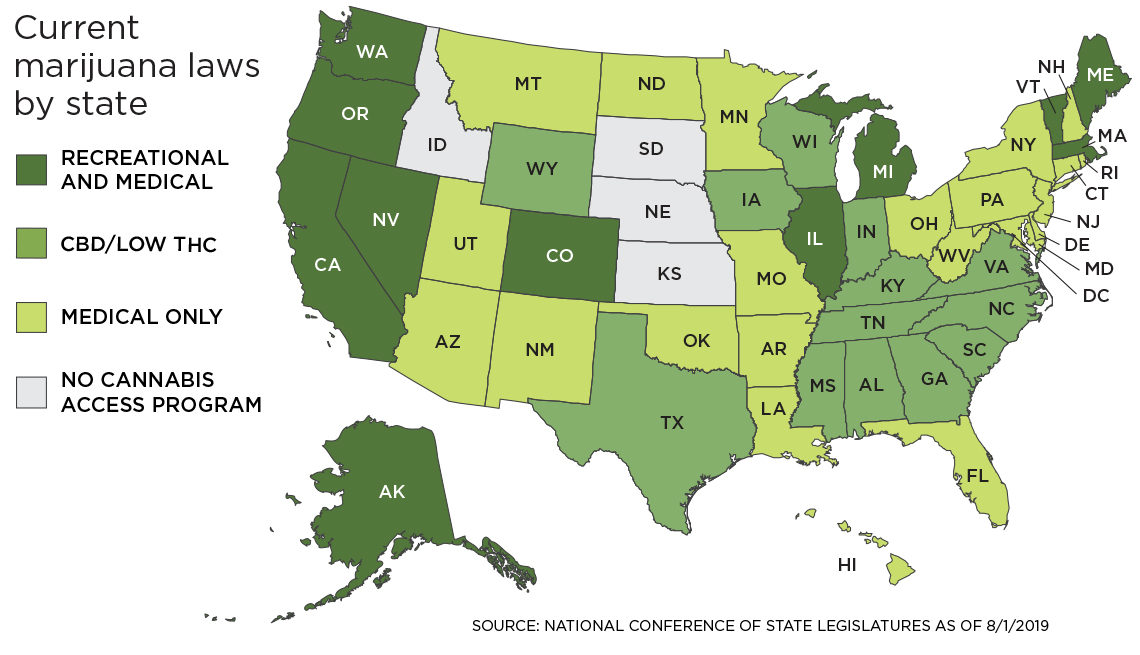
A map of the United States showing the legal status of marijuana color coded by stateCannabis: Where Is It Legal?
A map of the United States showing the legal status of marijuana color coded by state
AARP
Under federal law, all cannabis is illegal to sell, possess or use. The feds, however, are reluctant to enforce the prohibition in the face of mounting support by states.
Thirty-three states (plus the District of Columbia, Guam, Puerto Rico and the U.S. Virgin Islands) permit medical marijuana for qualifying patients; a doctor’s certification and patient card are generally required.
State laws differ on such critical questions as who can grow it, who can sell it and what health conditions qualify. Eleven states and the District of Columbia allow recreational marijuana use.
Under federal law, CBD (cannabidiol) derived from marijuana, which contains the psychoactive ingredient THC, is illegal; hemp-derived CBD that contains no more than 0.3 percent THC is legal to sell and consume — though the U.S. Food and Drug Administration says it is illegal to market CBD in food and supplements.
Thirteen states have passed laws allowing the sale of CBD/low THC products.
Details vary: Check your state’s laws for the latest info. For more information see the National Conference of State Legislatures.
6. Marijuana’s stoner stigma persists
Whether it’s a holdover from America’s decades-long war on drugs or pot’s still-illegal federal status, many older proponents of medical marijuana continue to hide their use.
The lingering stigma associated with pot keeps some people from telling their doctor, too, says Hillary Lum, a geriatrician and associate professor at the University of Colorado School of Medicine.
“In a recent survey, 30 percent of older adults didn’t answer the question about whether or not they used medical marijuana,” she says.
“If people feel uncomfortable with it on an anonymous survey, they may also feel uncomfortable telling their doctor. That could have ramifications for their health.”
7. Many doctors are in a quandary
Half of the primary care doctors working at Mayo Clinic medical offices said in a 2019 survey that they weren’t prepared to answer patients’ questions about medical marijuana — even though 58 percent believed it was a legitimate medical therapy for terminal illnesses, untreatable pain and cancer symptoms.
That hasn’t stopped some users — especially older adults — from approaching their doctors.
“My patients want to talk about it,” Lum says.
“But I’m in an information vacuum. We don’t have many clinical studies to show effectiveness. Medical schools, pharmacy schools and nursing schools haven’t taught it. It’s not in the pharmacy database we use for prescribing, so I don’t have a lot of information about potential drug interactions and side effects.”
A few institutions have declined to embrace its use. The Cleveland Clinic announced it would not recommend medical marijuana to its patients when it became legal to buy in Ohio in January.
Says Paul Terpeluk, a doctor of osteopathic medicine and medical director of the Cleveland Clinic’s Employee Health Services, “We’re just beginning to understand the effects of cannabinoids in the body. We do not believe states should be in the business of regulating and promoting medications.”
But other doctors prefer not to create obstacles to medical marijuana use.
Peter Grinspoon, a primary care physician at Massachusetts General Hospital and a Harvard Medical School instructor, took the unusual step of getting trained so he could certify his patients as medical marijuana users.
“I grew up with this, so it’s hard not seeing it as medicine,” Grinspoon explains.
His father, the Harvard psychiatrist Lester Grinspoon, is considered the “grandfather of medical marijuana” and wrote a book about the history and cultural use of medical marijuana in the 1970s; there’s even a marijuana strain in Europe named after him.
His brother used marijuana while battling leukemia, too.
“It makes sense to try cannabis when you consider the track record of other medications a lot of older adults take, especially for pain, sleep and anxiety,” Grinspoon says.
“Nonsteroidal anti-inflammatories like ibuprofen and naproxen can affect your kidneys, threaten your heart and cause gastrointestinal bleeding. Few people want to be on opiates — they haven’t proven to work well for long-term relief, you get constipated and they can be addictive. Sleep and anxiety drugs can leave you sedated and may affect memory. Cannabis can be as effective as anything.”
Even nursing homes are experiencing a profound shift toward acceptance.
One program at the Hebrew Home in Riverdale, New York, allows residents to use cannabis capsules or cannabis oil drops and has found that it eases pain, improves appetite and even reduced one resident’s opioid use.
The program stays compliant with federal rules by having residents buy and administer cannabis themselves or with the help of a caregiver who’s not on the home’s staff.
“The benefits are nothing short of amazing and should be more widely available to residents of long-term care facilities,” says Daniel Reingold, the CEO of RiverSpring Health, which operates the Hebrew Home.
The nursing home is now leading a group of nonprofit long-term care facilities in several states planning to launch a large study this fall of medical marijuana’s effects in older adults.
(Note: The purchase of medical marijuana from a dispensary is not covered by the U.S. Department of Veterans Affairs, Medicare, Medicaid or private insurance, though in some cases all may cover FDA-approved prescription drugs, such as Marinol, that are based on cannabis.)
Where AARP Stands
In March, the AARP Board of Directors approved a policy supporting the medical use of marijuana for older adults in states that have legalized it.
The decision was based on the growing body of research suggesting marijuana may be helpful in treating certain medical conditions and symptoms.
The policy also notes that decisions related to the use of medical marijuana should be made between a patient and a health care provider and appropriately balance clinical evidence of benefit and harm, the patient’s preferences and values, and any laws that may apply.
According to the policy, “AARP also supports further clinical research of medical use of cannabinoids to help alleviate both the symptoms of disease and the side effects of the treatment for diseases.”
The policy adds that “AARP believes the DEA’s [Drug Enforcement Administration] classification of marijuana as a Schedule I controlled substance deters the medical use and scientific study of cannabinoids” and calls on federal officials to examine options to allow more clinical research.

Sari Harrar
health, medicine and science writer
I am an award-winning freelance writer with more than 20 years of experience covering health, medicine, and science — for national magazines, books, custom-content publications, websites and newspapers.
Sari-Harrar-2012-400Journalism I write for many of the most widely-read magazines and newspapers in the U.S.  My work appears in Dr. Oz’s The Good Life magazine, Good Housekeeping, Prevention, O, The Oprah Magazine, Reader’s Digest, The Philadelphia Inquirer, Consumer Reports on Health, Organic Gardening and other leading publications.
Books I’ve written and collaborated on more than 15 health-related books for major publishers including Rodale and Reader’s Digest.
Custom Content I produce custom content — including ghost-written books and newspaper columns, magazine and newsletter articles and web content –for leading doctors, major health systems, organizations, universities and corporations.

AARP is a nonprofit, nonpartisan organization that empowers people to choose how they live as they age.
Two marijuana leaves superimposed on a caduceus medical symbol