Showing posts with label Algal blooms. Show all posts

Tuesday, January 19, 2021

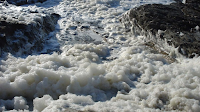
SEA FOAM - Sea foam is created by the agitation of seawater containing high concentrations of dissolved organic matter, which can come from the natural environment in the form of algal blooms or from man-made sources. As the waves crash onto the shore or lap at the beach, depending on where you are, there's usually some leftover frothy bits that cling to the sand. On windy days, this foamy stuff can even be lifted off the ground and blown around. What is it? And is it dangerous to touch it or let the dog run around in it? It's sea foam, and it is not nearly as green as the color we call sea foam. It's usually whitish, though it's probably a little dingy rather than being sparkling white. Sometimes it's more of a reddish-brown, though, and that's the sea foam to watch out for. Sea water is 96.5 percent water and 2.5 percent salt. That only adds up to 99 percent, so what's the other 1 percent? A lot of things - it's "proteins, fats, dead algae, detergents and other pollutants," plus other bits of organic and inorganic matter. When these particles get agitated by wind and waves, they froth. You can create the same effect by putting some sea water in a bottle and shaking it. The bubbles happen because of molecules called surfactants. These surfactants can come from natural sources, like algae and seaweed, or from human pollution, like fertilizers, detergents and sewage. One end of the molecule is hydrophobic – it repels water. The other end is hydrophilic – it attracts water.

.......................................................................................................................................................................................................................................................................................................................................................................................................

What Exactly Is Sea Foam?

BY KRISTEN HALL-GEISLER


Sea foam is created by the agitation of seawater containing high concentrations of dissolved organic matter, which can come from the natural environment in the form of algal blooms or from man-made sources. 

As the waves crash onto the shore or lap at the beach, depending on where you are, there's usually some leftover frothy bits that cling to the sand.

On windy days, this foamy stuff can even be lifted off the ground and blown around.

What is it? And is it dangerous to touch it or let the dog run around in it?

It's sea foam, and it is not nearly as green as the color we call sea foam. It's usually whitish, though it's probably a little dingy rather than being sparkling white.

Sometimes it's more of a reddish-brown, though, and that's the sea foam to watch out for.

Sea water is 96.5 percent water and 2.5 percent salt. That only adds up to 99 percent, so what's the other 1 percent?

A lot of things. According to the National Oceanic and Atmospheric Administration (NOAA), it's "proteins, fats, dead algae, detergents and other pollutants," plus other bits of organic and inorganic matter.

When these particles get agitated by wind and waves, they froth. You can create the same effect by putting some sea water in a bottle and shaking it.

The bubbles happen because of molecules called surfactants, which Popular Science explains are "sticky molecules that cling to the surface between water and air."

These surfactants can come from natural sources, like algae and seaweed, or from human pollution, like fertilizers, detergents and sewage.

One end of the molecule is hydrophobic – it repels water. The other end is hydrophilic – it attracts water.

The easiest shape for these molecules to form is a sphere, with the hydrophobic ends on the inside and the hydrophilic ends pointing outward.

Spheres (even if they aren't perfect) make bubbles. And a lot of bubbles make sea foam!

Now, about that reddish-brown sea foam. That's often due to phytoplankton, also known as algae blooms, which is a natural phenomenon.

These tiny organisms release toxins that aren't good for you, your dog, the birds, or anything, really. The toxins can irritate eyes and ears, and even the respiratory system.

The white foam may not be toxic, but that doesn't mean it's harmless.

When weather gets completely out of control, the churning of the water creates a lot of sea foam.

Like, a lot. In the winter of 2020, a king tide in Washington state with 25-foot (nearly 8-meter) waves created a "blender effect" that churned up sea foam as high as a man's chest.

Later that spring and halfway around the world, so much sea foam appeared in the Netherlands that it killed five very experienced surfers.

NOW THAT'S COLOR

In 2001, Crayola introduced a minty-green crayon called "seafoam."

According to Canva, it's a soft blue-green that is not the same as mint green. These two colors have different hex codes used by designers.

Seafoam is a mix of green, blue and a little gray, and it looks nothing like the sea foam found in the actual sea.

Kristen Hall-Geisler

CONTRIBUTING WRITER

Kristen Hall-Geisler is a freelance writer and book editor living in Oregon. As an automotive journalist since 2006, she's honed her research and interviewing skills with HowStuffWorks, The New York Times, TechCrunch, Popular Science, US News & World Report and more. She loves falling down the rabbit hole of research and emerging with a book or article that others find useful and — she hopes — entertaining while still being based on solid sources. She is the author of the historical novel "Skull and Sidecar" as well as the nonfiction books "Take the Wheel: A Woman’s Guide to Buying a Car Her Own Damn Self" and "Lightning in a Throttle: Three Early Electric Vehicle Victories."

https://science.howstuffworks.com/environmental/earth/oceanography/sea-foam.htm?utm_medium=recirc&utm_source=taboola&utm_campaign=feed


You might also like:


Algae Blooms 

(Red Tides)

CLICK HERE . . . to view . . . 

https://puricare.blogspot.com/2017/07/algae-blooms-red-tides-algae-blooms-are.html

...........................................................................................................................................................................................................................................................................................

Detergents And Water Pollution

CLICK HERE . . . to view . . . 

https://puricare.blogspot.com/2017/07/detergents-and-water-pollution-many-of.html

...........................................................................................................................................................................................................................................................................................

A dangerous guide to beachcombing

CLICK HERE . . . to view . . . 

https://puricarechronicles.blogspot.com/2017/12/beachcombing-if-you-see-something-that.html

...........................................................................................................................................................................................................................................................................................

Water Contaminants 

CLICK HERE . . . to view . . . 

https://puricare.blogspot.com/2016/10/water-contaminants-health-effects-epas.html

...........................................................................................................................................................................................................................................................................................

Foam Definition in Chemistry

CLICK HERE . . . to view . . . 

https://puricare.blogspot.com/2019/10/foam-definition-foam-is-substance-made.html

...........................................................................................................................................................................................................................................................................................

The Dead Sea & Bible Prophecy

CLICK HERE . . . to view . . . 

https://puricarechronicles.blogspot.com/2020/05/the-dead-sea-bible-prophecy-ezekiels.html

...........................................................................................................................................................................................................................................................................................

Worsening Algal Blooms

CLICK HERE . . . to view . . . 

https://puricare.blogspot.com/2020/05/worsening-algal-blooms-toxic-algae.html

Thursday, August 13, 2020

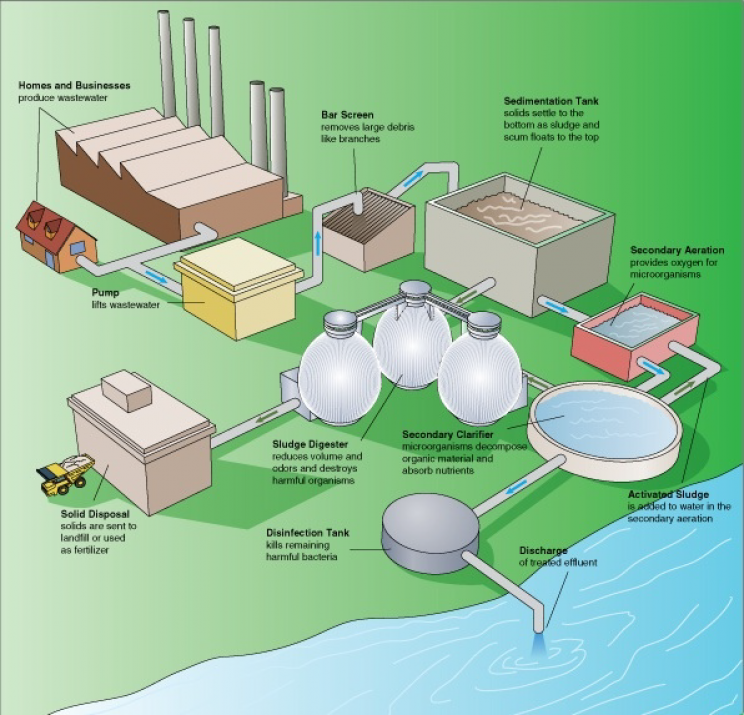
HOW MODERN WASTEWATER TREATMENT CHANGED OUR WORLD - Without wastewater treatment, diseases and infections would ravage our society. Wastewater treatment is often an overlooked necessity of civilization. Without proper sewer systems, wastewater treatment plants, and overall regulation, our cities would be ripe with disease and human waste everywhere. When you flush a toilet, your waste flows through the sewers to a wastewater treatment plant that treats it. Sewer systems are a topic all their own, so we'll mainly focus on how your wastewater goes from one of the dirtiest substances on the planet back into water that's safe for the environment. Some wastewater plants known as full-cycle reuse plants will even take wastewater and treat it all the way back to drinking water, which will then be pumped to city inhabitants. Today's level of engineering and chemistry allow full-cycle reuse plants to output drinking water chemically identical to what's in your tap right now. When wastewater arrives at a treatment facility, it first gets all the large chunks filtered out through a screen, a rather large one. These screens are generally called bar screens, and their main job is to make the sewage more homogenous so it can flow through pumps and pipes in the plant. The waste removed from bar screens is sent off to the landfill, and the slightly less chunky sewage heads to the next step, the grit chamber.

How Modern Wastewater Treatment Changed our World
...............................................................................................................................................................
How Modern Wastewater Treatment Changed our World
How Modern Wastewater Treatment Changed our WorldWithout wastewater treatment, diseases and infections would ravage our society
By Trevor English


Wastewater treatment is often an overlooked necessity of civilization.
Without proper sewer systems, wastewater treatment plants, and overall regulation, our cities would be ripe with disease and human waste everywhere.
Believe it or not, much of the modern wastewater management technology we consider standard in any 21st century home, things like toilets and sewer pipes, are actually relatively new in the grand scheme of history.
The history of wastewater treatment
That's not to say that sewer systems haven't been around for ages.
After all, the ancient Romans had a complex system of sewers at the peak of their empire.
How Modern Wastewater Treatment Changed our World
Roman sewer in Cologne
Rather, the knowledge of how poorly managed wastewater can drastically impact the health of society is relatively new.
The Romans had a centralized sewage management system, although it was fairly rudimentary by today's standards.
Open and closed ditches and pipes would carry away excrement and trash, primarily using rainwater runoff.
The contaminated water would then flow into large concrete tanks that let the sewage settle out before the water was allowed to flow into the nearby rivers.
There was indoor plumbing, and public latrines were also built over the sewers.
In medieval Europe, closed sewers, stone conduits, or ditches were used to drain sewage away from residential areas, often in conjunction with septic tanks, but chamber pots were often dumped directly onto the streets.
Between 1858 and 1859 the Thames in London was chock full of untreated wastewater, which combined with very hot weather to cause what became known as "the Great Stink".
The 17th and 18th centuries saw a rapid expansion in waterworks and pumping systems, but the Industrial Revolution led to even more rapid growth of cities and pollution, which acted as a constant source for the outbreak of deadly diseases like cholera and typhoid.
As cities grew in the 19th century, increasing public health concerns led to the development of municipal sanitation programs and the construction of sewer systems in many cities.
These systems often discharged sewage directly into rivers without treatment, but by the late 19th century, chemical treatments and sedimentation systems were in use in many cities.
The construction of centralized sewage treatment plants began between the late 19th and early 20th centuries.
These systems passed sewage through a combination of physical, biological, and chemical processes to remove pollutants.
Also beginning in the 1900s, new sewage-collection systems were designed to separate storm-water from domestic wastewater, to prevent treatment plants from becoming overloaded during heavy rains.
In the 1910s and 20s, engineers developed more sophisticated systems to treat drinking water before it was supplied to residents in cities.
Stepping back for a moment and examining the timeline here, we can begin to understand just how recent effective wastewater treatment on a grand scale appeared.
Roughly 150 years ago was the first few centralized instances of water treatment for cities. It would take decades for more rigid practices to emerge.
In 1972, the Clean Water Act was passed in the United States. Up until this point, sewage treatment for some cities still relied on chemical treatment and filtration, and the treated sewage was often dumped into rivers and streams.
There was little in the way of pretreatment of industrial wastewater to prevent toxic chemicals from interfering with the biological processes used at sewage treatment plants.
After the passage of the Clean Water Act, cities started a process known as secondary treatment, which removes all the pollutant organic materials from the effluent.
Wastewater with high concentrations of organic materials and nutrients being dumped into rivers was causing algal blooms and the bacteria growth, which created dead zones in rivers.
The secondary treatment essentially eradicates the effluent of microorganisms and organics so that when it's discharged, it has little effect on the surrounding environment.
To think, just 50 years ago many communities in the world were dumping mostly untreated sewage into rivers.
Wastewater treatment processes have really experienced their most rapid growth in the last 30 or so years, now with every planned municipality in the world having some form of a centralized wastewater management system.
It's all at a hefty cost too - on the scale of billions and billions of dollars.
Now, however, we can flush our toilets and shower without really having to worry about what's happening to all that dirty water.
It gets handled by trusty wastewater treatment plant operators before being discharged into local rivers and lakes.
"Oh, and what happens to all the solids from wastewater?" you might wonder.
Well in some cases, wastewater treatment plants will let it dry, package it up and sell it as fertilizer to help supplement the hefty costs of running a treatment plant.
In other cases, some plants will use the sludge to produce methane, which they will then burn for power or sell.
Wastewater treatment today uses science and engineering, though it is still a little bit smelly. We suppose it comes with the territory.
Now that we understand just how recently our knowledge of sanitation when it comes to human waste has emerged, let's take a closer look at exactly how wastewater treatment plants work. 
How modern wastewater treatment works
When you flush a toilet, your waste flows through the sewers to a wastewater treatment plant that treats it.
Sewer systems are a topic all their own, so we'll mainly focus on how your wastewater goes from one of the dirtiest substances on the planet back into water that's safe for the environment, and in theory, safe enough to drink.
Some wastewater plants known as full-cycle reuse plants will even take wastewater and treat it all the way back to drinking water, which will then be pumped to city inhabitants.
This may sound gross, but today's level of engineering and chemistry allow full-cycle reuse plants to output drinking water chemically identical to what's in your tap right now.
Before we dive into the specific process of wastewater treatment, let's put things into a scale.
New York City has an array of 14 wastewater treatment plants that handle 1.3 billion gallons of wastewater per day (4.9 billion liters).
That is enough wastewater to fill the dead sea with sewage in 8 years, just from one large city.
So, society produces a lot of waste. Let's see what happens first when it arrives at a wastewater treatment plant.
How Modern Wastewater Treatment Changed our World
Pre & Primary Treatment
How Modern Wastewater Treatment Changed our WorldWhen wastewater arrives at a treatment facility, it first gets all the large chunks filtered out through a screen, a rather large one.
These screens are generally called bar screens, and their main job is to make the sewage more homogenous so it can flow through pumps and pipes in the plant.
The waste removed from bar screens is sent off to the landfill, and the slightly less chunky sewage heads to the next step, the grit chamber.
Grit chambers are essentially just big pools that you definitely don't want to swim in, they allow the larger particles in the sewage to settle out to the bottom.
These larger particles, things like dirt, sand, and large food particles, are called grit. Again, this process aids in making the sewage more homogenous than when it came in. The grit is also trucked off to landfills.
After the sewage gets pretty homogenized in these first few processes, it moves onto the primary clarifiers.
Primary clarifiers function as giant settling basins that allow particles larger than 10 μm (0.01 mm), referred to as suspended solids, to settle out to the bottom of the basin.
A giant skimming arm also scrapes away fat and grease that rise along the surface of the water.
These primary clarifiers are based on a principle called settling velocity, essentially just the speed at which particles settle.
Engineers make sure that the inflow of the water to the primary clarifier isn't more than the settling velocity of the particles, which ensures that particles still settle out and the sewage keeps on flowing.
Upon leaving the primary clarifiers, the sewage is free of solids bigger than 10 μm and at this point, is mostly contaminated with organic matter.
The sewage then moves on to aeration basins, beginning the secondary treatment processes.
Secondary wastewater treatment
Aeration basins are essentially bubbly hot tubs for sewage.
They bubble up air through the bottom of the sewage, which invigorates the sewage with dissolved oxygen.
How Modern Wastewater Treatment Changed our World
A view of 3 clarifiers
Engineers also pump in activated sludge into aeration basins, which is essentially bacteria and waste from the next round of clarifiers.
This activated sludge raises the oxygen content of the water and the bacteria go on a feeding frenzy, eating up all of the organic matter.
After the aeration basins, the sewage is going to look a lot clearer and it will head onto the secondary clarifiers.
This is the final filtering process, where all the remaining particles settle out.
The stuff that settles out is that activated sludge just mentioned, and a part of it is reused to make the aeration basins run smoothly.
What isn't used is left to dry out before it's disposed of or used as fertilizer.
How Modern Wastewater Treatment Changed our World
By the time the sewage leaves the secondary clarifiers, 85 percent of all organic matter has been removed and it will look fairly clear.
It might also be safe to drink too, but you're probably not going to want to. The final process before discharge is disinfection.
This process kills off all the bacteria still left in the water and makes sure there aren't any diseases being discharged into rivers.
This is typically done through chlorine, ozone, or ultraviolet disinfection (or a combination of these).
Ozone disinfection involves discharging electricity into the water to cause oxygen gas molecules to turn into ozone molecules, which oxidizes the bacteria, causing their cell walls to break, and kills them.
Chlorine treatment kills the bacteria in a similar manner but is a liquid chemical added to the water, and the treatment plant operators will generally remove the chlorine before releasing the effluent so the chlorine doesn't damage the environment.
Lastly, engineers can also use ultraviolet light to scramble the DNA of the bacteria, making it impossible for them to reproduce.
All three of these processes have different pros and cons and are used fairly interchangeably across the world.
In most cases, after disinfection, the water is released into rivers and streams.
In regions where water is scarce, sometimes the treated wastewater will head back for another round of treatment to be made into drinking water.
Chemically, this is very safe and could probably be used in many more places around the world if it wasn't for the stigma surrounding the closed-loop process of turning wastewater back into drinking water.
The entire process takes around 24 to 36 hours for a molecule of water to make it through the treatment plant.
And that's the magic of wastewater treatment. It's an essential process that allows us to live our lives without having to think about our own waste.
Be sure to thank all the wastewater treatment plant operators around you, because they have to deal with what you don't want to, 24/7.

Trevor English
Author
Trevor is a civil engineer (B.S.) by trade and an accomplished writer with a passion for inspiring everyone with new and exciting technologies. He is also a published children’s book author and the producer for the YouTube channel Concerning Reality.

Founded on the core mission of connecting likeminded engineers around the globe, Interesting Engineering is now a leading community with more than 15 million+ minds. Every day we share a new idea, a new thought, an upcoming technology OR an engineering breakthrough that will change the way you think about technology and engineering in today’s world and in the near future. Whether it’s a device that can charge your mobile in seconds or it’s the latest model of Boeing that has launched moments ago, we will bring everything up on your screen to view, to share and to grant you the power to comment. We believe that sharing information is the only way that can enrich and empower humans on this earth and we follow this as our core mission and responsibility. If you have got something that could entice the world, then Interesting Engineering is a perfect platform to show off your work to the outside world.
How Modern Wastewater Treatment Changed our World

Wednesday, January 1, 2020

POTABLE WATER - Potable water simply means water that is safe to drink. Organic contaminants are carbon-based chemicals which are introduced through agricultural runoff or industrial discharge. They can be responsible for a range of severe health problems. Radiological threats include radon, cesium, plutonium and uranium. Inorganic pollutants, such as mineral acids, inorganic salts, metals, cyanides, and sulfates, persist in the environment. Heavy metals can cause neurological problems in humans, especially in the unborn and children. Arsenic can cause cancer, skin lesions, cardiovascular disease, diabetes, and cognitive impairment. Algal blooms can also introduce cyanotoxins to drinking water as well. Waterborne pathogens including bacteria, viruses, protozoa, and parasites are usually introduced to water via feces and can cause a range of illness from mild gastroenteritis to potentially fatal diarrhea, dysentery, hepatitis, typhoid fever, cholera, and cryptosporidiosis.

Potable Water
.................................................................................................................................................................
Potable Water
What Is Potable Water?
FLUENCE NEWS TEAM


Of the more than 2 billion people who lack potable water at home, 263 million must travel 30 minutes per trip to collect it.
With a global drinking water crisis on the horizon, technologies old and new make the most of existing water resources
“Potable water” simply means water that is safe to drink, and it is becoming scarcer in the world.
Increasing use is stressing freshwater resources worldwide, and a seemingly endless list of contaminants can turn once potable water into a health hazard or simply make it unacceptable aesthetically.
Of the more than 2 billion people who lack potable water at home, 844 million don’t have even basic drinking water service, including 263 million who must travel 30 minutes per trip to collect water.
About 159 million drink untreated surface water.
Unsafe drinking water is a major cause of diarrheal disease, which kills about 800,000 children under the age of 5 a year, usually in developing countries, but 90 countries are expected to fail to reach the goal of universal coverage by 2030.
What Makes Water Unsuitable for Drinking?
The World Health Organization (WHO) organizes potable water contamination as organic, inorganic, radiological, and microbiological, and includes measures of acceptability of taste, smell, and appearance.
Organic contaminants are carbon-based chemicals, including solvents and pesticides, which are introduced through agricultural runoff or industrial discharge.
They can be responsible for a range of severe health problems from cancer to endocrine function disruption.
Radiological threats include radon, cesium, plutonium and uranium.
In North America, radon is the leading cause of lung cancer in nonsmokers and the leading environmental cause of cancer mortality overall.
Inorganic pollutants, such as mineral acids, inorganic salts, metals, cyanides, and sulfates, persist in the environment.
Heavy metals can cause neurological problems in humans, especially in the unborn and children, and also bio-accumulate in some foods.
Arsenic can cause cancer, skin lesions, cardiovascular disease, diabetes, and cognitive impairment.
Algal blooms from nutrients like phosphorus and nitrogen can also introduce cyanotoxins to drinking water as well.
Waterborne pathogens including bacteria, viruses, protozoa, and parasites are usually introduced to water via feces and can cause a range of illness from mild gastroenteritis to potentially fatal diarrhea, dysentery, hepatitis, typhoid fever, cholera, and cryptosporidiosis.
Millions are also infected with waterborne tropical diseases that include trachoma, the most common cause of preventable blindness.
Also threating drinking water are so-called “emerging contaminants” or “contamininants of emerging environmental concern,” which include pharmaceuticals introduced through sewage and runoff from livestock operations.
Turbidity (lack of clarity caused by mixed-in particles) can give water an unacceptable taste, smell, or look.
Whether turbid water is harmful or just unattractive depends on the material present.
For effective potable water treatment, it’s important to carefully analyze source water and then tailor treatment to specific water conditions and standards.
Treating Water for Potability
Many time-tested water treatment processes are still in use today in primary treatment stages.
The history of water treatment goes back thousands of years, as far as Minoan civilization, circa 1700 BCE, and the ancient Egyptians, who first used alum flocculation and sedimentation to clarify water circa 1500 BCE.
Sedimentation is allowing particles in turbid water to settle. Alum and other “sticky” additives known as polyelectrolytes aid the settling process by flocculation, or sticking particles together into “flocs.”
Flocculation and sedimentation with clarifiers are common in water treatment plants.
The understanding of microbiology that came with the work of Dr. John Snow and Louis Pasteur in the 1800s had great implications for water treatment.
Research connected turbidity to pathogens, and sand filters were first used for treatment of a public water supply in 1829 London.
Municipal water systems in the United States followed suit in the early 1900s, and the process of filtration with layers of sand, gravel, and charcoal remains widespread today.
But disinfectants like chlorine in America and ozone in Europe played the largest role in ending epidemics of waterborne diseases such as typhoid, dysentery, and cholera.
Today, municipal water supplies routinely prechlorinate to prevent algae and biological growth, or chlorinate in the final stages of water treatment.
Chlorination in conjunction with aeration is also used to remove dissolved iron, and aeration effectively removes volatile organic compounds (VOCs).
Other disinfection methods include ultraviolet (UV) light and pH adjustment.
Modern Water Treatments
In modern times, advances in technology have built on the foundation of older treatments.
For example, aerobic processes have long been the mainstay of wastewater treatment, particularly for sewage and other waste streams high in organic or biodegradable content.
In aerobic processes, microorganisms that thrive in oxygenated water break down organic contaminants and remove nitrates.
The newest and most efficient aerobic treatment is found in the membrane aerated biofilm reactor (MABR), which uses up to 90% less energy for aeration, the most energy-intensive stage of biological treatment.
In MABR, simultaneous nitrification-denitrification takes place in a single tank that holds a spirally wound, air-permeable membrane.
Aeration takes place at near-atmospheric pressure. MABR, which is notable for its high effluent quality as well as its energy savings, is available to retrofit existing plants, as well as in small, packaged systems suitable for decentralized treatment strategies.
Decentralization places smaller plants near the point of use, eliminating the need for huge, regional plants and the costly pipeline networks that are financially out of reach for many regions.
Other water purification processes that use membranes have made significant strides since the 1970s and 1980s, including in reverse osmosis filtration.
Modern filtration in reverse osmosis (RO) is accomplished by forcing pressurized water through a membrane that is semi-permeable at the molecular level to exclude unwanted solutes.
One common way RO is used in the production of potable water is through desalination. Advances in the mid-2010s increased its energy and cost-efficiency.
Modern desalination plants are producing about 50% of Israel’s potable water. Higher recovery rates and lower consumption of energy and chemicals have made desalination much less expensive.
Now desalination is available in scalable and quickly deployed Smart Packaged options suitable for decentralization.
Anaerobic digestion, a biological treatment process that relies on microbes that flourish in the absence of oxygen, is now used to remove organic material and trace organic contaminants (TOCs) generated by human activity.
TOCs accumulate by biomagnification and bioaccumulation in organisms and cause irreversible damage in humans and animals by disrupting endocrine systems and causing tumors.
During the anaerobic digestion process, microorganisms break down organic compounds, creating a biogas that is mostly methane. Waste-to-energy systems can also be installed to collect the methane and use it to generate energy.
Ion exchange, a chemical process that exchanges unwanted dissolved ions for similarly charged ions, is used extensively for potabilization in processes including water softening, demineralization, dealkalization, deionization, and disinfection.
Specialized ion exchange resins targeted at specific contaminants like nitrates, perchlorate, and uranium also have become increasingly popular for potable water production.
The Future of Potable Water
Demand for fresh water worldwide is projected to increase 55% between 2000 and 2050, and recently, NASA scientists have determined that freshwater resources are being used faster than they are being replenished.
Jay Famiglietti, a senior hydrologist at NASA, has warned, “The water table is dropping all over the world. There’s not an infinite supply of water.”
Potable water is fundamental to human life, and we can expect it to be a growing issue for the foreseeable future.

Fluence brings together breakthrough water-treatment technologies and proven delivery platforms to optimize the water cycle for the 21st century. We provide the middle market with water, wastewater, and reuse solutions that can be quickly deployed anywhere in the world, empowering businesses and communities to make the most of their water resources.
Solutions for the Complete Water Cycle
We offer an integrated range of services across the complete water cycle, from early-stage evaluation, through design and delivery, to ongoing support and optimization of water-related assets. Our solutions include:
Energy-efficient technology that lowers capex and opex
Packaged and pre-engineered decentralized treatment solutions for quick deployment
Tailored financing packages to finance water and wastewater treatment plants
Constructing and operating water assets under build-operate-transfer (BOT), operating and financing leases, and reuse-as-a-service (RaaS)

Potable Water