Showing posts with label Aviation hazards. Show all posts

Friday, November 15, 2019

VOLCANIC ASHFALL HAZARD - Ashfall is the most widespread and frequent volcanic hazard. Ashfall rarely endangers human lives, but it can have devastating effects on the things that we rely upon from day to day. As a result of its fine-grained abrasive character and widespread distribution by wind, ashfall and volcanic ash clouds are a major hazard to aviation. Ash fallout to the ground can pose significant disruption and damage to buildings, transportation, water and wastewater, power supply, communications equipment, agriculture, and primary production leading to potentially substantial societal impacts and costs, even at thicknesses of only a few millimetres or inches. Fine grained ash, when ingested can cause health impacts to humans and animals.

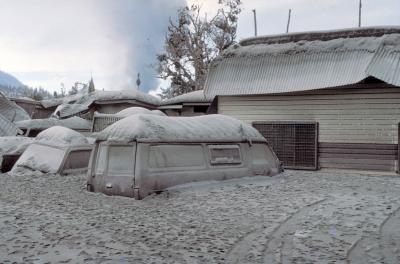
Ash buries cars and buildings after the 1984 eruption of Rabaul, Papua New Guinea. 
 (Click image to view full size.)
Ash buries cars and buildings after the 1984 eruption of Rabaul, Papua New Guinea.
..................................................................................................................................................................
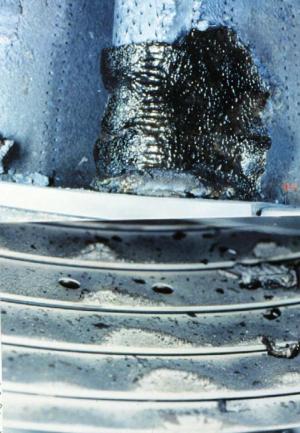
Ash deposits inside the jet engine that encountered the ash cloud from Redoubt Volcano on 15 December 1989. 
 (Click image to view full size.)
Ash deposits inside the jet engine that
encountered the ash cloud from
Redoubt Volcano on 15 December 1989.
Volcanic Ashfall Hazard
Ashfall is the most widespread and frequent volcanic hazard
USGS Volcano Hazards Program


Explosive eruptions produce ash.
All explosive volcanic eruptions generate tephra, fragments of rock that are produced when magma or rock is explosively ejected.
The largest fragments, blocks and bombs (>64 mm, 2.5 inches diameter), can be expelled with great force but are deposited near the eruptive vent.
Lapilli-sized material (6-64 mm, 0.24-2.5 inches diameter) can be carried upward within in a volcanic plume and downwind in a volcanic cloud, but fall to the ground as the eruption cloud cools.
The smallest material, volcanic ash (<2 mm diameter) is both easily convected upward within the plume and carried downwind for very long distances; as it falls out of suspension it can potentially affect communities and farmland across hundreds, or even thousands, of square kilometers (miles).
Ash endangers aviation and infrastructure.
Ashfall rarely endangers human lives, but it can have devastating effects on the things that we rely upon from day to day.
As a result of its fine-grained abrasive character and widespread distribution by wind, ashfall and volcanic ash clouds are a major hazard to aviation.
The primary hazard from Alaska volcanoes is ash clouds impacting aviation and ashfall reaching areas downwind, owing to widespread dispersal by wind.
Ash fallout to the ground can pose significant disruption and damage to buildings, transportation, water and wastewater, power supply, communications equipment, agriculture, and primary production leading to potentially substantial societal impacts and costs, even at thicknesses of only a few millimetres or inches.
Additionally, fine grained ash, when ingested can cause health impacts to humans and animals.
Impacts from ashfall are more complex and multi-faceted than for any of the other volcanic hazards.
Variabilities include the distance from the eruption source, orientation and dispersion of the eruption cloud, the amount of ashfall received, physical and chemical properties of the ash, characteristics of the receiving environment (such as climate and land use), and the ability of affected community to adapt to ashfall.

The USGS sponsored Volcanic Ashfall Impacts Working Group offers resources and guidance for ashfall preparedness and impact.
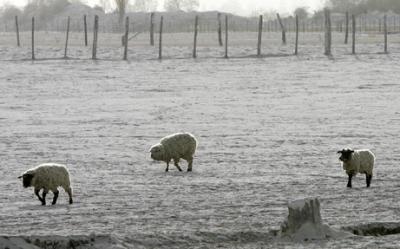
Ash covered the pasture reducing livestock access to feed in Futaleufú following the 2008 Chaitén eruption.
 (Click image to view full size.)
Ash covered the pasture reducing livestock access to feed in Futaleufú following the 2008 Chaitén eruption.

Tuesday, October 15, 2019

RED LIGHTS ON TOP OF BUILDINGS - Aircraft warning lights are lighting devices that are attached to tall structures and are used as collision avoidance measures. Such devices make structures more visible to passing aircraft and are usually used at night, although they may be used during the day as well. These lights need to be of sufficient brightness in order to be visible for miles around the structure. These lights can generally be found attached to any tall structure such as broadcast masts and towers, water tanks located on high elevation, electricity pylons, chimneys, tall buildings, cranes and wind turbines.

Aircraft Warning Lights
..........................................................................................................................................................
Red Lights On Top Of Buildings
Why do tall buildings have red lights on top of them?
factsinbrief.com 


These red lights are called aircraft warning lights.
Aircraft warning lights are lighting devices that are attached to tall structures and are used as collision avoidance measures.
Such devices make structures more visible to passing aircraft and are usually used at night, although they may be used during the day as well. These lights need to be of sufficient brightness in order to be visible for miles around the structure.
These lights can generally be found attached to any tall structure such as broadcast masts and towers, water tanks located on high elevation, electricity pylons, chimneys, tall buildings, cranes and wind turbines.
Shorter structures that are located close to airports may also require lighting.
Red lights are commonly found to be used in urban areas, since it is easier for pilots to spot them from above.
In general, there are several types of lights that are used worldwide. 
The International Civil Aviation Organization (ICAO) sets standards, usually adopted worldwide, for the performance and characteristics of aviation warning lamps.
About Us
Our website www.factsinbrief.com was launched in June 2017 and its purpose is to provide people visiting it with very interesting general knowledge information.
Here, you can find very interesting and comprehensive information on various topics. All the articles presented are a result of a thorough research to be able to provide information and knowledge as accurately as possible.
The goal is not the reproduction of mass information as it has been seen in recent years from various websites, but the valid acquisition of general knowledge through relatively short articles.
Aircraft Warning Lights