
Showing posts with label Cars. Show all posts

Friday, July 31, 2020

SOLAR PANELS ON CARS - Much like solar-powered homes, solar cars harness energy from the sun, and then convert it into electricity. That electricity then fuels the car's powertrain, which is similar to the combination of an electric motor and battery-based energy storage that drives modern hybrid cars. Solar cars can accomplish this through photovoltaic cells. PVCs are the components in solar paneling that convert the sun's energy to electricity. They're made up of semiconductors, usually made of silicon that absorb the light. The sunlight's energy then frees electrons in the semiconductors, creating a flow of electrons. That flow generates the electricity that powers the battery or the specialized motor in solar cars. The earliest solar cars were DIY jobs that date back to the 1970s and were mostly designed and assembled in car enthusiasts' garages. Several other organizations experimented with race cars designed to take advantage of solar power. These helped engineers understand the potential of collecting and storing solar energy, maximizing aerodynamics and identifying other challenges to running a car powered off the sun. As for major auto manufacturers' contributions to the field, Ford and Mazda, notably, both introduced solar hybrid concept cars in the mid-2000s, and Cadillac designed a concept car that used solar panels to help power accessories like interior lighting and audio that typically draw off a car's electrical system.

Tesla Cybertruck
.................................................................................................................................................
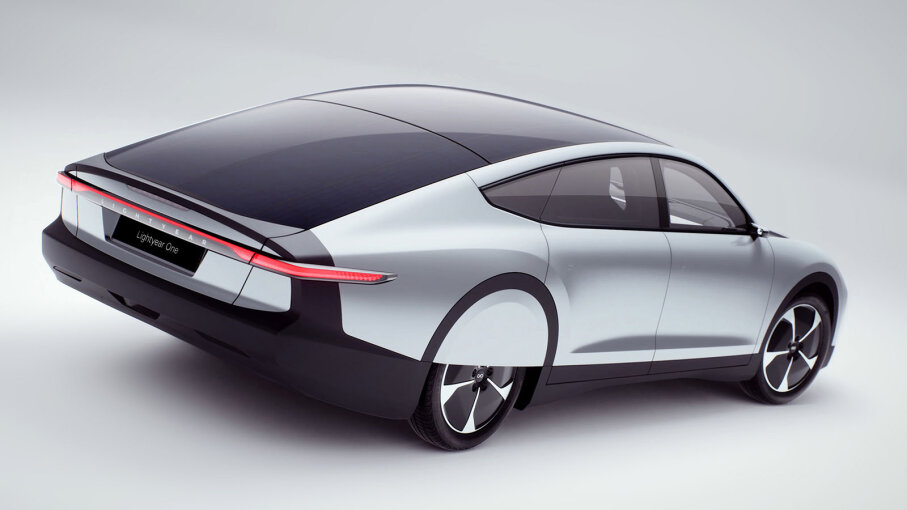
Lightyear One
The roof and hood of the Lightyear One are comprised of integrated
solar cells so the car can charge itself whenever it absorbs sunlight.
Solar Panels Are Slowly Making Their Way on Cars
BY CRISTEN CONGER & CHERISE THREEWITT


There may be no such thing as a free lunch, but what about a free ride?
Think of how awesome it would be if your car could keep running without you spending a dime on fuel.
If you drove a solar-powered car that dream could be a lot closer to a reality.
Much like solar-powered homes, solar cars harness energy from the sun, and then convert it into electricity.
That electricity then fuels the car's powertrain, which is similar to the combination of an electric motor and battery-based energy storage that drives modern hybrid cars.
Solar cars can accomplish this through photovoltaic cells (PVC).
PVCs are the components in solar paneling that convert the sun's energy to electricity. They're made up of semiconductors, usually made of silicon that absorb the light.
The sunlight's energy then frees electrons in the semiconductors, creating a flow of electrons. That flow generates the electricity that powers the battery or the specialized motor in solar cars.
The earliest solar cars were DIY jobs that date back to the 1970s and were mostly designed and assembled in car enthusiasts' garages.
Several other organizations experimented with race cars designed to take advantage of solar power.
These helped engineers understand the potential — and the limitations — of collecting and storing solar energy, maximizing aerodynamics and identifying other challenges to running a car powered off the sun.
As for major auto manufacturers' contributions to the field, Ford and Mazda, notably, both introduced solar hybrid concept cars in the mid-2000s, and Cadillac designed a concept car that used solar panels to help power accessories like interior lighting and audio that typically draw off a car's electrical system (which, in turn, contributes to fuel consumption).
None of these concept cars made it to production, which means they were never available to consumers.
After that, investment in solar car technology more or less went dark, at least as a mainstream pursuit.
On the upside, though, many automakers have shifted development resources toward making hybrid and plug-in hybrid cars more practical, efficient and affordable than ever.
This, in turn, means it might be time to give solar cars another shot, though the new-generation solar cars on the horizon are more like hybrids that add solar power to the mix.
Are Solar-powered Cars Practical?
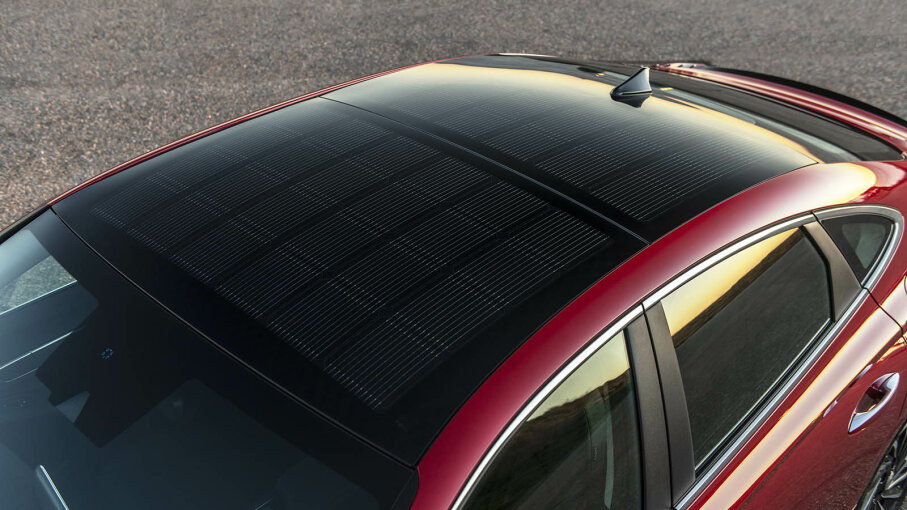
Hyundai Sonata
The 2020 Hyundai Sonata Hybrid features a Solar Roof System that recharges
 the car's hybrid battery and increases the car's driving range by a couple of miles a day.
The renewed interest in solar panels on cars is less about the panels themselves becoming better, and more about the fact that hybrid and electric cars, and their infrastructure, is better.
In other words, it's easier and more affordable than ever for consumers to go buy a readily available electric or hybrid car, and these cars are more efficient, easier to charge, and have fewer compromises overall than EVs and hybrids of just a couple generations ago.
That means there are more people who can take advantage of solar power to run a car, and that solar power will literally go farther than it would have in the past.
That said, solar panel technology has improved, too.
It's more affordable and easier for most consumers to incorporate into a home or garage update. But solar-powered cars still have a long way to go.
In fact, it's unlikely that we'll see a car that can be fully powered by a solar panel integrated into the roof, because a panel that size is just too small to produce the power needed.
EnergySage, a company that helps consumers research and shop for solar technology, estimates that a car completely covered in solar panels (not just the roof) could only power an electric car for a maximum of 25 miles (40 kilometers) a day, and that's assuming weather and other conditions are absolutely perfect.
Yet, EnergySage argues a solar panel that gives a car a boost of just a few miles a day is still worth the investment.
So which automakers are investing in the technology?
There are several. High-tech company Lightyear released two Lightyear Research Vehicles to test its integrated solar technology on the road in June 2020.
The company says it is preparing to produce an exclusive series of cars equipped with its solar technology by the end of 2021.
Germany's Sono Motors has spent three years developing a manufacturing process that will enable the seamless integration of solar cells into the body of its Sion electric car.
On June 30, 2020, the company announced it had partnered with Roding Automobile GmbH to begin production of its next generation of Sion prototypes.
Toyota is testing a version of the Prius with an integrated solar roof in Japan.
This demo version, which is not for sale, can charge the car while it is being driven; its earlier version could only charge while parked.
The 2020 Hyundai Sonata Hybrid, however, is available to American consumers and comes with a solar roof panel that recharges the car's batteries.
The roof panel generates enough electric power to increase the car's driving range by about 2 miles (3.2 kilometers) a day.
The Tesla Cybertruck, which was unveiled in November 2019 but isn't expected to be released until late 2021, has an option for solar panels, even though Tesla CEO Elon Musk has previously said that solar panels on cars are too inefficient.
And that brings us to the question of whether or not the extra cost of adding solar panels to a car is worth it.
For example, cars in sunnier locations and cars that are parked outside rather than in a garage, will generate more solar power and offer more of a financial benefit to owners.
But the question still remains to be seen whether the financial costs to automakers will be beneficial enough to produce them.
DIY solar panel kits that are designed to contribute to powering the battery of an electric or plug-in hybrid car via the home's charging system are available.
Similar aftermarket kits are offered and marketed as ways to help power RVs or trailers.
They can also be used to collect and store energy for camping accessories such as tents or cooking setups, like those designed to mount in the bed of a pickup truck.
Tesla Cybertruck
Tesla's Cybertruck has optional solar panels, which can be used to
power things like its camping equipment.
Solar kits for these purposes are mainstream enough that they're available at online and big box retailers.
As for now, though, adding solar panels directly to your car isn't very common. Though they may someday become more plausible for more consumers.
SOLAR CAR COMPETITIONS
Solar car racing has been going on since the 1980s, long before today's consumer-focused efforts at getting solar cars on the road.
The 1,872-mile (3,012-kilometer) World Solar Challenge began in 1983 and races across Australia every two years.
The American Solar Challenge started in 1990 and follows a route across North America that changes almost every year.

About Cristen Conger  
Raised on a steady diet of Technicolor musicals and library books, Cristen Conger always wanted to be a writer when she grew up. While working toward her journalism degree at the University of Georgia, she learned to avoid starry-eyed statements about childhood dreams and stick to hard facts. After graduating, Cristen decided she'd spent enough time chasing down REM band members in Athens and hitched up the road to Atlanta where she jumped on board with the award-winning web site HowStuffWorks.com.

As a writer and blogger for HowStuffWorks and a contributing writer for Discovery News, Cristen specializes in technology and the science of everyday living. Her articles have featured on Huffington Post, ABC Science and MSNBC.com. She also co-hosts the popular Stuff Mom Never Told You podcast, which explores gender issues such as relationships, careers and women's history. A graduate of University of Georgia, where she majored in journalism, Cristen reads, writes, runs and dabbles in improv comedy.

Cherise Threewitt
CONTRIBUTING WRITER 
Cherise Threewitt is a Chicago-based writer and editor with 15 years of experience covering the automotive industry. At HowStuffWorks, Cherise enjoys researching and writing stories that make cars and car culture interesting and accessible for everyone. When Cherise isn't writing, she's probably at the gym, paddling on Lake Michigan, or driving her 2019 Subaru WRX.
Hyundai Sonata

Sunday, September 8, 2019

ANTI-LOCK BRAKE SYSTEM (ABS) - The ABS is a four-wheel system that prevents wheel lock-up by automatically modulating the brake pressure during an emergency stop. By preventing the wheels from locking, it enables the driver to maintain steering control and to stop in the shortest possible distance under most conditions. During normal braking, the ABS and non-ABS brake pedal feel will be the same. Vehicles with ABS are equipped with a pedal-actuated, dual-brake system. If there is an ABS failure, the system will revert to normal brake operation so you will not be without brakes. Normally the ABS warning light will turn on and let you know there is a fault. When that light is on it is safe to assume the ABS has switched to normal brake operation and you should drive accordingly.

ABS lights on car dash
...................................................................................................................................................
 Anti-Lock Brake System (ABS)
ABS Brakes and the Facts
by Matthew Wright 


Since most cars on the road today have some form of Anti-lock Brake System (ABS) they are important enough to take a look at how they work and clear up some misinformation about them.
As always, what is described here is how most systems work in general.
Since different manufacturers have their own versions of ABS their specifications and part names may differ.
If you're having a problem with the ABS on your vehicle you should always refer to the specific service and repair manuals for your vehicle.
The ABS is a four-wheel system that prevents wheel lock-up by automatically modulating the brake pressure during an emergency stop.
By preventing the wheels from locking, it enables the driver to maintain steering control and to stop in the shortest possible distance under most conditions.
During normal braking, the ABS and non-ABS brake pedal feel will be the same.
During ABS operation, a pulsation can be felt in the brake pedal, accompanied by a fall and then rise in brake pedal height and a clicking sound.
Vehicles with ABS are equipped with a pedal-actuated, dual-brake system.
The basic hydraulic braking system consists of the following:
·          ABS Hydraulic Control Valves and Electronic Control Unit
·          Brake Master Cylinder
·          Necessary brake tubes and hoses
The anti-lock brake system consists of the following components:
·          Hydraulic Control Unit (HCU)
·          Anti-Lock Brake Control Module
·          Front Anti-Lock Brake Sensors/Rear Anti-Lock Brake Sensors
Anti-Lock Brake Systems (ABS) Operate as Follows
1.        When the brakes are applied, fluid is forced from the brake master cylinder outlet ports to the HCU inlet ports. This pressure is transmitted through four normally open solenoid valves contained inside the HCU, then through the outlet ports of the HCU to each wheel.
2.        The primary (rear) circuit of the brake master cylinder feeds the front brakes.
3.        The secondary (front) circuit of the brake master cylinder feeds the rear brakes.
4.        If the anti-lock brake control module senses a wheel is about to lock, based on anti-lock brake sensor data, it closes the normally open solenoid valve for that circuit. This prevents any more fluid from entering that circuit.
5.        The anti-lock brake control module then looks at the anti-lock brake sensor signal from the affected wheel again.
6.        If that wheel is still decelerating, it opens the solenoid valve for that circuit.
7.        Once the affected wheel comes back up to speed, the anti-lock brake control module returns the solenoid valves to their normal condition allowing fluid flow to the affected brake.
8.        The anti-lock brake control module monitors the electro-mechanical components of the system.
9.        Malfunction of the anti-lock brake system will cause the anti-lock brake control module to shut off or inhibit the system. However, normal power-assisted braking remains.
10.   Loss of hydraulic fluid in the brake master cylinder will disable the anti-lock system. The 4-wheel anti-lock brake system is self-monitoring. When the ignition switch is turned to the RUN position, the anti-lock brake control module will perform a preliminary self-check on the anti-lock electrical system indicated by a three-second illumination of the yellow ABS wanting indicator.
11.   During vehicle operation, including normal and anti-lock braking, the anti-lock brake control module monitors all electrical anti-lock functions and some hydraulic operations.
12.   Each time the vehicle is driven, as soon as vehicle speed reaches approximately 20 km/h (12 mph), the anti-lock brake control module turns on the pump motor for approximately one-half second. At this time, a mechanical noise may be heard. This is a normal function of the self-check by the anti-lock brake control module.
13.   When the vehicle speed goes below 20 km/h (12 mph), the ABS turns off.
14.   Most malfunctions of the anti-lock brake system and traction control system, if equipped, will cause the yellow ABS warning indicator to be illuminated.
Most light trucks and SUVs use a form of ABS known as Rear Wheel ABS.
The Rear Wheel Anti Lock (RWAL) system reduces the occurrence of rear wheel lockup during severe braking by regulating rear hydraulic line pressure.
The system monitors the speed of the rear wheels during braking.
The Electronic Brake Control Module (EBCM) processes these values to produce command controls to prevent the rear wheels from locking.
This system uses three basic components to control hydraulic pressure to the rear brakes. These components are:
·                     Electronic Brake Control Module
·                     Anti-Lock Pressure Valve
·                     Vehicle Speed Sensor
Electronic Brake Control Module
The EBCM mounted on a bracket next to the master cylinder, contains a microprocessor and software for system operation.
Anti-Lock Pressure Valve
The Anti-Lock Pressure Valve (APV) is mounted to the combination valve under the master cylinder, has an isolation valve to maintain or increase hydraulic pressure and a dump valve to reduce hydraulic pressure.
Vehicle Speed Sensor
The Vehicle Speed Sensor (VSS) located on the left rear of the transmission on two-wheel drive trucks and on the transfer case of four-wheel drive vehicles, produces an AC voltage signal that varies in frequency according to the output shaft speed. On some vehicles the VSS is located in the rear differential.
Base Braking Mode
During normal braking, the EBCM receives a signal from the stop lamp switch and begins to monitor the vehicle speed line. The isolation valve is open and the dump valve is seated. This allows fluid under pressure to pass through the APV and travel to the rear brake channel. The reset switch does not move because hydraulic pressure is equal on both sides.
Anti-Lock Braking Mode
During a brake application the EBCM compares vehicle speed to the program built into it. When it senses a rear wheel lock-up condition, it operates the anti-lock pressure valve to keep the rear wheels from locking up.
To do this the EBCM uses a three-step cycle:
·                     Pressure Maintain
·                     Pressure Decrease
·                     Pressure Increase
Pressure Maintain
During pressure maintain the EBCM energizes the isolation solenoid to stop the flow of fluid from the master cylinder to the rear brakes. The reset switch moves when the difference between the master cylinder line pressure and the rear brake channel pressure becomes great enough. If this happens, it grounds the EBCM logic circuit.
Pressure Decrease
During pressure decrease the EBCM keeps the isolation solenoid energized and energizes the dump solenoid. The dump valve moves off its seat and fluid under pressure moves into the accumulator.
This action reduces rear pipe pressure preventing rear lock-up. The reset switch grounds to tell the EBCM that pressure decrease has taken place.
Pressure Increase
During pressure increase the EBCM de-energizes the dump and isolation solenoids. The dump valve reseats and holds the stored fluid in the accumulator. 
The isolation valve opens and allows the fluid from the master cylinder to flow past it and increase pressure to the rear brakes.
The reset switch moves back to its original position by spring force. This action signals the EBCM that pressure decrease has ended and driver applied pressure resumes.
System Self-Test
When the ignition switch is turned "ON," the EBCM performs a system self-test. It checks its internal and external circuit and performs a function test by cycling the isolation and dump valves.
The EBCM then begins its normal operation if no malfunctions are detected.
Brake pedal pulsation and occasional rear tire "chirping" are normal during RWAL operation. The road surface and severity of the braking maneuver determine how much these will occur.
Since these systems only control the rear wheels, it is still possible to lock the front wheels during certain severe braking conditions.
Spare Tire
Using the spare tire supplied with the vehicle will not affect the performance of the RWAL or system.
Replacement Tires
Tire size can affect the performance of the RWAL system. Replacement tires must be the same size, load range, and construction on all four wheels.
Contrary to popular belief ABS brakes will not stop your car faster. The idea behind ABS brakes is that you maintain control of your vehicle by avoiding wheel lock up.
When your wheels lock up you have no steering control and turning the steering wheel to avoid a collision will do you no good. When the wheels stop turning, it's done and over.
When driving on slippery roads you need to allow for increased braking distance since the wheels will lock up much easier and the ABS will cycle much faster.
Speed is a factor also, if you're going too fast even the control ABS gives you will not be enough to overcome plain inertia. You may turn the wheel to the left or right, but inertia will keep you going forward.
If there is an ABS failure, the system will revert to normal brake operation so you will not be without brakes.
Normally the ABS warning light will turn on and let you know there is a fault. When that light is on it is safe to assume the ABS has switched to normal brake operation and you should drive accordingly.
Hopefully, this has helped you understand how ABS systems work. It is a technology that has been in use for many years before it was adapted for automotive use.
Aircraft have been using some form of ABS since WW II and it is a tried and true system that can be a great help in avoiding accidents if it is used as it was meant to be used.
Matthew Wright
Automotive repair expert with three decades of experience
Former newspaper reporter and editor
Specializes in vintage European vechicles
Experience
Matthew Wright is a former writer for ThoughtCo. He has experience in both journalism and auto repair. Wright has worked in the automotive industry since 1989, specializing in European auto repair and rebuilding. After almost a decade in the business, he began working as a reporter in 1996, and has held positions as a newspaper staff writer and magazine editor. After some years in journalism, he returned to the automotive world, opening an exclusive repair and restoration facility for vintage European vehicles.
Education
Matthew Wright attended Georgia State University. His automotive education came from three decades of maintaining, troubleshooting, and repairing cars.
LiveAbout and Dotdash
LiveAbout is a reference site focused on entertainment, activities, and hobbies. We know that time away from the stress of work and responsibilities at home is limited, and we want to help you make the most of those precious hours.
That’s why our coverage is a lovable jumble of urban legends, sports history, and esoteric trivia. Our articles discuss everything from fashion advice to UFO sightings, all so you can make the most of your time off.
For more than 20 years, Dotdash brands have been helping people find answers, solve problems, and get inspired. We are one of the top-20 largest content publishers on the Internet according to comScore, and reach more than 30% of the U.S. population monthly. Our brands collectively have won more than 20 industry awards in the last year alone, and recently Dotdash was named Publisher of the Year by Digiday, a leading industry publication.

ABS lights on car dash

Monday, September 2, 2019

AIRSPEED VS. GROUND SPEED - Ground speed is how fast an airplane is traveling, relative to a fixed point on the ground. If there's a strong wind pushing an aircraft, that's reflected in the ground speed. Airspeed, in contrast, is how fast an airplane is really flying strictly under its own power, which is calculated by subtracting the wind speed from the ground speed. Airspeed doesn't just affect airplanes. It also affects our vehicles on the ground. A car's airspeed on the highway is what really determines its fuel efficiency, rather than ground speed or the speedometer reading.

airplane graphic
.............................................................................................................................................
Airspeed Vs. Ground Speed
What's the Difference Between Airspeed and Ground Speed?
BY PATRICK J. KIGER


Back in February 2019, a Virgin Atlantic Boeing 787 jet flying over Pennsylvania in route from Los Angeles to London reached what might seem like an amazing speed of 801 miles per hour (1,289 kilometers per hour), according to CBS News.
But the speed record wasn't because that Virgin Atlantic aircraft itself was exceptionally fast.
Like a sprinter running with the wind at his back, the aircraft benefited from an exceptionally fast jet stream, a high-speed wind moving at 231 miles per hour (371.7 kilometers per hour). It was the fastest jet stream in more than 60 years.
As this explainer on the NASA website details, ground speed is how fast an airplane is traveling, relative to a fixed point on the ground.
Think of it this way: Ground speed is how fast an airplane's shadow would move across the land. If there's a strong wind pushing an aircraft, that's reflected in the ground speed.
Airspeed, in contrast, is how fast an airplane is really flying strictly under its own power, which is calculated by subtracting the wind speed from the ground speed. 
On a perfectly still day, the airspeed is equal to the ground speed. But if the wind is blowing in the same direction that the aircraft is moving, the airspeed will be less than the ground speed.
Airspeed doesn't just affect airplanes. It also affects our vehicles on the ground.
As this study published in 2013 in the International Journal of Energy and Environmental Engineering describes, a car's airspeed on the highway is what really determines its fuel efficiency, rather than ground speed or the speedometer reading.
NOW THAT'S INTERESTING
As NASA points out, a kite has a ground speed of 0 miles per hour, because you're holding it on the end of a string. But since it moves in the air, it has an airspeed that's equal to the speed of the wind.

Patrick J. Kiger has written for HowStuffWorks since 2008 covering a wide array of topics, from history and politics to pop culture and technology. He worked as a newspaper reporter for the Pittsburgh Press, and the Orange County Register in California, where he covered one of the biggest serial murder cases in U.S. history, and also as a staff writer at Baltimore Magazine. As a freelancer, Patrick has written for print publications such as GQ, Mother Jones and the Los Angeles Times, and on the web for National Geographic Channel, Discovery News, Science Channel and Fast Company, among others. In recent years, he's become increasingly interested in how technological advances are altering urban life and the design of cities, and has written extensively on that subject for Urban Land magazine. In his spare time, Patrick is a longtime martial arts student and a fan of crime fiction, punk rock and classic Hollywood films.
airplane graphic

Friday, December 15, 2017

WHEEL VIBRATION - How to tell if your wheels or tires are bent - A wheel and tire assembly that is out of round will have a specific harmonic frequency as it spins. As the speed changes, the harmonic changes, or modulates, as well. At certain speed ranges this modulation can reach a frequency that will overwhelm the vibration-dampening capacities of the suspension. That's the point at which you begin to feel a vibration in the car that was previously being damped out.

Wheel Vibration
Diagnosing Wheel Vibration
How to tell if your wheels or tires are bent
by Sean Philips


One of the most annoying things that can happen to any car is when it picks up some kind of vibration.
While a vibration is not usually a safety issue unless it becomes very bad, a shaking car can be no fun at all to drive, and can sometimes be screamingly frustrating to diagnose which of the many complex components that govern the car's contact with the road is causing the steering wheel shimmy.
For a car to run smoothly at speed requires the contact with the road and the transmission of the contact forces to be achieved within very tight tolerances.
The majority of vibration problems are caused by the wheels or tires being out of tolerance in some way, usually because of an impact. 
When I go to diagnose a vibration, I always check the wheels first, then the tires, followed by alignment and suspension.
Alignment and suspension issues will require other articles, so we'll address how to diagnose wheels and tires first.
I generally start with a couple of questions for the driver:
DO YOU FEEL THE VIBRATION IN THE STEERING WHEEL OR IN THE SEAT?
The answer can give us an idea of whether the vibration is coming from the front end, which will generally transmit vibration directly to the steering wheel, or from the back end, which will transmit vibration more through the frame of the car and into the seat.
This is not always 100% indicative, as there are a number of variables involved in car vibrations.
Certain alignment issues in the back end can cause the steering wheel to vibrate as it shakes the car from side to side, for instance.
DO YOU FEEL THE VIBRATION AT A CERTAIN RATE OF SPEED?
Many people come to me already saying, “I get this weird shake between X and Y miles per hour.”
I am immediately fairly certain that either a wheel is bent or a tire is out of round.
A vibration that has a “sweet spot” at a certain speed range is a classic symptom of harmonic modulation caused by a small bend.
A wheel and tire assembly that is out of round will have a specific harmonic frequency as it spins, depending on how many bends, the severity of the bends, tire wear and other factors.
As the speed changes, the harmonic changes, or modulates, as well.
At certain speed ranges this modulation can reach a frequency that will overwhelm the vibration-dampening capacities of the suspension.
That's the point at which you begin to feel a vibration in the car that was previously being damped out.
DO YOU FEEL A VIBRATION IN THE BRAKE PEDAL UNDER HARD BRAKING?
If under moderate to stiff braking pressure you can feel the brake pedal shake under your foot, this is a good indication that what you have is a warped brake rotor or other brake-related issues.
The brake rotor must be either replaced or re-lathed to make it perfectly flat.
Once we understand the history of the vibration, the next step is to inspect the wheels and tires.
The best way to do this is to remove all four wheels and spin the wheel and tire assembly on a balancer.
Once the wheel is on the balancer, it should be spun by hand. With the wheel centered and spinning, we look carefully at the outer edges of the wheel on both the inboard and outboard faces.
Factory tolerances for a wheel are about .030” (30 thousandths of an inch) both lateral (side to side) and radial (up and down).
Most deflections or bends outside that range will be visible to the naked eye while the wheel is spinning centered.
If the wheel is straight, the line formed by the outer edges of the rim should be relatively stable, and it should not wobble from side to side.
If the wheel is straight, determine if the tire is out of round.
Put your eyes level with the tread surface as it spins and look straight across the surface.
Does the tread bounce up and down without an equivalent motion in the wheel? The tire is probably out of round.
A steel belt may be bent or delaminated inside the tire, or the tire may be wearing irregularly. 
Look at the tire straight on; do the tread blocks wiggle from side to side?
This indicates that the tires are getting lateral wear, usually as a result of an alignment issue.
Of course, it may be difficult to convince your local tire shop to let you go out back and watch your wheels spin on their balancer.
Different shops will have different policies on this, as insurance regulations are often involved.
If yours won't, I can only suggest trying smaller shops who can make exceptions if you explain what you're trying to do.
Alternately, you can jack up the car or put it on jack stands, put the transmission in neutral and spin the wheels on the car, or have a friend spin them while you look under the car at the inboard side.
It's not as accurate, because the suspension will move a little, but it's a quick and (very) dirty way to get a rough idea.

Sean Phillips is the Operations Manager at Rim and Wheel Works, a family-operated wheel and tire repair shop located in Waltham, Massachusetts.
EXPERIENCE
Sean has been straightening, refinishing, welding and replacing wheels for more than a decade, making him one of the most experienced wheel repair specialists in the world. He has repaired thousands of wheels, sold thousands of tires, and trained multiple wheel straighteners and tire technicians. As a skier and Colorado native, he has a particular interest and expertise in snow tires and winter driving.
 “At Rim and Wheel Works, our focus is on all kinds of drivers; the daily driver, the enthusiast, and those that want their ‘bling.’ I myself am less of a journalist and more of a hands-on repair guy, and that is the kind of focus and perspective I intend to bring to About.com Tires and Wheels. Tires and wheels tend to be things you don’t really think about until you have to. I think about them every day. Our customers appreciate our honest, no-nonsense advice and that we go out of our way to save them money, and I hope my readers will appreciate that as well.”
You might also like:

CLICK HERE:


CLICK HERE:


CLICK HERE:


CLICK HERE:


CLICK HERE:
.
Multi-Media Filter, Highly-Activated Carbon Filter,
Zeolite-Process Water Softener With Brine Tank,
Fiberglass Ballast-Type Pressure Tank
(fully automatic backwash & regeneration)
.
PURICARE 
INDUSTRIAL 
ENTERPRISES 
Water 
Treatment 
Systems
.
.
...
Aganan, Pavia, Iloilo, Philippines
...
CLICK HERE . . . to view company profile . . .

Tachmina Laminated
Sand Filter


Reverse Osmosis with Cartridge Pre-Filters
Ultraviolet Bactericidal System
with Cartridge Pre-Filters