Showing posts with label Hydraulic systems. Show all posts

Tuesday, December 22, 2020

HYDRAULICS - Challenge your friends to hold down the plunger of the large (10ml) syringe while you push down on the plunger of the small 2.5ml syringe. Strange that a small piston can generate so much force. Multiplying the force. Using a 10 ml and a 2.5 ml syringe lift a 10kg brick with as little effort as possible. Which set up would you use? 2.5ml syringe is used to push the 10ml syringe. The 10ml syringe is used to push the 2.5ml syringe. This system can hardly budge the brick. The hydraulic system above can lift the brick with little effort. The effort is magnified by this system The system on the left can hardly budge the brick. Even though the brick may be lifted higher, this hydraulic system cannot generate the force required. Explain how the hydraulic system above can multiply the effort to lift the brick. Click for extra, vital information. Multiplying the force or distance activity. Construct the hydraulic system on the right. Challenge your friends to hold down the plunger of the large (10ml) syringe while you push down on the plunger of the small 2.5ml syringe. Strange that a small piston can generate so much force. Connect a 2.5ml syringe to a 10ml syringe as shown. Design a hydraulic system to lift a small mass, maximum distance off the ground with as little movement from the controlling syringe as possible. Hydraulic Pressure. Pressure produced by the effort piston passes through the fluid (water) to the load's piston.


.....................................................................................................................................................................................................................................................................................................................................................................................................

Hydraulics

Challenge your friends to hold down the plunger of the large (10ml) syringe while you push down on the plunger of the small 2.5ml syringe. Strange that a small piston can generate so much force.

dynamicscience.com


Multiplying the force

Using a 10 ml and a 2.5 ml syringe lift a 10kg brick with as little effort as possible.

Which set up would you use?

2.5ml syringe is used to push the 10ml syringe.

The 10ml syringe is used to push the 2.5ml syringe. This system can hardly budge the  brick.

The hydraulic system above can lift the brick with little effort. The effort is magnified by this system

The system on the left can hardly budge the brick.

Even though the brick may be lifted higher, this hydraulic system cannot generate the force required.

Click to see a 120kb movie of the hydraulic system capable of lifting 10kg brick.

Explain how the hydraulic system above can multiply the effort to lift the brick. Click for extra, vital information.

Multiplying the force or distance activity.

Construct the hydraulic system on the right.

Challenge your friends to hold down the plunger of the large (10ml) syringe while you push down on the plunger of the small 2.5ml syringe.

Strange that a small piston can generate so much force. Click for further information

Connect a 2.5ml syringe to a 10ml syringe as shown.

Design a hydraulic system to lift a small mass, maximum distance off the ground with as little movement from the controlling syringe as possible.

Click to see a 120kb movie.

Hydraulic Pressure

Pressure produced by the effort piston passes through the fluid (water) to the load's piston.

This piston has a larger area and so the pressure from the smaller piston presses on a larger area.

This produces a larger force, in this case 5 times the force.

http://www.dynamicscience.com.au/tester/solutions1/hydraulicus/hydraulics.htm


You might also like:

.

Pascal's Principle and Hydraulics

CLICK HERE . . . to view . . . 

https://puricare.blogspot.com/2020/10/blog-post_92.html

...........................................................................................................................................................................................................................................................................................

Hydraulics And Pneumatics

CLICK HERE . . . to view . . . 

https://puricare.blogspot.com/2019/04/hydraulics-and-pneumatics-both-systems.html

...........................................................................................................................................................................................................................................................................................

Fluid Dynamics

CLICK HERE . . . to view . . . 

https://puricarechronicles.blogspot.com/2017/12/fluid-dynamics-fluid-dynamics-is-one-of.html

...........................................................................................................................................................................................................................................................................................

 Hydraulic Hammers 

CLICK HERE . . . to view . . . 

https://puricare.blogspot.com/2020/08/hydraulic-hammers-hydraulic-hammer-is.html

...........................................................................................................................................................................................................................................................................................

Hydrology 

CLICK HERE . . . to view . . .  

https://puricare.blogspot.com/2018/12/hydrology-hydrologists-are-large-and.html

...........................................................................................................................................................................................................................................................................................

Weird & Wonderful 

Water Facts

CLICK HERE . . . to view . . . 

https://puricarechronicles.blogspot.com/2017/12/weird-wonderful-water-facts-we-need.html

...........................................................................................................................................................................................................................................................................................

God’s Flawless Design of Water 

CLICK HERE . . . to view . . . 

https://puricarechronicles.blogspot.com/2020/11/gods-flawless-design-of-water-makes.html


Friday, October 16, 2020

PASCAL'S PRINCIPLE AND HYDRAULICS - Pascal's Principle - Blaise Pascal was a French mathematician, physicist and religious philosopher who lived in the mid-seventeenth century. He made some significant observations about fluid and pressure. He noticed that the shape of a container had no effect on pressure. He also noticed that pressure applied to an enclosed fluid is transmitted undiminished to every part of the fluid, as well as to the walls of the container. When it says "enclosed fluid," that means that in order for Pascal's Law to be true, you have to be looking at a liquid in a closed container. Hydraulic systems use incompressible fluids, such as oil or water, to transmit forces from one location to another within the fluid. Hydraulics are used in most breaking systems. Pascal's law states that when there is an increase in pressure at any point in a confined fluid, there is an equal increase at every other point in the container. Therefore Pascal's law can be interpreted as saying that any change in pressure applied at any given point of the fluid is transmitted undiminished throughout the fluid. Imagine if you have a U-tube filled with water and pistons are placed at each end, pressure exerted against the left piston will be transmitted throughout the liquid and against the bottom of the right piston. The pressure that the left piston exerts against the water will be exactly equal to the pressure the water exerts against the right piston.

.....................................................................................................................................................................................................................................................................................................................................................................................................

Pascal's Principle and Hydraulics

edinformatics.com


Pascal's Principle

Blaise Pascal was a French mathematician, physicist and religious philosopher who lived in the mid-seventeenth century.

He made some significant observations about fluid and pressure.

He noticed that the shape of a container had no effect on pressure.

He also noticed that pressure applied to an enclosed fluid is transmitted undiminished to every part of the fluid, as well as to the walls of the container.

When it says "enclosed fluid," that means that in order for Pascal's Law to be true, you have to be looking at a liquid in a closed container.

Pascal's Principle and Hydraulics

Hydraulic systems use incompressible fluids, such as oil or water, to transmit forces from one location to another within the fluid.

Hydraulics are used in most breaking systems.

Pascal's law states that when there is an increase in pressure at any point in a confined fluid, there is an equal increase at every other point in the container.

Therefore Pascal's law can be interpreted as saying that any change in pressure applied at any given point of the fluid is transmitted undiminished throughout the fluid.

How do Hydraulics Work?

Imagine if you have a U-tube filled with water and pistons are placed at each end, pressure exerted against the left piston will be transmitted throughout the liquid and against the bottom of the right piston.

The pressure that the left piston exerts against the water will be exactly equal to the pressure the water exerts against the right piston.

Now suppose the tube on the right side is made wider and a piston of a larger area is used; for example, the piston on the right has 10 times the area of the piston on the left.

If a 1 N load is placed on the left piston, an additional pressure due to the weight of the load is transmitted throughout the liquid and up against the larger piston.

The additional pressure is exerted against the entire area of the larger piston.

While the pressure exerted is the same, since there is 10 times the area, 10 times as much force is exerted on the larger piston.

Thus, the larger piston will support a 10 N load - ten times the load on the smaller piston.

Pascal's Law and Mechanical Advantage ----Pascal's law allows forces to be multiplied.

Generally, the mechanical advantage is calculated as:

MA = (the distance over which force is applied) ÷ (the distance over which the load is moved)

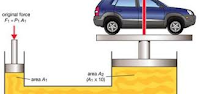
Applied to the system shown below, such as a hydraulic car lift, Pascal's law allows forces to be multiplied.

The cylinder on the left shows a cross-section area of 1 square inch, while the cylinder on the right shows a cross-section area of 10 square inches.

The cylinder on the left has a weight (force) on 1 pound acting downward on the piston, which lowers the fluid 10 inches.

As a result of this force, the piston on the right lifts a 10 pound weight a distance of 1 inch.

The 100 pound load on the 1 square inch area causes an increase in pressure on the fluid in the system.

This pressure is distributed equally throughout and acts on every square inch of the 10 square inch area of the large piston.

As a result, the larger piston lifts up a 1000 pound weight.

The larger the cross-section area of the second piston, the larger the mechanical advantage, and the more weight it lifts.

The formulas that relate to this are shown below:

Area1/Area2= Distance moved 2/Distance moved 1

This system can be thought of as a simple machine (lever), since force is multiplied. The mechanical advantage can be found by rearranging terms in the above equation to

Mechanical Advantage(MA) = D1/D2 = A2/A1

For the sample problem above, the MA would be 10:1 (10 inches/ 1 inch or 10 square inches / 1 square inch).

Take the Edinformatics Challenge

Edinformatics has designed a two part -end of year- 8th grade science test that accesses both "Knowledge and Concepts" (Part I), and "Reasoning and Analysis Skills" (part II). Most of the science material used for the test is consistent with current intermediate school textbooks. Several questions require more rigorous mathematics that is contained within the newly initiated Common Core Standards and the NGSS (Next Generation Science Standards).

https://www.edinformatics.com/math_science/pascals-principle-and-hydraulics.html


You might also like:

..

Hydraulics

CLICK HERE . . . to view . . . 

https://puricare.blogspot.com/2020/12/hydraulics-challenge-your-friends-to.html

...........................................................................................................................................................................................................................................................................................

What are Fluids? 

CLICK HERE . . . to view . . . 

https://puricare.blogspot.com/2019/05/what-are-fluids-fluids-are-substances.html

...........................................................................................................................................................................................................................................................................................

Fluid Dynamics

CLICK HERE . . . to view . . . 

https://puricare.blogspot.com/2019/09/fluid-dynamics-fluid-dynamics-is-one-of.html

...........................................................................................................................................................................................................................................................................................

Hydrostatic Pressure

CLICK HERE . . . to view . . . 

https://puricare.blogspot.com/2019/04/hydrostatic-pressure-fluid-pressure-and.html

...........................................................................................................................................................................................................................................................................................