:max_bytes(150000):strip_icc():format(webp)/blood-geyser-in-yellowstone-natinal-park--617624218-5aba6937eb97de0036312ae4.jpg)
..................................................................................................................................................
Exploring the Yellowstone Supervolcano
By Carolyn Collins Petersen
There's a powerful and violent menace lurking under
northwestern Wyoming and southeastern Montana, one that has reshaped the
landscape several times over the last several million years.
It's called the Yellowstone Supervolcano and the resulting
geysers, bubbling mudpots, hot springs, and evidence of long-gone volcanoes make Yellowstone
National Park a fascinating geologic wonderland.
The official name for this region is the "Yellowstone
Caldera", and it spans an area about 72 by 55 kilometers (35 to 44
miles) in the Rocky Mountains.
The caldera has been geologically active for 2.1
million years, periodically sending lava and clouds
of gas and dust into the atmosphere, and reshaping the landscape for hundreds
of kilometers.
Yellowstone Caldera is among the world's largest
such calderas.
The caldera, its supervolcano, and the underlying magma chamber
help geologists understand volcanism and is a prime place to study
first-hand the effects of hot-spot geology on the Earth's surface.
The History and Migration of
the Yellowstone Caldera
The Yellowstone Caldera is really the "vent" for a
large plume of hot material that extends hundreds of kilometers down through
Earth's crust.
The plume has persisted for at least 18 million years and is a
region where molten rock from Earth's mantle rises to the surface.
The plume has remained relatively stable while the North
American continent has passed over it. Geologists track a series of
calderas created by the plume.
These calderas run from the east to northeast and follow the
motion of the plate moves to the southwest. Yellowstone Park lies right in the
middle of the modern caldera.
The caldera experienced "super-eruptions" 2.1 and 1.3
million years ago, and then again about 630,000 years ago.
Super-eruptions are massive ones, spreading clouds of ash and
rock over thousands of square kilometers of the landscape.
Compared to those, smaller eruptions and the hot-spot activity
Yellowstone exhibits today are relatively minor.
The Yellowstone Caldera Magma
Chamber
The plume that feeds the Yellowstone Caldera moves through a
magma chamber some 80 kilometers (47 miles) long and 20 km (12 miles) wide.
It is filled with molten rock that, for the moment, lies fairly
quietly below Earth's surface, although from time to time, the movement of the
lava inside the chamber triggers earthquakes.
Heat from the plume creates the geysers (which
shoot superheated water into the air from underground), hot springs,
and mudpots scattered throughout the region.
Heat and pressure from the magma chamber is slowly increasing
the height of the Yellowstone Plateau, which has been rising more rapidly in
recent times.
So far, however, there is no indication that a volcanic eruption
is about to occur.
Of more concern to scientists studying the region is the danger
of hydrothermal explosions in between major super-eruptions.
These are outbursts caused when underground systems of
superheated water are disturbed by earthquakes. Even earthquakes at a great
distance can affect the magma chamber.
Will Yellowstone Erupt Again?
Sensational stories crop up every few years suggesting that
Yellowstone is about to blow again.
Based on detailed observations of the earthquakes that occur
locally, geologists are sure that it will erupt again, but probably
not anytime soon.
But make no mistake about it, a Yellowstone super-eruption will
happen again, and when it does, it will be a catastrophic mess.
What Happens During a
Super-Eruption?
Within the park itself, lava flows from one or more volcanic
sites would likely cover much of the landscape, but the bigger worry is
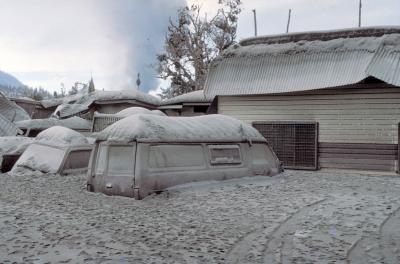
ash clouds blowing away from the site of the eruption.
Wind would blow the ash as far as 800 kilometers (497 miles),
eventually blanketing the mid-section of the U.S. with layers of ash and
devastating the nation's central breadbasket region.
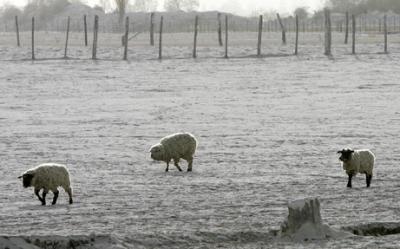
Other states would see a dusting of ash, depending on their
proximity to the eruption.
While it's not likely that all life on earth would be destroyed,
it would definitely be affected by the clouds of ash and the massive release
of greenhouse gases.
.
On a planet where the climate is already altering rapidly, a additional discharge would likely change growing patterns, shorten growing seasons, and lead to fewer sources of food for all of Earth's life.
.
On a planet where the climate is already altering rapidly, a additional discharge would likely change growing patterns, shorten growing seasons, and lead to fewer sources of food for all of Earth's life.
The U.S. Geological Survey maintains a close watch on the
Yellowstone Caldera.
Earthquakes, small hydrothermal events, even a slight change in
the eruptions of Old Faithful (Yellowstone's famous geyser), provide clues to
changes deep underground.
If magma starts to move in ways that indicate an eruption, the
Yellowstone Volcano Observatory will be the first to alert surrounding
populations.
Carolyn
Collins Petersen
Astronomy
Expert
Education
M.S.,
Journalism and Mass Communications, University of Colorado - Boulder
B.S.,
Education, University of Colorado
Introduction
Author/co-author
of seven books on astronomy and planetary science, including Astronomy
101 and Space Exploration: Past, Present, Future
CEO of
Loch Ness Productions, a production company specializing in educational
materials for planetariums and science centers
Member
of the American Astronomical Society and International Planetarium Society
Experience
Carolyn
Collins Petersen is a science writer, producer, and former research astronomer.
She is the CEO of Loch Ness Productions, a production company specializing
educational documentary shows for planetariums and science centers. She has
published 7 books on astronomy and planetary science, including Astronomy
101, Space Exploration: Past, Present, Future, and Hubble Vision.
In
addition to her own books and articles on astronomy, Carolyn has written
exhibition texts for the Griffith Observatory in Los Angeles, the NASA/Jet
Propulsion Laboratory in Pasadena, and the California Academy of Sciences in
San Francisco.
Previously,
Carolyn worked on a Hubble Space Telescope instrument team and served as an
editor for Sky Publishing, which publishes Sky & Telescope and Skywatch.
Carolyn has written more than 40 documentaries and several webcasts on space
science, and she regularly gives public presentations and lectures on topics in
astronomy.
Education
Carolyn
earned a master's degree from the University of Colorado – Boulder, where she
studied astronomy, astrophysics, and science communication. She also received
her B.S. from the University of Colorado.
Publications
Space Exploration: Past, Present, Future, 2017, Amberley
Books
Astronomy 101: From the Sun and Moon to Wormholes and Warp Drive, Key Theories,
Discoveries, and Facts about the Universe, 2013, Adams Media
Visions
of the Cosmos (with J.C. Brandt), 2005, Cambridge University Press
Hubble
Vision (with J.C. Brandt), 2003, Cambridge University Press (two
editions)
The
New Solar System (editor, with K. Beatty and A.C. Chaikin), 1999,
Cambridge University Press and Sky Publishing
Jupiter! 1989,
Facts on File.
ThoughtCo
and Dotdash
ThoughtCo is a premier
reference site focusing on expert-created education content. We are one of the
top-10 information sites in the world as rated by comScore, a leading Internet
measurement company. Every month, more than 13 million readers seek answers to
their questions on ThoughtCo.
For more
than 20 years, Dotdash brands have been helping people find answers,
solve problems, and get inspired. We are one of the top-20 largest content
publishers on the Internet according to comScore, and reach more than 30% of
the U.S. population monthly. Our brands collectively have won more than 20
industry awards in the last year alone, and recently Dotdash was named Publisher
of the Year by Digiday, a leading industry publication.