Showing posts with label Graphene. Show all posts

Wednesday, August 19, 2020

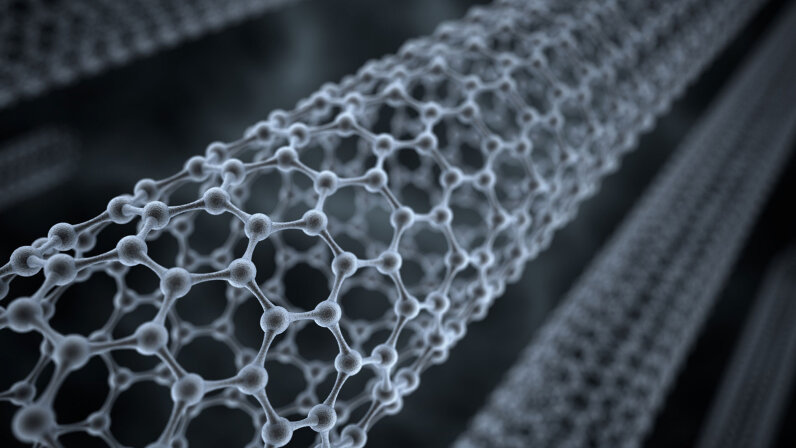
GRAPHENE - 200 Times Stronger Than Steel, 1,000 Times Lighter Than Paper - A sheet of graphene looks like an atomic-scale honeycomb. Measuring in at just one atom thick, a sheet of graphene checks all the boxes of a supermaterial: Graphene is 200 times stronger than steel by weight; It is 1,000 times lighter than paper; It is 98 percent transparent; It conducts electricity better than any other known material at room temperature; It can convert light at any wavelength into a current; And, last but not least, graphene is made from carbon, the fourth most-abundant element in the universe, so we're not likely to run out. Graphene gets its superpowers from its structure. If you could zoom in close enough, you'd see that a sheet of graphene looks like an atomic-scale honeycomb. Individual carbon atoms are arranged in a hexagonal pattern that resembles chicken wire. Each carbon atom in a sheet of graphene is covalently bonded to three other carbon items, which gives the material its incredible strength. Why does graphene conduct electricity so well? Again, because of the way those carbon atoms are bonded. Each carbon atoms has four electrons in its outer shell, but only three of those electrons are shared with its neighboring three carbon atoms. The remaining electron is called a pi electron and is free to move in three-dimensional space, which allows it to transmit electrical charges across the sheet of graphene with almost no resistance.
graphene
A sheet of graphene looks like an atomic-scale honeycomb.
................................................................................................................................................................
low-cost semitransparent perovskite solar cellsGraphene
200 Times Stronger Than Steel, 1,000 Times Lighter Than Paper
BY DAVE ROOS


In 2004, two scientists at the University of Manchester conducted a deceptively simple experiment with potentially world-changing consequences.
The researchers, Andre Geim and Konstantin Novoselov, were playing around with graphite, the stuff in the tip of your pencil.
Graphite is made of super-thin sheets of pure carbon stacked on top of each other.
Geim and Novoselov wanted to see if they could isolate a single sheet of graphite, an impossibly thin layer of carbon measuring just one atom thick.
So, they grabbed a roll of sticky tape. Yes, the same transparent tape in the plastic applicator that you keep in your junk drawer.
Here's how Geim described his technique, as reported by the BBC.
"You put [sticky tape] on graphite or mica and peel the top layer. There are flakes of graphite that come off on your tape. Then you fold the tape in half and stick it to the flakes on top and split them again. And you repeat this procedure 10 or 20 times. Each time, the flakes split into thinner and thinner flakes. At the end you're left with very thin flakes attached to your tape. You dissolve the tape and everything goes into solution."
The sticky-tape method worked!
By isolating a single-layer sheet of carbon, Geim and Novoselov were credited with discovering a brand-new material called graphene that's now believed to be the strongest, lightest and most electrically conductive substance on Earth.
In 2010, Geim and Novoselov shared the Nobel Prize in physics for discovering graphene, and researchers around the world began clamoring for ways to use this remarkable "supermaterial" to build more powerful and longer-lasting batteries, faster microchips, flexible circuitry, implantable biosensors and more.
A decade later, graphene has yet to deliver on its much-hyped promises, but insiders are confident that we'll finally be seeing smartphones, electric cars and sensors using graphene-based technology in the next few years.
Why Is Graphene a Supermaterial?
Measuring in at just one atom thick, a sheet of graphene checks all the boxes of a supermaterial:
o  Graphene is 200 times stronger than steel by weight.
o  It is 1,000 times lighter than paper.
o  It is 98 percent transparent.
o  It conducts electricity better than any other known material at room temperature.
o  It can convert light at any wavelength into a current.
o  And, last but not least, graphene is made from carbon, the fourth most-abundant element in the universe, so we're not likely to run out
Graphene gets its superpowers from its structure.
If you could zoom in close enough, you'd see that a sheet of graphene looks like an atomic-scale honeycomb.
Individual carbon atoms are arranged in a hexagonal pattern that resembles chicken wire.
Each carbon atom in a sheet of graphene is covalently bonded to three other carbon items, which gives the material its incredible strength.
Why does graphene conduct electricity so well?
Again, because of the way those carbon atoms are bonded.
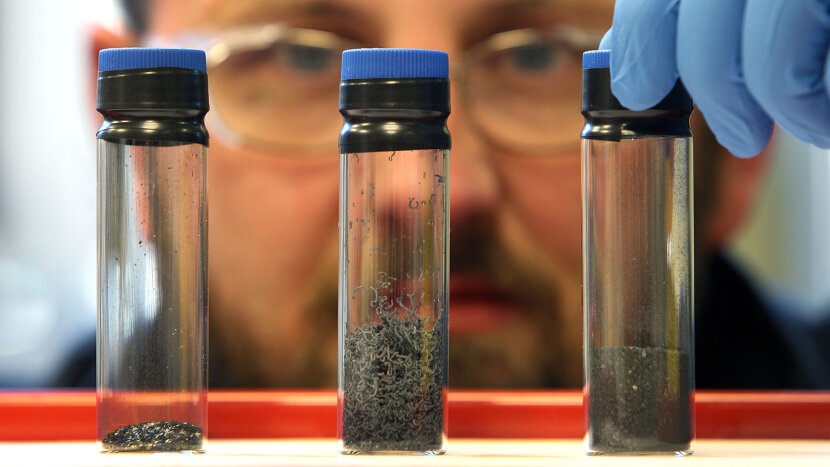
graphite to graphene
At Cabot Corporation, senior researcher Matt Hesketh examines the progression
 of graphene in three vials. The vial on the left is graphite, the middle one
is graphite expanded, and the one on the right is graphene.
Each carbon atoms has four electrons in its outer shell, but only three of those electrons are shared with its neighboring three carbon atoms.
The remaining electron is called a pi electron and is free to move in three-dimensional space, which allows it to transmit electrical charges across the sheet of graphene with almost no resistance. In fact, graphene is the fastest conductor of electricity at room temperature of any known substance.
The 'Magic Angle'
A recent discovery may add yet another superpower to graphene's brag list.
A team at Massachusetts Institute of Technology (MIT) was experimenting with dual-layered graphene — two layers of single-atom graphene stacked together — when they stumbled upon a new, nearly magical property of graphene.
When the layers are rotated slightly out of line with each other — a displacement of exactly 1.1 degrees — the graphene becomes a superconductor.
Superconductors are the rarest class of materials that conduct electricity with absolutely no resistance and zero heat.
The discovery of graphene's "supermaterial" sent shockwaves through the scientific community.
Although the experiment was conducted at extreme low temperatures (close to 0 degrees Kelvin or minus 459.67 F), it opened up the possibility that by combining graphene with other superconductive elements, we're closer than ever to room-temperature superconductivity.
Such an achievement would radically improve the energy efficiency of everything from gadgets to cars to entire electric grids.
How Might Graphene Transform Technology?
Superconductivity is still decades away, but revolutionary graphene-based products are coming to the market much sooner, says Andrea Ferrari, a professor of nanotechnology and director of the Cambridge Graphene Centre.
"By 2024, there will be a variety of graphene products on the market," says Ferrari, "including batteries, photonics, night vision cameras and more."
Consumers have been eagerly awaiting graphene-based batteries for years.
The lithium-ion batteries in all our gadgets are relatively slow to charge, lose their juice quickly and burn out after a set number of cycles.
That's because the electrochemical process that powers lithium-ion batteries generates a lot of heat.
But since graphene is the world's most efficient electrical conductor, it produces a lot less heat when charging up or discharging electricity.
Graphene-based batteries are promising five times faster charging speeds than lithium-ion, three times longer battery life, and five times as many cycles before they need to be replaced.
Electronics companies like Samsung and Huwei are actively developing graphene-based batteries for smartphones and other gadgets, but the earliest those will hit the market is 2021.
As for graphene batteries in electric cars — which could dramatically increase their driving radius — that's still a few years off.
An entire industry has been built on lithium-ion technology and it won't change overnight.
"The battery industry is very conservative," says Jesus de la Fuente, CEO of Graphanea, a company that manufactures and sells pure graphene and graphene-based chips to academic researchers and R&D departments.
"It might change the composition of batteries a few times every five to ten years, which makes it very difficult to introduce new products in this industry."
There are a few graphene-based batteries on the market, including some wired and wireless chargers from a company called Real Graphene, but those are only the tip of the iceberg, says Ferrari, who is also the science and technology officer for the Graphene Flagship, a 1-billion-euro collaboration by the European Union to speed the development of graphene technology.
Research partners with the Flagship are already making graphene batteries that outperform today's best high-energy cells by 20 percent capacity and 15 percent energy.
Other teams have built graphene-based solar cells that are 20 percent more efficient at converting sunlight to electricity.
Other Uses for Graphene
While graphene batteries might be first to market, researchers are busy developing countless other applications for this miracle material.
Biosensors are a big deal. Imagine an incredibly thin and flexible chip that can be injected into the bloodstream to monitor real-time health data like insulin levels or blood pressure.
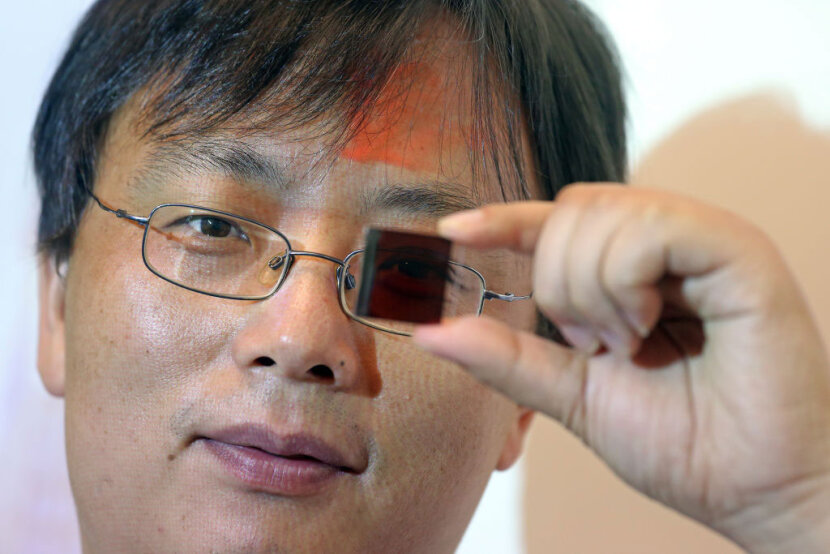
low-cost semitransparent perovskite solar cells
Physics professor Dr. Yan Fung, holds a new invention of low-cost
semitransparent solar cells with graphene electrodes
at Poly University in Hung Hom, China, 2015.
Or a graphene interface that sends signals back and forth to the brain to detect an upcoming epileptic seizure or even prevent it.
Thin, stretchable sensors can also be worn on the skin or woven into the fabric of clothes.
Photonics is another field that's already incorporating graphene.
By integrating graphene into light-sensitive chips, cameras and other sensors can greatly improve sensitivity to even the faintest light waves across the visible and invisible spectrum.
That will not only improve the image quality of cameras and telescopes, but also medical imagery.
Filtration is yet another promising application of graphene.
Simple water purification filters built with graphene polymers can bind to organic and inorganic contaminants in drinking water.
Researchers at the Graphene Flagship have also created desalinization technologies based on graphene diodes that can remove over 60 percent of salt from seawater for agricultural and other uses.
All these developments will take time, but Ferrari at the Cambridge Graphene Centre is confident that graphene will live up to its hype.
In fact, he is equally excited about the yet-undiscovered properties of the estimated 2,000 other monolayer materials that are also being isolated, sticky tape method or otherwise.
"We say graphene, but we're really talking about a large number of options that are being explored," says Ferrari. "Things are moving in the right direction."
NOW THAT'S COOL
Sports equipment maker Head was one of the first to jump on the graphene bandwagon. Its Graphene XT tennis racket claims to be 20 percent lighter than racquets with the same swing weight.

Dave Roos
CONTRIBUTING WRITER
Dave is a freelance journalist who has contributed hundreds of articles to HowStuffWorks since 2007, with a specialty in personal finance, economics and business. Raised in Pittsburgh, Pennsylvania, he attended Duke University where he earned the B.A. in comparative religious studies that has served him so well.
Dave began freelancing when he and his wife moved to Mexico in 2003, publishing articles about Mexican food and culture in The New York Times, the Los Angeles Times and Newsweek. Nearly 15 years and three kids later, Dave and his family recently moved back to Mexico and just might stay a while.
graphite to graphene

Friday, January 26, 2018

GRAPHENE - Carbon is very special. It can form diamond and graphite—even though the former is super hard and the latter is quite soft. Graphene is another form of carbon material - this time a single layer of graphite. It has very useful electrical, thermal, and physical properties. Its applications include replacing silicon in areas like electronic devices.

 
.
Graphene
Seeing God’s Handiwork and Care in Chemistry
by Avery Foley 


God’s creation is filled with amazing design.
Often when we think of design, we immediately picture hummingbirds, butterflies, or the human body.
But God’s design can be seen in the obvious and the not so obvious.
Have you ever stopped to consider how even chemistry showcases God’s handiwork, creativity, and care for his creation?

Graphene, the “Wonder Material”

Carbon, the sixth element on the periodic table, is considered “King of the Elements.”
It appears in three major forms in nature. One of these forms, diamond, is transparent and the hardest known material while another form, graphite, is black and very soft.
Carbon is essential to life.
In 2002 researchers at the University of Manchester isolated graphene, an ultra-thin sheet of carbon atoms, by peeling off layers of graphite with tape until they had a layer just one atom thick.
Now the strongest material known to man, this “wonder material” is pliable, strong, and conductive.
Professor Stuart Burgess, a professor and gifted design engineer at the University of Bristol in the UK (and a biblical creationist), says this of carbon and graphene,
Carbon is very special. It can form diamond and graphite—even though the former is super hard and the latter is quite soft.
Graphene is another form of carbon material - this time a single layer of graphite.
It has very useful electrical, thermal, and physical properties. Its applications include replacing silicon in areas like electronic devices.
It is truly remarkable how God can design carbon to do such diverse things by simply changing the type of bond connections in the structure!
Some of the things we see as simple in creation—like water (H2O) and carbon (C) - are actually profound Designer materials [materials that bear hallmarks of having been formed for a purpose by a Designer] that have remarkable properties that are useful to man.

Graphene and Seawater

Providing clean water to those around the world is a challenge many engineers are seeking to solve.
Theoretically the oceans are an endless source of water—except, of course, for the problem that it’s not drinkable.
But researchers in the UK recently announced that they’ve developed a sieve using a compound called graphene oxide to filter seawater.
Previous attempts have been unsuccessful because the graphene oxide swelled in the water, allowing particles to go through.
But researchers now say they can control the size and expansion of the pores by using an epoxy resin coat over the graphene oxide membrane.
This allows salt, and other impurities, to be filtered out, leaving fresh drinking water.
While this energy-efficient method still needs further research and development before it can be used, it’s an exciting prospect that will perhaps allow millions to access fresh water.

God’s Care for Creation

God’s design and care for his creation can be seen everywhere we look.
The more we study what he has made, the more we realize that he has put his fingerprints on everything from small molecules to blue whales.
Our world truly is a designer world. It should cause us to say, along with the psalmist,
When I look at your heavens, the work of your fingers, the moon and the stars, which you have set in place, what is man that you are mindful of him, and the son of man that you care for him? (Psalm 8:3–4)

Avery Foley is a writer for Answers in Genesis from Ontario, Canada. She holds a masters of arts in theological studies from Liberty Baptist Theological Seminary.
.
Multi-Media Filter, Highly-Activated Carbon Filter,
Zeolite-Process Water Softener With Brine Tank,
Fiberglass Ballast-Type Pressure Tank
(fully automatic backwash & regeneration)
.
PURICARE 
INDUSTRIAL 
ENTERPRISES 
Water 
Treatment 
Systems
.
.
...
Aganan, Pavia, Iloilo, Philippines
...
CLICK HERE . . . to view company profile . . .

Tachmina Laminated
Sand Filter


Reverse Osmosis with Cartridge Pre-Filters
Ultraviolet Bactericidal System
with Cartridge Pre-Filters


...

Tuesday, April 25, 2017

GRAPHENE AND WATER TREATMENT - Graphene is a two dimensional mesh of carbon atoms arranged in the form of a honeycomb lattice.Graphene naturally repels water, but when narrow pores are made in it, rapid water permeation is allowed. This sparked ideas regarding the use of graphene for water filtration and desalination, especially once the technology for making these micro-pores has been achieved.

Graphene and Water 
Treatment
Introduction and Market Status

What is water treatment?
Water treatment is the collective name for a group of mainly industrial processes that make water more suitable for its application, which may be drinking, medical use, industrial use and more.
.
A water treatment process is designed to remove or reduce existing water contaminants to the point where water reaches a level that is fit for use.
. .
Specific processes are tailored according to intended use - for example, treatment of greywater (from bath, dishwasher etc.) will require different measures than black water (from toilets) treatment.
 . .

Main types of water treatments
All water treatments involve the removal of solids (usually by filtration and sedimentation), bacteria, algae and inorganic compounds.
.  .
Used water can be converted into environmentally acceptable water, or even drinking water through various treatments.
.
Water treatments roughly divide into industrial and domestic/municipal.
..
Industrial water treatments include boiler water treatment (removal or chemical modification of substances that are damaging to boilers), cooling water treatment (minimization of damage to industrial cooling towers) and wastewater treatment (both from industrial use and sewage).
. 
Wastewater treatment is the process that removes most of the contaminants from wastewater or sewage, producing a liquid that can be disposed to the natural environment and a sludge (semi-solid waste).
. 
Wastewater is used water, and includes substances like food scraps, human waste, oils and chemicals.
. 
Home uses create wastewater in sinks, bathtubs, toilets and more, and industry donates its fare share as well.
.  
Wastewater and sewage need to be treated before being released to the environment. This is done in plants that reduce pollutants to a level nature can handle, usually through repeatedly separating solids and liquids, which progressively increases water purity.
. 
Wastewater treatments usually consist of three levels: a primary (mechanical) level, in which solids are removed from raw sewage by screening and sedimentation.
.  
This level can remove about 50-60% of the solids, and is followed by the second level - secondary (biological) treatment. Here, dissolved organic matter that escaped primary treatment is removed, by microbes that consume it as food and convert it into carbon dioxide, water and energy.
.  . 
The tertiary treatment removes any impurities that are left, producing an effluent of almost drinking-water quality.
. 
The technology required for this stage is usually expensive and sophisticated, and demands a steady energy supply and specific chemicals.
. 
Disinfection, typically with chlorine, can sometimes be an additional step before discharge of the effluent. It is not always done due to the high price of chlorine, as well as concern over health effects of chlorine residuals.
.. 
Municipal water consists of surface water and groundwater. surface water, like lakes and rivers, usually require more more treatment than groundwater (water located under the ground).
. 
Municipal/community water is treated by public or private water utilities companies to ensure that the water is potable (safe for drinking), palatable (have no unusual or disturbing taste) and sufficient for the needs of the community.
. 
Water flows or is pumped to a central treatment facility, where it is pumped into a distribution system.
. 
Initial screening is performed to remove large objects and then the water undergoes a series of processes like: pre-chlorination (for algae control), aeration (removal of dissolved iron and manganese), coagulation (removal of colloids), sedimentation (solids separation), desalination (removal of salt) and disinfection (killing bacteria).
. 
Other processes that may be used are: lime softening (the addition of lime to precipitate calcium and magnesium ions), activated carbon adsorption (to remove chemicals that cause taste and odor) and fluoridation (increasing the concentration of fluoride to prevent dental cavities).
. 
As water is both vital for life and in limited supply, many efforts are placed to find technologies that can help ensure the maintainability of water resources.
. 
Among the innovative methods that have been researched and developed are:
·       nanotechnology - the use of nanotechnology to purify drinking water can help remove microbes and bacteria. Many nano-water treatment technologies use composite nanoparticles that emit silver ions to destroy contaminants.
. 
·      membrane chemistry - membranes, through which water passes and is filtered and purified. The pores of membranes used in ultrafiltration can be remarkably fine. This technology exists, and efforts are constantly being made to make it more dependable, cost-efficient and common. Membranes’ selective separation grants filtration abilities that can pose as alternatives to processes like flocculation, adsorption and more.
. 
·      seawater desalination - processes that extract salt from saline water, to produce fresh water suitable for drinking or irrigation. While this technology is in use and also holds much promise for growing in the future, it is still expensive, with reverse osmosis technology consuming a vast amount of energy (the desalination core process is based on reverse osmosis membrane technology).
. 
. ·   Innovative wastewater processing - new technologies aim to transform wastewater into a resource for energy generation as well as drinking water. Modular hybrid activated sludge digesters, for example, can remove nutrients for use as fertilizers, decreasing almost by half the amount of energy traditionally required for this treatment in the process.
 ..
What is graphene?
Graphene is a two dimensional mesh of carbon atoms arranged in the form of a honeycomb lattice.
 . 
It has earned the title “miracle material” thanks to a startlingly large collection of incredible attributes.
.  
This thin, one atom thick substance (it is so thin in fact, that you’ll need to stack around three million layers of it to make a 1mm thick sheet!) is the lightest, strongest, thinnest, best heat-and-electricity conducting material ever discovered, and the list does not end there.
. 
Graphene is the subject of relentless research and is thought to be able to revolutionize whole industries, as researchers work on many different kinds of graphene-based materials, each one with unique qualities and designation.

Graphene and water treatment

Water is an invaluable resource and the intelligent use and maintenance of water supplies is one of the most important and crucial challenges that stand before mankind. 
New technologies are constantly being sought to lower the cost and footprint of processes that make use of water resources, as potable water (as well as water for agriculture and industry) are always in desperate demand.
Much research is focused on graphene for different water treatment uses, and nanotechnology also has great potential for elimination of bacteria and other contaminants.
Among graphene’s host of remarkable traits, its hydrophobia is probably one of the traits most useful for water treatment.
Graphene naturally repels water, but when narrow pores are made in it, rapid water permeation is allowed. 
This sparked ideas regarding the use of graphene for water filtration and desalination, especially once the technology for making these micro-pores has been achieved.
Graphene sheets (perforated with miniature holes) are studied as a method of water filtration, because they are able to let water molecules pass but block the passage of contaminants and substances.
Graphene’s small weight and size can contribute to making a lightweight, energy-efficient and environmentally friendly generation of water filters and desalinators.
It has been discovered that thin membranes made from graphene oxide are impermeable to all gases and vapors, besides water, and further research revealed that an accurate mesh can be made to allow ultrafast separation of atomic species that are very similar in size - enabling super-efficient filtering.
This opens the door to the possibility of using seawater as a drinking water resource, in a fast and relatively simple way.
Recent commercial activity in the field of graphene water treatments
In November 2014, the Malaysian based Graphene Nanochem that is traded in the AIM of the London Stock Exchange signed an agreement with Singapore-based HWV to develop and commercialize the PlatClean V1 system - a graphene-enhanced water treatment system for the oil and gas industry.
.
In August 2014, the U.S based Biogenic Reagents announced starting a commercial production of graphene-carbon compound based Ultra-Adsorptive Carbon products to replace traditional activated carbon products for air and water purification..
.
In March 2013, Lockheed Martin announced the development of a new graphene-based water desalination technology, with hopes to commercialize it by 2014-2015.
.
Their system is said to be energy-efficient and include graphene filters with nanoholes to screen salt from water.
.
Membrane 
Systems


CLICK HERE . . .

Growing Meat 
Chickens
CLICK HERE . . .
.

Poultry farms ventilation 
and cooling systems
CLICK HERE . . .
http://puricare.blogspot.com/2016/09/ventilation-and-cooling-systems-for.html 

http://puricare.blogspot.com/2016/09/ventilation-and-cooling-systems-for.html 
.
Multi-Media Filter, Highly-Activated Carbon Filter,
Zeolite-Process Water Softener With Brine Tank,
Fiberglass Ballast-Type Pressure Tank
(fully automatic backwash & regeneration)

PURICARE 
INDUSTRIAL 
ENTERPRISES 
Water 
Treatment 
Systems
.
.
...
Aganan, Pavia, Iloilo, Philippines
...

CLICK HERE . . . to view company profile . . .


.
.
.
Ballast-Type
Pressure Tanks
Houston Water Pump with
Mazaki Automatic Pump Controller
Ultra-Violet Bactericidal Lamps