Showing posts with label Artificial intelligence AI. Show all posts

Sunday, January 10, 2021

USING ROBOTS IN OUR LIFE - Advantages and disadvantages of using robots in our life - Robots can perform repetitive tasks for a long time but they do not get better with experience. They are not able to act any different from what they are programmed to do. With the heavy application of robots, humans may become overly dependent on the machines, losing their mental capacities. If control of robots goes in the wrong hands, robots may cause destruction. Robots can never improve the results of their jobs outside of their predefined programming. They do not think. They do not have emotions or conscience. They can take the place of the humans in several situations. Robots might take over our jobs and they could take over the world. Robotics or artificial intelligence (AI) are used in manufacturing, in search, in rescue missions & in the military. They are used in factories all over the world and many people recently have lost their jobs as Robots have become more efficient and precise than the humans. Robots can go to the planets. They can be used to explore the space. They can spy on the people in ways the people can’t move and from views the humans can’t reach. Robots can go far down into the unknown places where humans would be crushed. They can give us the information that humans can’t get. They can work at places 24/7 without any salary and food. Plus they don’t get bored.

.............................................................................................................................................................................................................................................................................................................................................

Using Robots In Our Life

Advantages and disadvantages of using robots in our life

.

Robots can perform repetitive tasks for a long time but they do not get better with experience. They are not able to act any different from what they are programmed to do. With the heavy application of robots, humans may become overly dependent on the machines, losing their mental capacities. If control of robots goes in the wrong hands, robots may cause destruction. Robots can never improve the results of their jobs outside of their predefined programming. They do not think. They do not have emotions or conscience. They can take the place of the humans in several situations. Robots might take over our jobs and they could take over the world.

BY HEBA SOFFAR


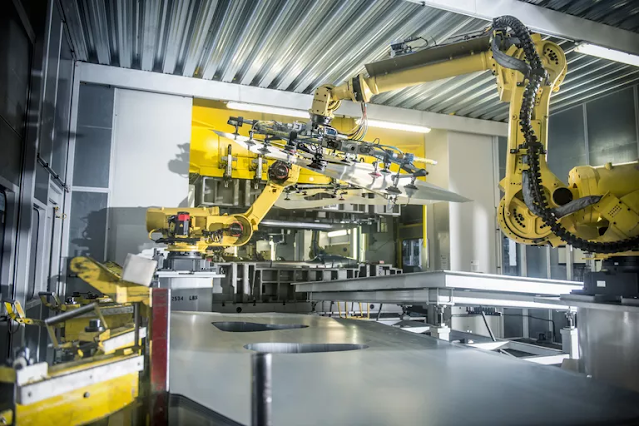
Robotics or artificial intelligence (AI) are used in manufacturing, in search, in rescue missions & in the military.

They are used in factories all over the world and many people recently have lost their jobs as Robots have become more efficient and precise than the humans.

Advantages of robots

The people should know the importance of robots to help them to determine when to use and when to not use robots.

Robots can go to the planets. They can be used to explore the space.

They can spy on the people in ways the people can’t move and from views the humans can’t reach.

Robots can go far down into the unknown places where humans would be crushed.

They can give us the information that humans can’t get.

They can work at places 24/7 without any salary and food. Plus they don’t get bored.

Robots can perform the tasks faster than humans and much more consistently and accurately.

They become more common each and every day.

The robotic pets can help the patients with depression and they keep them active.

Most of the robots are automatic so, they can move without any human interference.

They can entertain us and they can help us in certain tasks.

You can send them to a dangerous environment such as the deep sea or the war-zones.

You can use robots to produce the products in the factories such as assembling cars.

They can also be used to build parts for many products such as plane parts, car parts & construction supplies.

Robots do anything which we need to be precise & accurate.

New jobs are created because people have to fix and design robots.

Robots can work without sleep. So, they can work 24/7/365.

The overall cost of the product reduces as the work is done by robotic machines. The product is made through machines, assembled, packaged and distributed from one department to another.

So, this way the overhead cost, including the maintenance cost, is reduced to a lesser level.

Robots can endure a hostile environment of interplanetary space.They are made that the planetary atmospheres do not affect their physical state & performance.

They can replace the human beings in many areas of work.

They can shoulder greater responsibilities and they can be programmed to manage themselves.

Robots can be programmed to reach the Earth’s nadir. They can be used to dig for the fuels. They can be used for mining purposes.

They can be harnessed for exploring the depths of oceans. They can be used to overcome the limitations that humans have.

Robots can be used in carrying out repetitive & time-consuming tasks efficiently. They are used to do dangerous tasks.

They can adjust their parameters like their speed & time. They can act quickly, unaffected by the factors that affect the humans.

Robots do not require sleep or take breaks. They are able to function without stopping.

When employed to carry out dangerous tasks, the risk to the human health & safety is reduced.

They can work a long time without service or maintenance and they can be more productive than people.

Robots cannot tremble or shake as human hands do. They can have much smaller & versatile moving parts than the people.

They have performed medical surgeries because they can be faster and more precise than people.

Robots are designed to work in harsh environments like in space, without air, underwater & in the fire.

They can be used instead of people when human safety is a concern.

They can come in any size. Whatever size needed for any task can be created.

Robots can do jobs that people are unwilling to do. Many robotic probes have been sent throughout the solar system to never return back to Earth.

They can be stronger than people. Robots in warfare eliminate putting more people at risk.

Disadvantages of robots

Robots need a supply of power.

People can lose jobs in factories.

They need maintenance to keep them running.

It costs a lot of money to make or buy robots. The software and the equipment that you need to use with the robot cost much money.

Robots cost much money in maintenance & repair. Programs need to be updated to suit the changing requirements. The machines need to be made smarter.

In case of breakdown, the cost of repair may be very high. The procedures to restore lost code or data may be time-consuming & costly.

Robots can store large amounts of data but the storage, access, retrieval is not as effective as the human brain.

They can perform repetitive tasks for a long time but they do not get better with experience such as humans do.

Robots are not able to act any different from what they are programmed to do.

With the heavy application of robots, humans may become overly dependent on the machines, losing their mental capacities.

If control of robots goes in the wrong hands, robots may cause destruction.

Robots are not intelligent or sentient. They can never improve the results of their jobs outside of their predefined programming.

They do not think. They do not have emotions or conscience. This limits how the robots can help & interact with people.

Robots can take the place of many humans in factories. So, people have to find new jobs or be retrained.

They can take the place of the humans in several situations. If robots begin to replace the humans in every field, they will lead to unemployment.

Humans fear robots. Robots inspire two types of fear: firstly, that they might take over our jobs, and secondly, that they could take over the world.

Robots will steal our jobs. Robots have the effect of increasing productivity rather than eliminating jobs.

Robotics become increasingly present in our everyday life, with household robots, medical, industrial, on production lines, not to mention airports, banks, and hotels.

So, robots may dominate the human species.

Robots can operate on the basis of information fed to them through a chip, when one thing goes wrong the entire company bears a loss.

Robot can save times, but can also result in a lag.

It is a machine so you can’t expect too much from them. If the robot has malfunctioned, you need extra time to fix it, which would require reprogramming.

If robots would do all the work, and humans will just sit and monitor them, health hazards will increase rapidly. Obesity will be on top of the list and less labour at workplaces.

Name : Heba Soffar
Job : Telecommunication Engineer
Faculty of Engineering
Alexandria University
Electrical Engineering Department
B.Sc.Project : Wave propagation in Random and Deterministic Media
Country : Egypt

https://www.online-sciences.com/robotics/advantages-and-disadvantages-of-using-robots-in-our-life/


You might also like:


Robotic Building Construction

CLICK HERE . . . to view . . . 

https://puricare.blogspot.com/2020/08/robotic-building-construction-robotic.html

.................................................................................................................................................................................................................................................................................

Definition of a Robot

CLICK HERE . . . to view . . . 

https://puricare.blogspot.com/2020/12/the-definition-of-robot-science-fiction.html

.................................................................................................................................................................................................................................................................................
The Robotic Arm

CLICK HERE . . . to view . . . 

https://puricare.blogspot.com/2020/01/the-robotic-arm-concept-of-robotic-arms.html

.................................................................................................................................................................................................................................................................................

Historical Timeline About Robotics

CLICK HERE . . . to view . . . 

https://puricare.blogspot.com/2020/04/robotics-mechanized-human-like-figures.html

.................................................................................................................................................................................................................................................................................

Advanced Weaponry

CLICK HERE . . . to view . . . 

https://puricarechronicles.blogspot.com/2020/09/advanced-weaponry-strategic-trends-even.html

.................................................................................................................................................................................................................................................................................

Possible Future Disasters

CLICK HERE . . . to view . . . 

https://puricarechronicles.blogspot.com/2019/03/possible-future-disasters-socially-or.html 

Thursday, December 17, 2020

THE DEFINITION OF A ROBOT - Science fiction has become science fact with robots and robotics - A robot can be defined as a programmable, self-controlled device consisting of electronic, electrical, or mechanical units. It is a machine that functions in place of a living agent. Robots are especially desirable for certain work functions because, unlike humans, they never get tired; they can endure physical conditions that are uncomfortable or even dangerous; they can operate in airless conditions; they do not get bored by repetition, and they cannot be distracted from the task at hand. The concept of robots is a very old one yet the actual word robot was invented in the 20th century from the Czechoslovakian word robota or robotnik meaning slave, servant, or forced labor. Robots don't have to look or act like humans but they do need to be flexible so they can perform different tasks. Early industrial robots handled radioactive material in atomic labs and were called master/slave manipulators. They were connected together with mechanical linkages and steel cables. Remote arm manipulators can now be moved by push buttons, switches or joysticks. Current robots have advanced sensory systems that process information and appear to function as if they have brains. Their "brain" is actually a form of computerized artificial intelligence to perceive conditions and decide upon a course of action based on those conditions. Common industrial robots are generally heavy rigid devices limited to manufacturing. They operate in precisely structured environments and perform single highly repetitive tasks under pre-programmed control.

.......................................................................................................................................................................................................................................................................................................................................................... 

The Definition of a Robot

Science fiction has become science fact with robots and robotics

A robot can be defined as a programmable, self-controlled device consisting of electronic, electrical, or mechanical units.

More generally, it is a machine that functions in place of a living agent.

Robots are especially desirable for certain work functions because, unlike humans, they never get tired; they can endure physical conditions that are uncomfortable or even dangerous; they can operate in airless conditions; they do not get bored by repetition, and they cannot be distracted from the task at hand.

The concept of robots is a very old one yet the actual word robot was invented in the 20th century from the Czechoslovakian word robota or robotnik meaning slave, servant, or forced labor.

Robots don't have to look or act like humans but they do need to be flexible so they can perform different tasks.

Early industrial robots handled radioactive material in atomic labs and were called master/slave manipulators.

They were connected together with mechanical linkages and steel cables. Remote arm manipulators can now be moved by push buttons, switches or joysticks.

Current robots have advanced sensory systems that process information and appear to function as if they have brains.

Their "brain" is actually a form of computerized artificial intelligence (AI).

AI allows a robot to perceive conditions and decide upon a course of action based on those conditions.

Components of Robots

·       Effectors — "arms", "legs", "hands", "feet"

·       Sensors — parts that act like senses and can detect objects or things like heat and light and convert the object information into symbols that computers understand

·       Computer — the brain that contains instructions called algorithms to control the robot

·       Equipment — this includes tools and mechanical fixtures

Characteristics that make robots different from regular machinery are that robots usually function by themselves, are sensitive to their environment, adapt to variations in the environment or to errors in prior performance, are task oriented and often have the ability to try different methods to accomplish a task.

Common industrial robots are generally heavy rigid devices limited to manufacturing.

They operate in precisely structured environments and perform single highly repetitive tasks under pre-programmed control.

There were an estimated 720,000 industrial robots in 1998.

Tele-operated robots are used in semi-structured environments such as undersea and nuclear facilities.

They perform non-repetitive tasks and have limited real-time control.

Mary Bellis

New York-based film producer and director

Singled out by Forbes magazine for her writing on inventors. 

Known in art and independent film circles by the name CalmX

Creator of computer-generated art

Experience

Mary Bellis was a former writer for ThoughtCo, where she covered inventors for 18 years. She was a freelance writer, film producer, and director.  In addition, Forbes Best of the Web credited her for creating the number one online destination for information about inventors and inventions. Her writing has been reprinted and referenced in numerous educational books and articles. She was known for her short independent  films and documentaries, including one on Alexander Graham Bell. She specialized in making and exhibiting computer-generated art, while working as an animator, journalist and an independent video game developer. She died on March 28, 2015. 

Education

Mary Bellis held a Master of Fine Arts in film and animation from the San Francisco Art Institute.

ThoughtCo and Dotdash

ThoughtCo is a premier reference site focusing on expert-created education content. We are one of the top-10 information sites in the world as rated by comScore, a leading Internet measurement company. Every month, more than 13 million readers seek answers to their questions on ThoughtCo.

For more than 20 years, Dotdash brands have been helping people find answers, solve problems, and get inspired. We are one of the top-20 largest content publishers on the Internet according to comScore, and reach more than 30% of the U.S. population monthly. Our brands collectively have won more than 20 industry awards in the last year alone, and recently Dotdash was named Publisher of the Year by Digiday, a leading industry publication.

https://www.thoughtco.com/definition-of-a-robot-1992364


You might also like:


Robotics

CLICK HERE . . . to view . . . 

https://puricare.blogspot.com/2019/04/robotics-commercial-and-industrial.html

.......................................................................................................................................................................................................

The Robotic Arm

CLICK HERE . . . to view . . . 

https://puricare.blogspot.com/2020/01/the-robotic-arm-concept-of-robotic-arms.html

...........................................................................................................................................................................................................................................................................................

Robotic Building Construction

CLICK HERE . . . to view . . . 

https://puricare.blogspot.com/2020/08/robotic-building-construction-robotic.html

...........................................................................................................................................................................................................................................................................................

Advanced Weaponry

Strategic Trends

CLICK HERE . . . to view . . . 

https://puricarechronicles.blogspot.com/2020/09/advanced-weaponry-strategic-trends-even.html

...........................................................................................................................................................................................................................................................................................

End-Time Beasts

could the Anti-Christ in some form be a chimera, a hybrid human

CLICK HERE . . . to view . . . 

https://puricarechronicles.blogspot.com/2019/02/end-time-beasts-red-heifer-chimeras.html

...........................................................................................................................................................................................................................................................................................

Algorithms

The Most Efficient Way To Do The Math

CLICK HERE . . . to view . . . 

https://puricare.blogspot.com/2018/10/algorithms-most-efficient-way-to-do.html