Showing posts with label Toxic gases. Show all posts

Saturday, August 8, 2020

RESPIRATORS AND CLEAN AIR - How Do Respirators Allow You To Breathe Clean Air In A Contaminated Environment - A respirator is a device you can use to protect yourself from inhaling harmful or even poisonous substances. Any device that can do that could be theoretically referred to as a respirator. Respirators come in different shapes and sizes and are appropriate for different settings. You don’t want to use a gas mask designed for stopping dust in a place filled with harmful gases, because it would be absolutely useless and would potentially put your life in danger. Activated charcoal is another very common choice for filters in respirators, as each particle or granule of carbon offers a large surface area where pollutant particles can get trapped and adsorbed. Such filters are quite effective at filtering out acidic gases, such as chlorine, and particles like sediment and volatile organic compounds. Activated carbon filtering is even used in cigarette filters! The other and relatively more sophisticated way of being able to breathe in a contaminated setting is by using a respirator whose filters contain a substance that could react with the ‘bad’ chemical and neutralize it. For instance, a respirator with calcium oxide will bind with carbon dioxide present in the air and turn it into a different product. This way, all the harmful carbon dioxide will be removed and the user will be able to breathe in the contaminated environment.

Self-Contained Breathing Apparatus
................................................................................................................................................................
Polish MUA gas maskRespirators And Clean Air
How Do Respirators Allow You To Breathe Clean Air In A Contaminated Environment  
By Ashish


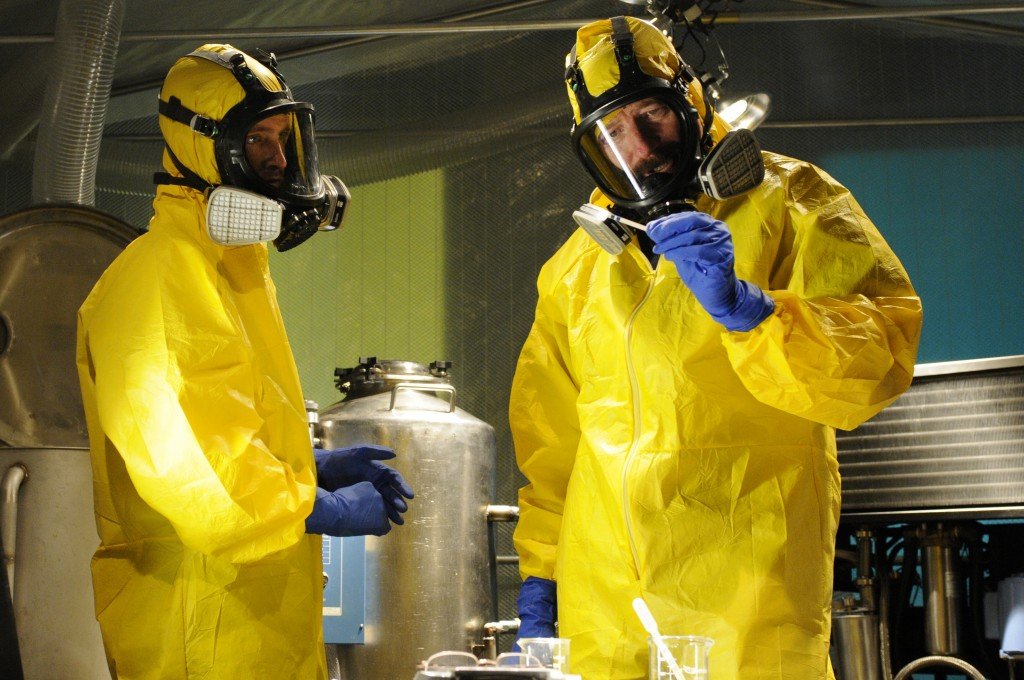
Have you watched the popular American TV show Breaking Bad?
The lead characters of the show are often shown working in chemistry labs, wearing respirators that basically cover their entire face.
walter-white-yellow-hazmat-meth-cook-suit
The lead characters of the show Breaking Bad always wore respirators while working in their lab.
There are many movies and TV shows that depict people donning respirators before entering a “contaminated” area.
In fact, respirators are not so uncommon, even in real life: firefighters wear a special type of respirator when entering sites that still have a lot of smoke and soot.
Chemists wear them in the laboratory and even elite security forces wear respirators before going into the “target area”, if they are expecting chemical threats.
I must admit, the first time I saw people putting on respirators in a contaminated environment, I couldn’t figure out how those little mask-like items worked.
I mean, I understood that the respirators could cover their nose and face and protect them from external injuries, but they still had to breathe in the same contaminated environment, right?
As in, the air they breathed still contained those impurities and harmful gases, so how did the respirators protect them from all that harmful smoke?
It’s very simply, actually, but first things first…
What is a respirator?
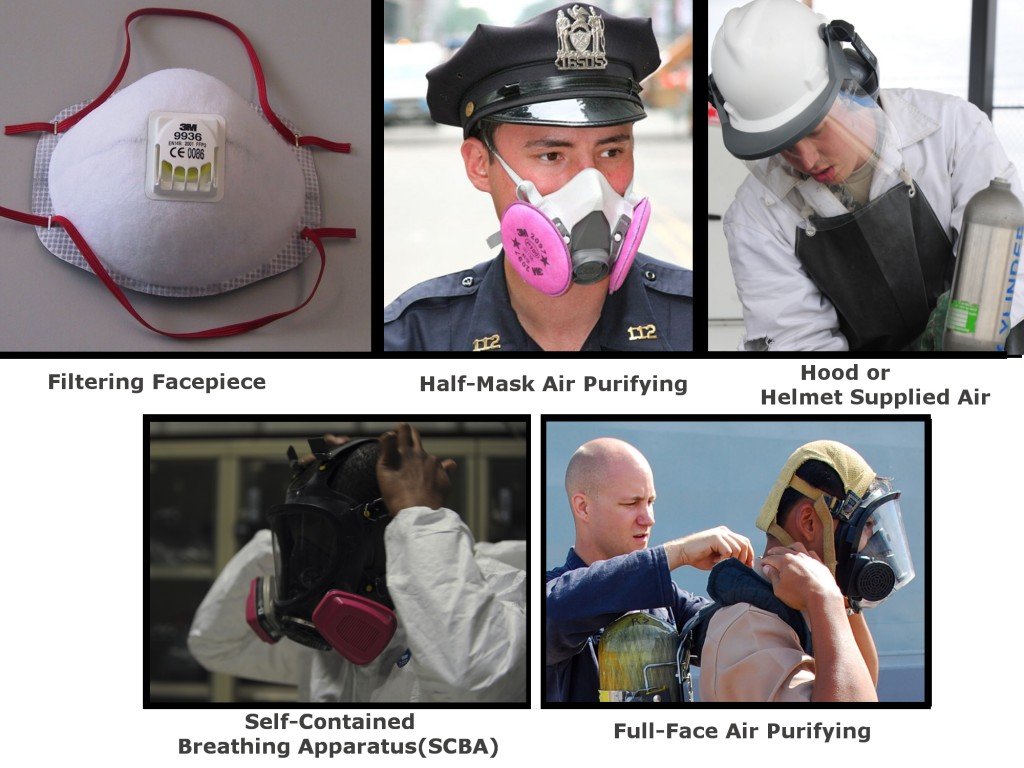
Different kinds of respirators.
A respirator is a device you can use to protect yourself from inhaling harmful or even poisonous substances (e.g., dangerous gases that contain ‘bad’ chemicals). Any device that can do that could be theoretically referred to as a respirator.
Respirators come in different shapes and sizes and are appropriate for different settings.
The second part of that sentence is the really important part.
You don’t want to use a gas mask designed for stopping dust in a place filled with harmful gases, because it would be absolutely useless and would potentially put your life in danger.
How do respirators work?
There are two ways to make contaminated air breathable:
1) physically filtering the air, and
2) reacting the contaminated air with a substance that removes or neutralizes the harmful chemicals within it.
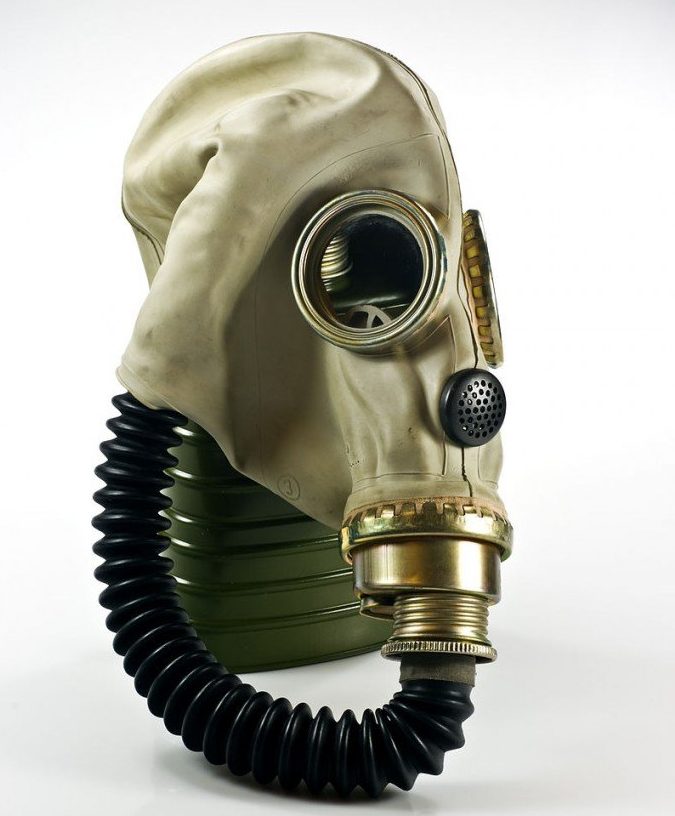
Polish MUA gas mask
A Polish MUA Gas Mask. Used from the 1970’s to the 1980’s
and was replaced by the Polish MP-4 gas mask.
There’s also a third way, wherein you could carry your own oxygen supply when entering a contaminated zone, but we’re only going to discuss techniques to filter air using respirators.
Consider dusty air, for example.
The gas mask that would be required to breathe in such a setting would contain a paper filter that could physically prevent dust particles from entering through the mask (to gain access to the nose or mouth of the wearer).
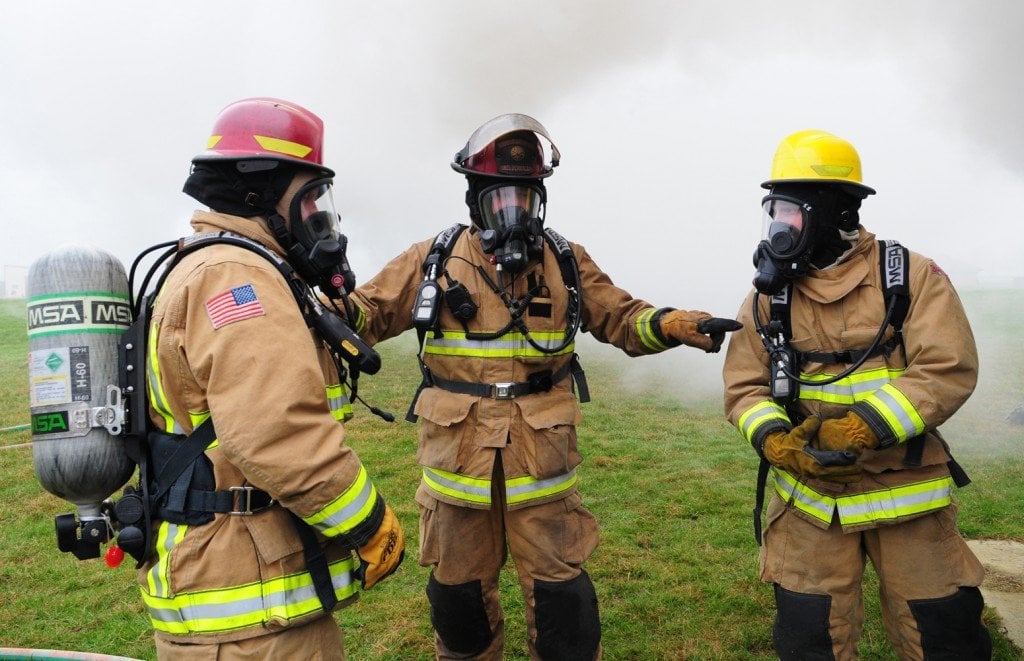
Self-Contained Breathing Apparatus
Self-Contained Breathing Apparatus. These types of respirators —
called a Self-Contained Breathing Apparatus (SCBA) — are usually worn by firefighters
on a mission. Such respirators use their own air tank to supply clean air,
so the wearer doesn’t have to worry about filters at all. 
Paper filters have very small holes that let only oxygen pass through and block all unwanted particles (e.g., dust, smoke, soot particles etc.).
It’s important to note that such a basic mask will be absolutely useless in the presence of toxic gases.
Activated charcoal is another very common choice for filters in respirators, as each particle or granule of carbon offers a large surface area where pollutant particles can get trapped and adsorbed.
Imagine filtering rocks out of sand… if you have a filter with pores that are big enough to let sand pass through, but are small enough to block rocks, filtering the rocks out of the sand would be easy, right?
That’s exactly what these types of filters do — they let oxygen molecules pass through and block bigger pollutant particles.
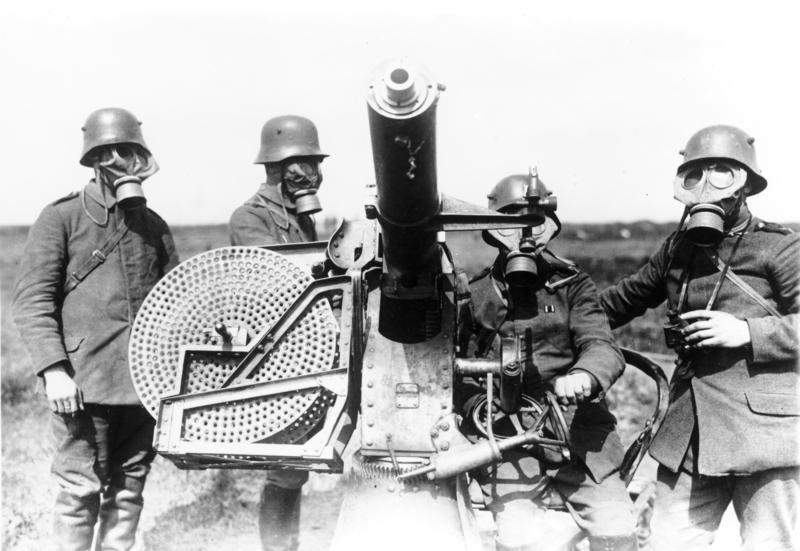
, How Do Respirators Allow You To Breathe Clean Air In A Contaminated Environment?, Science ABC, Science ABC
German soldiers with gas masks, 1915.
In the rudimentary gas masks used in the first world war, it was found
that wood charcoal was a good absorbent of poison gases.
Such filters are quite effective at filtering out acidic gases, such as chlorine, and particles like sediment and volatile organic compounds. Activated carbon filtering is even used in cigarette filters!
The other and relatively more sophisticated way of being able to breathe in a contaminated setting is by using a respirator whose filters contain a substance that could react with the ‘bad’ chemical (present in the contaminated air) and neutralize it.
For instance, a respirator with calcium oxide will bind with carbon dioxide (i.e., the pollutant) present in the air and turn it into a different product.
This way, all the harmful carbon dioxide will be removed and the user will be able to breathe in the contaminated environment.
Then again, this sort of respirator would be absolutely useless against chlorine or mustard gas.
That’s why it’s VERY IMPORTANT to check what kind of contamination setting a particular respirator will be effective in, as entering a ‘bad air’ zone wearing the wrong kind of respirator is tantamount to not wearing one at all!

Ashish is a Science graduate (Bachelor of Science) from Punjabi University (India). He spends a lot of time watching movies, and an awful lot more time discussing them. He likes Harry Potter and the Avengers, and obsesses over how thoroughly Science dictates every aspect of life… in this universe, at least.

ScienceABC.com was launched with the sole objective of finding and sharing fun and interesting science facts. We believe that Science is a fascinating and valuable area of study for people of all ages, and we’re not alone! This website is curated by a team of professionals who are passionate about Science. Our greatest hope is that the fun we have curating this content is the same for everyone who reads it.

walter-white-yellow-hazmat-meth-cook-suit

Saturday, June 15, 2019

CARBON DIOXIDE TOXICITY - Ordinarily, carbon dioxide is not poisonous. It diffuses from your cells into your bloodstream and from there out via your lungs, yet it is always present throughout your body. Carbon dioxide serves important physiological functions. As its level rises in the bloodstream, it stimulates the impulse to breathe. Carbon dioxide is essential for hemoglobin function. Carbon dioxide and oxygen bind at different sites on the hemoglobin molecule, but the binding of CO2 changes hemoglobin conformation. However, if you breathe high concentrations of carbon dioxide or re-breathe air (such as from a plastic bag or tent), you may be at risk for carbon dioxide intoxication or even carbon dioxide poisoning. Carbon dioxide intoxication and carbon dioxide poisoning are independent of oxygen concentration, so you may have enough oxygen present to support life, yet still suffer from the effects of rising carbon dioxide concentration in your blood and tissues.

Each carbon dioxide molecule consists of one carbon atom bonded to two oxygen atoms. While your body excretes carbon dioxide, too high of a concentration of the compound is toxic.
............................................................................................................................................
Carbon Dioxide
Is Carbon Dioxide Poisonous?
What You Need to Know About Carbon Dioxide Toxicity
by Anne Marie Helmenstine, Ph.D.  


You probably know carbon dioxide is a gas that is present in the air you breathe. Plants "breathe" it in order to make glucose.
You exhale carbon dioxide gas as a by-product of respiration.
Carbon dioxide in the atmosphere is one of the greenhouse gases.
You find it added to soda, naturally occurring in beer, and in its solid form as dry ice.
Based on what you know, do you think carbon dioxide is poisonous or is it non-toxic or somewhere in between?
You Need Carbon Dioxide to Live
Ordinarily, carbon dioxide is not poisonous. It diffuses from your cells into your bloodstream and from there out via your lungs, yet it is always present throughout your body.
Carbon dioxide serves important physiological functions. As its level rises in the bloodstream, it stimulates the impulse to breathe.
If the rate of breathing isn't sufficient to maintain the optimal level of CO2, the respiratory center responds by increasing the rate of breathing. 
Low oxygen levels, in contrast, do not stimulate increased rate or depth of breathing.
Carbon dioxide is essential for hemoglobin function.
Carbon dioxide and oxygen bind at different sites on the hemoglobin molecule, but the binding of CO2 changes hemoglobin conformation.
The Haldane Effect occurs when binding of carbon dioxide decreases the amount of oxygen bound for a particular partial pressure of the gas.
The Bohr Effect occurs when rising CO2 partial pressure or decreased pH causes hemoglobin to offload oxygen to tissues.
While carbon dioxide is a gas in the lungs, it exists in other forms in the blood.
The enzyme carbonic anhydrase converts about 70% to 80% of carbon dioxide into bicarbonate ions, HCO3-.
Between 5% and 10% of carbon dioxide is a dissolved gas in plasma. Another 5% to 10% is bound to hemoglobin as carbamino compounds in red blood cells.
The exact about of carbon dioxide varies according to whether blood is arterial (oxygenated) or venous (deoxygenated).
Too Much Carbon Dioxide Is Toxic
However, if you breathe high concentrations of carbon dioxide or re-breathe air (such as from a plastic bag or tent), you may be at risk for carbon dioxide intoxication or even carbon dioxide poisoning.
Carbon dioxide intoxication and carbon dioxide poisoning are independent of oxygen concentration, so you may have enough oxygen present to support life, yet still suffer from the effects of rising carbon dioxide concentration in your blood and tissues.
The condition of excess carbon dioxide concentration in the blood is called hypercapnia or hypercarbia.
Symptoms of carbon dioxide toxicity include high blood pressure, flushed skin, headache and twitching muscles.
At higher levels, you could experience panic, irregular heartbeat, hallucinations, vomited and potentially unconsciousness or even death.
There are several potential causes of hypercapnia.
It may result from hypoventilation, diminished consciousness, lung disease, rebreathing air, or exposure to an environment high in CO2 (e.g., near a volcano or geothermal vent or under in some workplaces).
It can also occur when supplemental oxygen is administered to a person with sleep apnea.
Diagnosis of hypercapnia is made by measuring blood carbon dioxide gas pressure or pH.
A blood gas concentration over 45 mmHg carbon dioxide combined with low serum pH indicates hypercarbia.
Fun Facts
·      The average adult human produces about 1 kg (2.3 lbs) of carbon dioxide per day. In other words, a person releases about 290 g (0.63 lbs) of carbon each day.
·     Breathing too quickly depletes carbon dioxide levels, causing hyperventilation. Hyperventilation, in turn, can lead to respiratory alkalosis. In contrast, breathing too shallowly or slowly eventually causes hypoventilation and respiratory acidosis.
·     You can hold your breath longer after hyperventilating than before it. Hyperventilation lowers the carbon dioxide concentration of arterial blood without having a significant impact on blood oxygen levels. The respiratory drive diminishes, so the urge to breathe is reduced. This carries a risk, however, since it's possible to lose consciousness before feeling an overwhelming urge to breathe.
Anne Marie Helmenstine, Ph.D.
Ph.D. in biomedical sciences from the University of Tennessee at Knoxville - Oak Ridge National Laboratory.
Science educator with experience teaching chemistry, biology, astronomy, and physics at the high school, college, and graduate levels.
ThoughtCo and About Education chemistry expert since 2001.
Widely-published graphic artist, responsible for printable periodic tables and other illustrations used in science.
Experience
Anne Helmenstine, Ph.D. has covered chemistry for ThoughtCo and About Education since 2001, and other sciences since 2013. She taught chemistry, biology, astronomy, and physics at the high school, college, and graduate levels. She has worked as a research scientist and also abstracting and indexing diverse scientific literature for the Department of Energy.
In addition to her work as a science writer, Dr. Helmenstine currently serves as a scientific consultant, specializing in problems requiring an interdisciplinary approach. Previously, she worked as a research scientist and college professor. 
Education
Dr. Helmenstine holds a Ph.D. in biomedical sciences from the University of Tennessee at Knoxville and a B.A. in physics and mathematics with a minor in chemistry from Hastings College. In her doctoral work, Dr. Helmenstine developed ultra-sensitive chemical detection and medical diagnostic tests.
ThoughtCo and Dotdash
ThoughtCo is a premier reference site focusing on expert-created education content. We are one of the top-10 information sites in the world as rated by comScore, a leading Internet measurement company. Every month, more than 13 million readers seek answers to their questions on ThoughtCo.
For more than 20 years, Dotdash brands have been helping people find answers, solve problems, and get inspired. We are one of the top-20 largest content publishers on the Internet according to comScore, and reach more than 30% of the U.S. population monthly. Our brands collectively have won more than 20 industry awards in the last year alone, and recently Dotdash was named Publisher of the Year by Digiday, a leading industry publication.

Each carbon dioxide molecule consists of one carbon atom bonded to two oxygen atoms. While your body excretes carbon dioxide, too high of a concentration of the compound is toxic.
 Each carbon dioxide molecule consists of one carbon atom bonded to two oxygen atoms. While your body excretes carbon dioxide, too high of a concentration of the compound is toxic.