Showing posts with label Aqueducts. Show all posts

Friday, January 31, 2020

NATURAL METHODS TO KEEP HOUSES COOL - Just imagine how miserable it would have been for folks in the scorching summer when their only option would be to vigorously wave a paper fan with their hands. People found plenty of natural methods to keep their houses cooler than the temperature outside. They identified ways to create a balance with the local environment. They employed methods of passive cooling to design houses in a way that is in accordance with the climate, enabling them to lower the temperature inside the house. Climate is most important in deciding how a building should be constructed. This must be done by taking into account the movement of the sun and wind on the site. The information that this provides determines the location of the rooms in the houses, so placing rooms in the opposite direction of the sun’s path would make the room naturally cooler than the others. Wind direction also plays an important role, as the flow of natural wind in a room would help keep it ventilated and cooler.

Pont du Gard three-tiered aqueduct was built in Roman times on the river Gardon. Provence summer day. - Image(cge2010)S
................................................................................................................................................................
Adalaj, Gujrat, India- November 16,2010 The beautiful Step well of Adalaj ( Adalaj or Rudabai stepwell or baoli ) Near Ahmadabad - Image( Abhijeet Khedgikar)s
Natural Methods To Keep Houses Cool

How Did Houses Cool Before ‘Air Conditioning’ Became A Thing?
Vishal Thakur  


Before the advent of artificial air conditioning, people used many different ways to cool their houses.
Some of these techniques included designing houses with respect to the surrounding environment, using evaporative cooling, wind-catchers, etc.
Summers can become an unbearable mess sometimes.
Rising temperatures in the afternoon, sun beating down on top of your head, roads filled with traffic and pollution… it all feels like a bad and very sweaty drag.
Fortunately, we now have the option of cushioning ourselves in an enclosed room with the temperature turned way down on the AC unit, effectively detaching ourselves from the heatwave going on outside.
This, of course, wasn’t always an option. The first air conditioning systems were powered back in 1902, meaning that artificial cooling is a relatively new phenomenon.
Just imagine how miserable it would have been for folks in the scorching summer when their only option would be to vigorously wave a paper fan with their hands.
Fortunately, they had more options then handheld fans, as people found plenty of natural methods to keep their houses cooler than the temperature outside.
They employed methods of passive cooling to design houses in a way that is in accordance with the climate, enabling them to lower the temperature inside the house.
Let’s look at some of the ways people naturally cooled their homes.
Ways in which houses were cooled naturally
Without modern technology, people relied heavily on the way houses were built in accordance with the local climate to maximize heat dissipation and thermal insulation.
Many buildings constructed today completely disregard this, as it is easy to simply build a box and slap electric air conditioning on the side.
In the past, people did not have this option, so they had to learn techniques to make houses as site-friendly and aligned with the climate as possible, making it completely natural.
These tricks were used to make their houses cooler:
House layout based on the climate of the site
As stated before, the climate of a site is one of the most important aspects of deciding how a building should be constructed.
This must be done by taking into account the movement of the sun and wind on the site.
The information that this provides determines the location of the rooms in the houses, so placing rooms in the opposite direction of the sun’s path would make the room naturally cooler than the others.
Wind direction also plays an important role, as the flow of natural wind in a room would help keep it ventilated and cooler.
Some very interesting examples include Indian step wells, which were dug underground in the shape of stairs.
The level underneath has water and as is away from sunlight, making it much cooler than the rooms above.
Shading of the house
Well-designed exterior shading of the house cuts off the harsh sunlight coming in during the afternoon.
This reduces the heat gain on the exterior surfaces of the house (windows and blank walls) and also ensures ambient temperatures in semi-open and outdoor areas of the house.
Initially, this shading was done with trees, but as techniques evolved, the shading could be achieved by an opaque slab running through the house (seen above modern windows), extended balconies, and perforated wooden shades called pergolas.
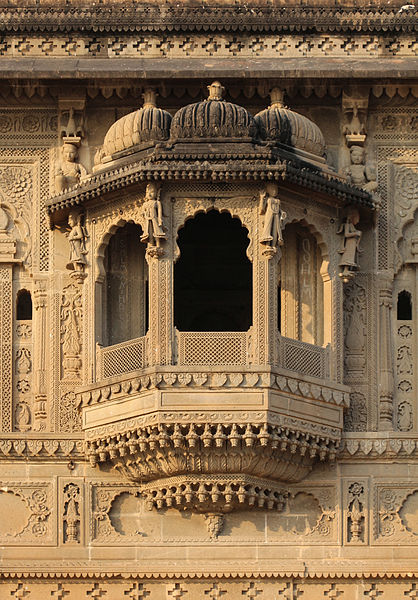
Examples of this are seen in Mughal architecture with jharokhas, which provide a separation of space, reducing the temperature of the room inside.
Thermal insulation
The thickness of the walls and the roof of the house plays an important role in transferring heat from the exterior to the interior.
Many materials are used to insulate this transfer, making the interior rooms much cooler.
These materials are stacked between the walls; some of the common ones are wool, cellulose fiber and glass fiber.
Thermal insulation boards are drilled on the back of the roof to avoid heat transfer.
Earth walls help a lot in insulating the houses, as it is a cooler material; adding splashes to the walls makes the incoming air cool and pleasant.
Natural Ventilation
Keeping windows facing the direction of the wind helps cool down rooms with the breeze.
Having two windows on two opposite walls or having a courtyard on one side helps this even further, as there is a constant flow of wind in the room, giving no time for the hot air to linger.
Innovative window-making techniques also help get rid of warm air. As warm air moves higher than cooler air, small vents were placed on the windows for its elimination, thus making the room cooler.
Black openings are also placed on the roof for the suctioning of warm air, with a wind tunnel on the ground to cool the incoming air.
Windcatcher
In use for thousands of years, a windcatcher is a small tower with an opening on the top.
The tower ‘catches’ the wind flowing above and forces it to enter the houses, thus cooling the interior. This is the simplest type of windcatcher.
Another type is used with a qanat, which is the opposite of the one described above. A qanat is an underground tunnel with a water body for the warm air to cool down.
The air then flows into the room and goes out of the opening on top of the tower, thus completing the ventilation cycle.
Evaporative Cooling
Our bodies cool through evaporation. As we exert energy and perspire (sweat), the evaporation cools our body down.
This same principle is used in making a room cooler through evaporation. Wet khas-mats hung on a window on a windy day will make the room cooler inside.
This method is so effective, in fact, that modern coolers use the same principles to operate.
The earliest example of this is the Egyptians using wet reeds on their windows to cool down their rooms.
Aqueducts
Romans gave us many engineering marvels and aqueducts are one of them.
Aqueducts are an underground network linked to a water supply and used to connect clear sources of water to community spaces and individual houses.
They were also used to take heat away from houses by pumping into the walls.
However, this was just for the elite, as it was an expensive system to develop and use.
These aqueducts were also used to fill Roman fountains, which were used to cool down the common public.
Conclusion
We’ve come a long way, from sprinkling water on our walls to installing electric air conditioners without a second thought.
People have always found ingenious ways to get some relief in the heat and identified ways to create a balance with the local environment.
As artificial air conditioning is not very environmentally friendly, we can still use some of these clever approaches when designing new buildings to reduce the need for artificial cooling!

Vishal is an Architect and a design aficionado. He likes making trippy patterns in his computer. Fascinated by technology’s role in humanity’s evolution, he is constantly thinking about how the future of our species would turn out – sometimes at the peril of what’s currently going on around him.
Cattail and reed plant isolated on white background. Wild grass - Image(Artiste2d3d)s


Adalaj, Gujrat, India- November 16,2010 The beautiful Step well of Adalaj ( Adalaj or Rudabai stepwell or baoli ) Near Ahmadabad - Image( Abhijeet Khedgikar)s
Stepwells make the room on the lower floors cooler. 
Maheshwar Fort
Jarokha’s help shade rooms from the penetrating sunlight. 
Plastic (mansard) or skylight window on attic with environmentally friendly and energy efficient thermal insulation rockwool. - Image(brizmaker)S
Thermal insulation on roofs to reduce heat gain. 

Earthship-ventilation-cooling-tube-schematic copy
Earth walls with openings for airflow
Edificios en Yazd, IrĂ¡n
Windcatcher
Windcatcher with qanat 


Cattail and reed plant isolated on white background. Wild grass - Image(Artiste2d3d)s
Egyptians used wet reeds for evaporative cooling 
Pont du Gard three-tiered aqueduct was built in Roman times on the river Gardon. Provence summer day. - Image(cge2010)S
Three-tier aqueduct 


Friday, July 27, 2018

THE WATER SYSTEM OF ANCIENT ROME - The Romans are renowned for engineering marvels, among which is the aqueduct that carried water for many miles in order to provide a crowded urban population with relatively safe, potable water, as well as less essential but very Roman aquatic uses. Aqueducts were built because the springs, wells, and Tiber River were no longer providing the safe water that was needed for the swelling urban population.

Aqueduct of San Lazaro in merida
.
The Water System Of Ancient Rome
Aqueducts, Water Supply and Sewers in Ancient Rome

Ann Olga Koloski-Ostrow, a Brandeis classicist who has studied the Roman latrine, says, "There are no ancient sources where you can really learn about daily life... You have to come upon information almost by chance."
That means it's hard to answer all the questions or to say with any confidence that this bit of information about the bathroom habits of the Roman Empire applies to the Republic as well.
With that caution, here is some of what we think we know about the water system of ancient Rome.
Roman Water Carriers - Aqueducts
The Romans are renowned for engineering marvels, among which is the aqueduct that carried water for many miles in order to provide a crowded urban population with relatively safe, potable water, as well as less essential but very Roman aquatic uses.
Rome had nine aqueducts by the time of the engineer Sextus Julius Frontinus (circa 35–105), appointed curator aquarum in 97, our main ancient source for the water supply.
The first of these was built in the fourth century B.C. and the last in the first century A.D.
Aqueducts were built because the springs, wells, and Tiber River were no longer providing the safe water that was needed for the swelling urban population.
Aqueducts Listed by Frontinus
1. In 312 B.C., the Appia Aqueduct was built 16,445 meters long.
2. Next was the Anio Verus, built between 272-269, and 63,705 meters.
3. Next was the Marcia, built between 144-140 and 91,424 meters.
4. The next aqueduct was the Tepula, built in 125, and 17,745 meters.
5. The Julia was built in 33 B.C. at 22,854 meters.
6. The Virgo was built in 19 B.C., at 20,697 meters.
7. The next aqueduct is the Alsientina, whose date is unknown. Its length is 32,848.
8. The last two aqueducts were built between 38 and 52 A.D. Claudia was 68,751 meters.
9. The Anio Novus was 86,964 meters.[+]

The Drinking Water Supply in the City

Water did not go to all residents of Rome.
Only the rich had private service and the rich were as likely to divert and, hence steal, the water from the aqueducts as anyone.
Water in residences only reached the lowest floors. Most Romans got their water from a constantly running public fountain.

Baths and Latrines

Aqueducts also supplied water to public latrines and baths.
Latrines served 12-60 people at once with no dividers for privacy or toilet paper -- only a sponge on a stick in the water to pass around.
Fortunately, water ran through the latrines constantly.
Some latrines were elaborate and may have been amusing. Baths were more clearly a form of entertainment as well as hygiene.
Sewer
When you live on the 6th floor of a walk-up with no latrine for blocks, the chances are you'll use a chamberpot.
What do you do with its content? That was the question that faced many an insula dweller in Rome, and many answered in the most obvious way.
They dumped the pot out the window onto any stray passerby. Laws were written to deal with this, but it still went on.
The preferred act was to dump solids into sewers and urine into vats where it was eagerly collected and even bought by fullers who needed the ammonia in their toga cleaning business.

The Big Sewer - The Cloaca Maxima

The main sewer of Rome was the Cloaca Maxima. It emptied into the Tiber River.
It was probably built by one of the Etruscan kings of Rome to drain the marshes in the valleys between the hills.

N.S. Gill is a Latinist and freelance writer with a longtime focus on the classical world.
Experience
In addition to writing articles on ancient history and classics for About.com, N.S. has been interviewed by Public Radio and National Geographic on Valentine's Day and the Roman calendar. She has TA'd classes in the Age of Pericles, technical terms, Classical culture and mythology. She has also taught Latin.
Education
N.S. Gill has a B.A. in Latin and an M.A. in linguistics from the University of Minnesota. She has also done graduate level coursework on classics at the University of Minnesota, writing two master's level papers, one on the misdating of an Oxyrhynchus papyrus and the other on Ovid as part of the program.
N.S. Gill
I hope to help spread the updated classical seed far abroad.
Like the inside of a seed, there is now a full-grown plant waiting to bloom -- in you. Most of the information I am providing is basic (never really "all there is to know about X, Y, or Z"), and often simplified. Especially in citations, you will find many ideas for further reading in the articles I submit, but if you want more, and don't want to go looking all over the place (starting with figuring out what to hunt for in JSTOR and L'AnnĂ©e philologique) for yourself, here is one simple tip: Look at the bibliographies for general topics in the Cambridge Ancient History.
https://www.thoughtco.com/aqueducts-water-supply-sewers-ancient-rome-117076

You might also like:
.
Water Supply
Backbone of Civilization and of Our Future
CLICK HERE . . .
 .
Featured imageAncient Roman Aqueduct
CLICK HERE . . .
.
History of drinking water treatment
CLICK HERE . . .

 .
HIPPOCRATES: 
Father of Water Filters
CLICK HERE . . .
..
Multi-Media Filter, Highly-Activated Carbon Filter,
Zeolite-Process Water Softener With Brine Tank,
Fiberglass Ballast-Type Pressure Tank
(fully automatic backwash & regeneration)
PURICARE 
INDUSTRIAL 
ENTERPRISES 
Water 
Treatment 
Systems
.
.
...
Aganan, Pavia, Iloilo, Philippines
Aqueduct of San Lazaro in merida

Monday, May 22, 2017

WATER SUPPLY - Backbone of Civilization and of Our Future - Most of the water suitable for human consumption flows underground, as a mere 0.009% of Earth’s water is situated in rivers, streams and springs. Without accessible potable water and water for other needs such as industry, transport and energy we will eventually just die out as a civilization.


Water Supply
Backbone of Civilization and of Our Future
Most of us take our water supply for granted, but water for society is akin to blood for the body; we rely on it to survive.
How many of us have ever taken the time to think about the fascinating journey our water supply has taken through the ages?
While most of us just accept that we can turn open a tap and water will pour out, early settlers had no such luxuries and had to dwell around major freshwater sources like rivers and natural springs to access fresh water.
Unfortunately that was not always easy as although two thirds of the Earth is covered in water, only 3% is drinkable and most of that is captured in glaciers and ice caps.
Most of the water suitable for human consumption flows underground, as a mere 0.009% of Earth’s water is situated in rivers, streams and springs.
Humans started digging wells and building aqueducts really long ago, such as the oldest wells ever found in Jezreel Valley, Israel which date back to around 6500 BC.
The Indus Valley civilization, famous for the first water management system, built wells, water pipes and toilets.
The first evidence of proper water supply though came from the Minoan civilization in Crete, who were the first known civilization to use underground clay pipes to supply drinking water.
The large-scale engineering projects of the Romans brought Indoor plumbing, supplied by great aqueducts such as the Pont du Gard aqueduct in Nimes, France.
Persians invented Qanats, gently sloping underground channels with a series of vertical access shafts that could supply them with an ongoing supply of cool, potable water from as far as 50 kilometers away.
The Mayans initiated water pressure and water purification, using limestone to filter their water, in a similar fashion to the modern ceramic water filters we use today.
Water supply in the UK began around 1325, and much has been done since.
But it must also be noted that unless the current ancient infrastructure is maintained and improved on we are in for major problems in the future.
Old iron pipes are contaminating the water supply with toxic metals.
And traces of both pharmaceutical and recreational drugs have been found in the water, which is not good for human or animal life.
Without accessible potable water and water for other needs such as industry, transport and energy we will eventually just die out as a civilization.
RELATED POSTS:
.
History of drinking 
water treatment


CLICK HERE . . .
.
WHEN DID MODERN WATER 
FILTRATION BEGIN?
CLICK HERE . . .
.
HIPPOCRATES: 
Father of Water Filters
CLICK HERE . . .

..
Multi-Media Filter, Highly-Activated Carbon Filter,
Zeolite-Process Water Softener With Brine Tank,
Fiberglass Ballast-Type Pressure Tank
(fully automatic backwash & regeneration)
.
PURICARE 
INDUSTRIAL 
ENTERPRISES 
Water 
Treatment 
Systems
.
...
Aganan, Pavia, Iloilo, Philippines
...
CLICK HERE . . . to view company profile . . .

Tachmina Laminated
Sand Filter


Reverse Osmosis with Cartridge Pre-Filters
Ultraviolet Bactericidal System
with Cartridge Pre-Filters