Showing posts with label Carbon. Show all posts

Wednesday, August 19, 2020

GRAPHENE - 200 Times Stronger Than Steel, 1,000 Times Lighter Than Paper - A sheet of graphene looks like an atomic-scale honeycomb. Measuring in at just one atom thick, a sheet of graphene checks all the boxes of a supermaterial: Graphene is 200 times stronger than steel by weight; It is 1,000 times lighter than paper; It is 98 percent transparent; It conducts electricity better than any other known material at room temperature; It can convert light at any wavelength into a current; And, last but not least, graphene is made from carbon, the fourth most-abundant element in the universe, so we're not likely to run out. Graphene gets its superpowers from its structure. If you could zoom in close enough, you'd see that a sheet of graphene looks like an atomic-scale honeycomb. Individual carbon atoms are arranged in a hexagonal pattern that resembles chicken wire. Each carbon atom in a sheet of graphene is covalently bonded to three other carbon items, which gives the material its incredible strength. Why does graphene conduct electricity so well? Again, because of the way those carbon atoms are bonded. Each carbon atoms has four electrons in its outer shell, but only three of those electrons are shared with its neighboring three carbon atoms. The remaining electron is called a pi electron and is free to move in three-dimensional space, which allows it to transmit electrical charges across the sheet of graphene with almost no resistance.
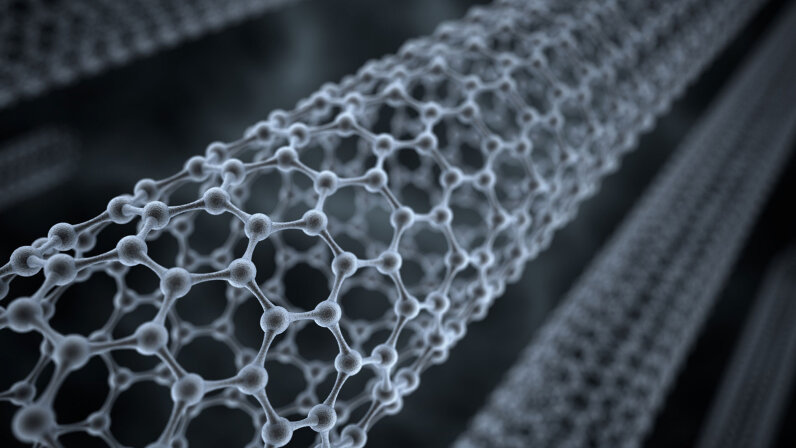
graphene
A sheet of graphene looks like an atomic-scale honeycomb.
................................................................................................................................................................
low-cost semitransparent perovskite solar cellsGraphene
200 Times Stronger Than Steel, 1,000 Times Lighter Than Paper
BY DAVE ROOS


In 2004, two scientists at the University of Manchester conducted a deceptively simple experiment with potentially world-changing consequences.
The researchers, Andre Geim and Konstantin Novoselov, were playing around with graphite, the stuff in the tip of your pencil.
Graphite is made of super-thin sheets of pure carbon stacked on top of each other.
Geim and Novoselov wanted to see if they could isolate a single sheet of graphite, an impossibly thin layer of carbon measuring just one atom thick.
So, they grabbed a roll of sticky tape. Yes, the same transparent tape in the plastic applicator that you keep in your junk drawer.
Here's how Geim described his technique, as reported by the BBC.
"You put [sticky tape] on graphite or mica and peel the top layer. There are flakes of graphite that come off on your tape. Then you fold the tape in half and stick it to the flakes on top and split them again. And you repeat this procedure 10 or 20 times. Each time, the flakes split into thinner and thinner flakes. At the end you're left with very thin flakes attached to your tape. You dissolve the tape and everything goes into solution."
The sticky-tape method worked!
By isolating a single-layer sheet of carbon, Geim and Novoselov were credited with discovering a brand-new material called graphene that's now believed to be the strongest, lightest and most electrically conductive substance on Earth.
In 2010, Geim and Novoselov shared the Nobel Prize in physics for discovering graphene, and researchers around the world began clamoring for ways to use this remarkable "supermaterial" to build more powerful and longer-lasting batteries, faster microchips, flexible circuitry, implantable biosensors and more.
A decade later, graphene has yet to deliver on its much-hyped promises, but insiders are confident that we'll finally be seeing smartphones, electric cars and sensors using graphene-based technology in the next few years.
Why Is Graphene a Supermaterial?
Measuring in at just one atom thick, a sheet of graphene checks all the boxes of a supermaterial:
o  Graphene is 200 times stronger than steel by weight.
o  It is 1,000 times lighter than paper.
o  It is 98 percent transparent.
o  It conducts electricity better than any other known material at room temperature.
o  It can convert light at any wavelength into a current.
o  And, last but not least, graphene is made from carbon, the fourth most-abundant element in the universe, so we're not likely to run out
Graphene gets its superpowers from its structure.
If you could zoom in close enough, you'd see that a sheet of graphene looks like an atomic-scale honeycomb.
Individual carbon atoms are arranged in a hexagonal pattern that resembles chicken wire.
Each carbon atom in a sheet of graphene is covalently bonded to three other carbon items, which gives the material its incredible strength.
Why does graphene conduct electricity so well?
Again, because of the way those carbon atoms are bonded.
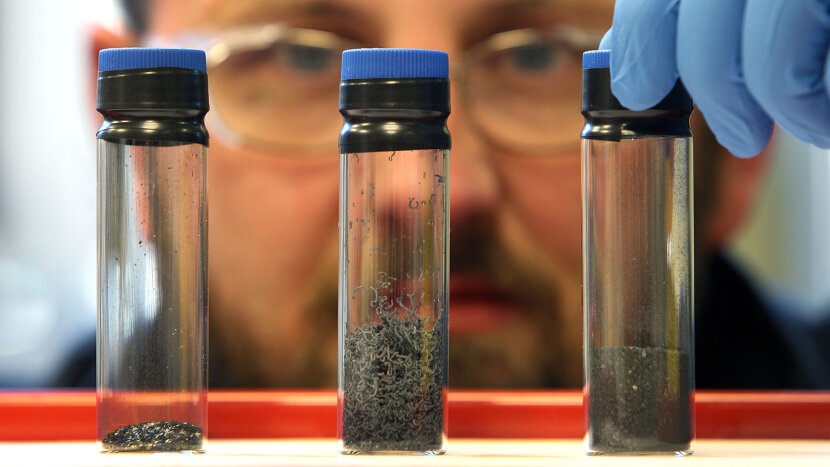
graphite to graphene
At Cabot Corporation, senior researcher Matt Hesketh examines the progression
 of graphene in three vials. The vial on the left is graphite, the middle one
is graphite expanded, and the one on the right is graphene.
Each carbon atoms has four electrons in its outer shell, but only three of those electrons are shared with its neighboring three carbon atoms.
The remaining electron is called a pi electron and is free to move in three-dimensional space, which allows it to transmit electrical charges across the sheet of graphene with almost no resistance. In fact, graphene is the fastest conductor of electricity at room temperature of any known substance.
The 'Magic Angle'
A recent discovery may add yet another superpower to graphene's brag list.
A team at Massachusetts Institute of Technology (MIT) was experimenting with dual-layered graphene — two layers of single-atom graphene stacked together — when they stumbled upon a new, nearly magical property of graphene.
When the layers are rotated slightly out of line with each other — a displacement of exactly 1.1 degrees — the graphene becomes a superconductor.
Superconductors are the rarest class of materials that conduct electricity with absolutely no resistance and zero heat.
The discovery of graphene's "supermaterial" sent shockwaves through the scientific community.
Although the experiment was conducted at extreme low temperatures (close to 0 degrees Kelvin or minus 459.67 F), it opened up the possibility that by combining graphene with other superconductive elements, we're closer than ever to room-temperature superconductivity.
Such an achievement would radically improve the energy efficiency of everything from gadgets to cars to entire electric grids.
How Might Graphene Transform Technology?
Superconductivity is still decades away, but revolutionary graphene-based products are coming to the market much sooner, says Andrea Ferrari, a professor of nanotechnology and director of the Cambridge Graphene Centre.
"By 2024, there will be a variety of graphene products on the market," says Ferrari, "including batteries, photonics, night vision cameras and more."
Consumers have been eagerly awaiting graphene-based batteries for years.
The lithium-ion batteries in all our gadgets are relatively slow to charge, lose their juice quickly and burn out after a set number of cycles.
That's because the electrochemical process that powers lithium-ion batteries generates a lot of heat.
But since graphene is the world's most efficient electrical conductor, it produces a lot less heat when charging up or discharging electricity.
Graphene-based batteries are promising five times faster charging speeds than lithium-ion, three times longer battery life, and five times as many cycles before they need to be replaced.
Electronics companies like Samsung and Huwei are actively developing graphene-based batteries for smartphones and other gadgets, but the earliest those will hit the market is 2021.
As for graphene batteries in electric cars — which could dramatically increase their driving radius — that's still a few years off.
An entire industry has been built on lithium-ion technology and it won't change overnight.
"The battery industry is very conservative," says Jesus de la Fuente, CEO of Graphanea, a company that manufactures and sells pure graphene and graphene-based chips to academic researchers and R&D departments.
"It might change the composition of batteries a few times every five to ten years, which makes it very difficult to introduce new products in this industry."
There are a few graphene-based batteries on the market, including some wired and wireless chargers from a company called Real Graphene, but those are only the tip of the iceberg, says Ferrari, who is also the science and technology officer for the Graphene Flagship, a 1-billion-euro collaboration by the European Union to speed the development of graphene technology.
Research partners with the Flagship are already making graphene batteries that outperform today's best high-energy cells by 20 percent capacity and 15 percent energy.
Other teams have built graphene-based solar cells that are 20 percent more efficient at converting sunlight to electricity.
Other Uses for Graphene
While graphene batteries might be first to market, researchers are busy developing countless other applications for this miracle material.
Biosensors are a big deal. Imagine an incredibly thin and flexible chip that can be injected into the bloodstream to monitor real-time health data like insulin levels or blood pressure.
low-cost semitransparent perovskite solar cells
Physics professor Dr. Yan Fung, holds a new invention of low-cost
semitransparent solar cells with graphene electrodes
at Poly University in Hung Hom, China, 2015.
Or a graphene interface that sends signals back and forth to the brain to detect an upcoming epileptic seizure or even prevent it.
Thin, stretchable sensors can also be worn on the skin or woven into the fabric of clothes.
Photonics is another field that's already incorporating graphene.
By integrating graphene into light-sensitive chips, cameras and other sensors can greatly improve sensitivity to even the faintest light waves across the visible and invisible spectrum.
That will not only improve the image quality of cameras and telescopes, but also medical imagery.
Filtration is yet another promising application of graphene.
Simple water purification filters built with graphene polymers can bind to organic and inorganic contaminants in drinking water.
Researchers at the Graphene Flagship have also created desalinization technologies based on graphene diodes that can remove over 60 percent of salt from seawater for agricultural and other uses.
All these developments will take time, but Ferrari at the Cambridge Graphene Centre is confident that graphene will live up to its hype.
In fact, he is equally excited about the yet-undiscovered properties of the estimated 2,000 other monolayer materials that are also being isolated, sticky tape method or otherwise.
"We say graphene, but we're really talking about a large number of options that are being explored," says Ferrari. "Things are moving in the right direction."
NOW THAT'S COOL
Sports equipment maker Head was one of the first to jump on the graphene bandwagon. Its Graphene XT tennis racket claims to be 20 percent lighter than racquets with the same swing weight.

Dave Roos
CONTRIBUTING WRITER
Dave is a freelance journalist who has contributed hundreds of articles to HowStuffWorks since 2007, with a specialty in personal finance, economics and business. Raised in Pittsburgh, Pennsylvania, he attended Duke University where he earned the B.A. in comparative religious studies that has served him so well.
Dave began freelancing when he and his wife moved to Mexico in 2003, publishing articles about Mexican food and culture in The New York Times, the Los Angeles Times and Newsweek. Nearly 15 years and three kids later, Dave and his family recently moved back to Mexico and just might stay a while.
graphite to graphene

Sunday, September 22, 2019

COAL – the Organic Rock - Coal is made up of organic components; specifically, plant matter that has been buried in an anoxic, or non-oxygenated, environment and compressed over millions of years. Because it is organic, coal defies the normal standards of classification for rocks, minerals, and fossils. Coal differs from every other kind of rock in that it is made of organic carbon: the actual remains, not just mineralized fossils, of dead plants. The carbon in coal was preserved from oxidation and remains in a chemically reduced form, available for oxidation.

Coal
........................................................................................................................................................
Coal
the organic rock
Everything You Need to Know About Coal
by Andrew Alden 


Coal is an enormously valuable fossil fuel that has been used for hundreds of years in industry.
It is made up of organic components; specifically, plant matter that has been buried in an anoxic, or non-oxygenated, environment and compressed over millions of years. 
Fossil, Mineral or Rock?
Because it is organic, coal defies the normal standards of classification for rocks, minerals, and fossils: 
·           A fossil is any evidence of life that has been preserved in rock. The plant remains that make up coal have been "pressure cooked" for millions of years. Therefore, it is not accurate to say that they have been preserved. 
·          Minerals are inorganic, naturally-occurring solids. While coal is a naturally-occurring solid, it is composed of organic plant material.
·          Rocks are, of course, made up of minerals. 
Talk to a geologist, though, and they'll tell you that coal is an organic sedimentary rock.
Even though it doesn't technically meet the criteria, it looks like a rock, feels like a rock and is found between sheets of (sedimentary) rock. So, in this case, it is a rock. 
Geology isn't like chemistry or physics with their steadfast and consistent rules. It is an Earth science; and like the Earth, geology is full of "exceptions to the rule." 
State legislators struggle with this topic as well: Utah and West Virginia list coal as their official state rock while Kentucky named coal its state mineral in 1998. 
Coal: the Organic Rock
Coal differs from every other kind of rock in that it is made of organic carbon: the actual remains, not just mineralized fossils, of dead plants.
Today, the vast majority of dead plant matter is consumed by fire and decay, returning its carbon to the atmosphere as the gas carbon dioxide.
In other words, it is oxidized. The carbon in coal, however, was preserved from oxidation and remains in a chemically reduced form, available for oxidation.
Coal geologists study their subject the same way that other geologists study other rocks.
But instead of talking about the minerals that make up the rock (because there are none, just bits of organic matter), coal geologists refer to the components of coal as macerals.
There are three groups of macerals: inertinite, liptinite, and vitrinite.
To oversimplify a complex subject, inertinite is generally derived from plant tissues, liptinite from pollen and resins, and vitrinite from humus or broken-down plant matter.
Where Coal Formed
The old saying in geology is that the present is the key to the past.
Today, we can find plant matter being preserved in anoxic places: peat bogs like those of Ireland or wetlands like the Everglades of Florida.
And sure enough, fossil leaves and wood are found in some coal beds.
Therefore, geologists have long assumed that coal is a form of peat created by the heat and pressure of deep burial.
The geologic process of turning peat into coal is called "coalification."
Coal beds are much, much larger than peat bogs, some of them tens of meters in thickness, and they occur all over the world.
This says that the ancient world must have had enormous and long-lived anoxic wetlands when the coal was being made. 
Geologic History of Coal
While coal has been reported in rocks as old as Proterozoic (possibly 2 billion years) and as young as Pliocene (2 million years old), the great majority of the world's coal was laid down during the Carboniferous Period, a 60-million-year stretch (359-299 m.y.a.) when sea level was high and forests of tall ferns and cycads grew in gigantic tropical swamps.
The key to preserving the forests' dead matter was burying it.
We can tell what happened from the rocks that enclose the coal beds: there are limestones and shales on top, laid down in shallow seas, and sandstones beneath laid down by river deltas.
Obviously, the coal swamps were flooded by advances of the sea. This allowed shale and limestone to be deposited on top of them.
The fossils in the shale and limestone change from shallow-water organisms to deep-water species, then back to shallow forms.
Then sandstones appear as river deltas advance into the shallow seas and another coal bed is laid down on top. This cycle of rock types is called a cyclothem.
Hundreds of cyclothems occur in the rock sequence of the Carboniferous. Only one cause can do that - a long series of ice ages raising and lowering the sea level.
And sure enough, in the region that was at the south pole during that time, the rock record shows abundant evidence of glaciers.
That set of circumstances has never recurred, and the coals of the Carboniferous (and the following Permian Period) are the undisputed champions of their type.
It has been argued that about 300 million years ago, some fungus species evolved the ability to digest wood, and that was the end of the great age of coal, although younger coal beds do exist.
A genome study in Science gave that theory more support in 2012. If the wood was immune to rot before 300 million years ago, then perhaps anoxic conditions were not always necessary.
Grades of Coal
Coal comes in three main types or grades. First, the swampy peat is squeezed and heated to form a brown, soft coal called lignite.
In the process, the material releases hydrocarbons, which migrate away and eventually become petroleum.
With more heat and pressure lignite releases more hydrocarbons and becomes the higher-grade bituminous coal.
Bituminous coal is black, hard and usually dull to glossy in appearance.
Still greater heat and pressure yields anthracite, the highest grade of coal. In the process, the coal releases methane or natural gas.
Anthracite, a shiny, hard black stone, is nearly pure carbon and burns with great heat and little smoke. 
If coal is subjected to still more heat and pressure, it becomes a metamorphic rock as the macerals finally crystallize into a true mineral, graphite.
This slippery mineral still burns, but it is much more useful as a lubricant, an ingredient in pencils and other roles.
Still more valuable is the fate of deeply buried carbon, which at conditions found in the mantle is transformed into a new crystalline form: diamond.
However, coal probably oxidizes long before it can get into the mantle, so only Superman could perform that trick.
Andrew Alden
Professional geologist, writer, photographer, and geological tour guide
Thirty-seven years of experience writing about geological subjects
Six years as a research guide with U.S. Geological Survey (USGS)
Experience
Andrew Alden is a former writer for ThoughtCo who contributed hundreds of articles for more than 17 years. Andrew works as a geologist, writer, editor, and photographer. He has written on geological subjects since 1981 and participates actively in his field. For example, Andrew spent six years as a research guide with the U.S. Geological Survey, leading excursions on both land land and at sea. And since 1992, he has hosted the earthquakes conference for the online discussion platform, The Well, which began as a dialogue between the writers and readers of the Whole Earth Review. 
In addition, Andrew is a longtime member of the member of the Geological Society of America — an international society that serves members in academia, government, and industry; and the American Geophysical Union — a community of earth and space scientists that advances the power of science to ensure a sustainable future.
Andrew lives in Oakland, California; and though he writes about the whole planet and beyond, Andrew finds his own city full of interest too and blogs about its geology
Education
Andrew Alden holds a bachelor's (B.A.) degree in Earth Science from the University of New Hampshire, College of Engineering and Physical Sciences, in Durham, N.H.
Awards and Publications
Andrew Alden on Earthquakes (The Well Group, Inc., 2011)
Assessment of River — Floodplain Aquifer Interactions (Environmental and Engineering Geoscience, 1997)
Andrew Alden on Hosting (The Well Group, Inc., 1995)
ThoughtCo and Dotdash
ThoughtCo is a premier reference site focusing on expert-created education content. We are one of the top-10 information sites in the world as rated by comScore, a leading Internet measurement company. Every month, more than 13 million readers seek answers to their questions on ThoughtCo.
For more than 20 years, Dotdash brands have been helping people find answers, solve problems, and get inspired. We are one of the top-20 largest content publishers on the Internet according to comScore, and reach more than 30% of the U.S. population monthly. Our brands collectively have won more than 20 industry awards in the last year alone, and recently Dotdash was named Publisher of the Year by Digiday, a leading industry publication.
Coal

Friday, January 26, 2018

GRAPHENE - Carbon is very special. It can form diamond and graphite—even though the former is super hard and the latter is quite soft. Graphene is another form of carbon material - this time a single layer of graphite. It has very useful electrical, thermal, and physical properties. Its applications include replacing silicon in areas like electronic devices.

 
.
Graphene
Seeing God’s Handiwork and Care in Chemistry
by Avery Foley 


God’s creation is filled with amazing design.
Often when we think of design, we immediately picture hummingbirds, butterflies, or the human body.
But God’s design can be seen in the obvious and the not so obvious.
Have you ever stopped to consider how even chemistry showcases God’s handiwork, creativity, and care for his creation?

Graphene, the “Wonder Material”

Carbon, the sixth element on the periodic table, is considered “King of the Elements.”
It appears in three major forms in nature. One of these forms, diamond, is transparent and the hardest known material while another form, graphite, is black and very soft.
Carbon is essential to life.
In 2002 researchers at the University of Manchester isolated graphene, an ultra-thin sheet of carbon atoms, by peeling off layers of graphite with tape until they had a layer just one atom thick.
Now the strongest material known to man, this “wonder material” is pliable, strong, and conductive.
Professor Stuart Burgess, a professor and gifted design engineer at the University of Bristol in the UK (and a biblical creationist), says this of carbon and graphene,
Carbon is very special. It can form diamond and graphite—even though the former is super hard and the latter is quite soft.
Graphene is another form of carbon material - this time a single layer of graphite.
It has very useful electrical, thermal, and physical properties. Its applications include replacing silicon in areas like electronic devices.
It is truly remarkable how God can design carbon to do such diverse things by simply changing the type of bond connections in the structure!
Some of the things we see as simple in creation—like water (H2O) and carbon (C) - are actually profound Designer materials [materials that bear hallmarks of having been formed for a purpose by a Designer] that have remarkable properties that are useful to man.

Graphene and Seawater

Providing clean water to those around the world is a challenge many engineers are seeking to solve.
Theoretically the oceans are an endless source of water—except, of course, for the problem that it’s not drinkable.
But researchers in the UK recently announced that they’ve developed a sieve using a compound called graphene oxide to filter seawater.
Previous attempts have been unsuccessful because the graphene oxide swelled in the water, allowing particles to go through.
But researchers now say they can control the size and expansion of the pores by using an epoxy resin coat over the graphene oxide membrane.
This allows salt, and other impurities, to be filtered out, leaving fresh drinking water.
While this energy-efficient method still needs further research and development before it can be used, it’s an exciting prospect that will perhaps allow millions to access fresh water.

God’s Care for Creation

God’s design and care for his creation can be seen everywhere we look.
The more we study what he has made, the more we realize that he has put his fingerprints on everything from small molecules to blue whales.
Our world truly is a designer world. It should cause us to say, along with the psalmist,
When I look at your heavens, the work of your fingers, the moon and the stars, which you have set in place, what is man that you are mindful of him, and the son of man that you care for him? (Psalm 8:3–4)

Avery Foley is a writer for Answers in Genesis from Ontario, Canada. She holds a masters of arts in theological studies from Liberty Baptist Theological Seminary.
.
Multi-Media Filter, Highly-Activated Carbon Filter,
Zeolite-Process Water Softener With Brine Tank,
Fiberglass Ballast-Type Pressure Tank
(fully automatic backwash & regeneration)
.
PURICARE 
INDUSTRIAL 
ENTERPRISES 
Water 
Treatment 
Systems
.
.
...
Aganan, Pavia, Iloilo, Philippines
...
CLICK HERE . . . to view company profile . . .

Tachmina Laminated
Sand Filter


Reverse Osmosis with Cartridge Pre-Filters
Ultraviolet Bactericidal System
with Cartridge Pre-Filters


...