Showing posts with label Industrial wastewater. Show all posts

Saturday, August 1, 2020

AEROBIC WASTEWATER TREATMENT SYSTEMS AND HOW THEY WORK - Biological wastewater treatment systems can be efficient and economical technologies for breaking down and removing organic contaminants from heavily organic-laden wastes, such as those produced in the food and beverage, chemical manufacturing, oil and gas, and municipal industries. Aerobic wastewater treatment systems use oxygen-feeding bacteria, protozoa, and other specialty microbes to clean water. These systems optimize the naturally occurring process of microbial decomposition to break down industrial wastewater contaminants so they can be removed. The organic contaminants these microorganisms decompose are often measured in biological oxygen demand, or BOD, which refers to the amount of dissolved oxygen needed by aerobic organisms to break down organic matter into smaller molecules. High levels of BOD indicate an elevated concentration of biodegradable material present in the wastewater and can be caused by the introduction of pollutants such as industrial discharges, domestic fecal wastes, or fertilizer runoff. Because these organisms require oxygen, aerobic systems require some means of supplying oxygen to the biomass by adding wastewater treatment ponds (which work by creating a large surface area for introducing air to the wastewater) and/or by incorporating some type of mechanical aeration device to introduce oxygen into the biomass.

Aerobic Wastewater Treatment Systems
...............................................................................................................................................
What Are Aerobic Wastewater Treatment Systems and How Do They Work?
SAMCO


Typically used as a secondary wastewater treatment method after the initial larger contaminants have been settled and/or filtered out, biological wastewater treatment systems can be efficient and economical technologies for breaking down and removing organic contaminants from heavily organic-laden wastes, such as those produced in the food and beverage, chemical manufacturing, oil and gas, and municipal industries.
Anaerobic and aerobic systems are two of the main types of biological wastewater treatment, but this article will focus on “what aerobic wastewater treatment systems are and how they work.
What is aerobic wastewater treatment?
Aerobic wastewater treatment systems use oxygen-feeding bacteria, protozoa, and other specialty microbes to clean water (as opposed to anaerobic systems that do not need oxygen).
These systems optimize the naturally occurring process of microbial decomposition to break down industrial wastewater contaminants so they can be removed.
The organic contaminants these microorganisms decompose are often measured in biological oxygen demand, or BOD, which refers to the amount of dissolved oxygen needed by aerobic organisms to break down organic matter into smaller molecules.
High levels of BOD indicate an elevated concentration of biodegradable material present in the wastewater and can be caused by the introduction of pollutants such as industrial discharges, domestic fecal wastes, or fertilizer runoff.
How do aerobic wastewater treatment systems work?
Because these organisms require oxygen, aerobic systems require some means of supplying oxygen to the biomass by adding wastewater treatment ponds (which work by creating a large surface area for introducing air to the wastewater) and/or by incorporating some type of mechanical aeration device to introduce oxygen into the biomass.  
Depending on the chemical makeup of the wastewater in relation to the effluent requirements, a biological wastewater treatment system might be composed of several different processes and numerous types of microorganisms.
They will also require specific operational procedures that will vary depending on the environment needed to keep biomass growth rates optimal for the specific microbial populations.
For example, it is often required to monitor and adjust aeration to maintain a consistent dissolved oxygen level to keep the system’s bacteria multiplying at the appropriate rate to meet discharge requirements.
In addition to dissolved oxygen, biological systems often need to be balanced for flow, load, pH, temperature, and nutrients.
Balancing a combination of system factors is where the biological treatment process can become very complex.
Below are examples of some common types of aerobic biological wastewater treatment systems, including a brief description of how they function within an industrial wastewater treatment regimen to give you an idea of the types of technologies and systems that might benefit your industrial facility.
Activated sludge
Used widely used in municipal applications, activated sludge processes occur when wastewaters from the primary treatment phase enter an aeration tank.
After aeration in the presence of suspended (freely floating) aerobic microorganisms, the organic material is broken down and consumed, forming biological solids which flocculate into larger clumps, or flocs.
The suspended flocs enter a settling tank and are removed from the wastewater by sedimentation. Recycling settled solids to the aeration tank controls levels of suspended solids, while excess solids are wasted as sludge.
Activated sludge treatment systems typically have larger space requirements and generate large amounts of sludge, with associated disposal costs, but capital and maintenance costs are relatively low, compared to other options.
Fixed-bed bioreactors, or FBBRs
These systems consist of multiple-chambered tanks in which the chambers are packed tight with porous ceramic, porous foam, and/or plastic media.
Wastewater then passes through the immobilized bed of media. The media is engineered to have a high enough surface area to encourage a robust biofilm formation with long solids lifespan, resulting in low sludge formation and lowest sludge disposal costs.
A well-engineered fixed-bed bioreactor will allow wastewater to flow through the system without channeling or plugging.
Chambers can be aerobic and still have anoxic zones to achieve aerobic carbonaceous removal and full anoxic denitrification at the same time.
More advanced biological processes can be facilitated with these systems (for example, nitrification, denitrification, desalination, sulfide-reduction, and anammox), by having unique bacterial populations colonize the biofilm media in separate tank chambers, which can be uniquely configured to treat your facility’s specific wastewater constituents.
Moving bed bioreactors, or MBBRs
MBBRs typically consist of aeration tanks filled with small moving polyethylene biofilm carriers held within the vessel by media retention sieves.
Today the plastic biofilm carriers come from many vendors in many sizes and shapes, are typically half- to one-inch diameter cylinders or cubes and are designed to be suspended with their immobilized biofilm throughout the bioreactor by aeration or mechanical mixing.
Because of the suspended moving bio-film carriers, MBBRs allow high BOD wastewaters to be treated in a smaller area with no plugging.
MBBRs are typically followed by a secondary clarifier, but no sludge is recycled to the process; excess sludge settles, and a slurry removed by vacuum truck, or settled solids are filter pressed and disposed as a solid waste.
Membrane bioreactors, or MBRs
MBRs are advanced biological wastewater treatment technologies that combine conventional suspended growth activated sludge with membrane filtration, rather than sedimentation, to separate and recycle the suspended solids.
As a result, MBRs operate with much higher mixed liquor suspended solids (MLSS) and longer solids residence times (SRTs), producing a significantly smaller footprint with a much higher quality effluent compared to conventional activated sludge.
MBRs primarily target BOD and total suspended solids (TSS).
MBR system design varies depending on the nature of the wastewater and the treatment goals, but a typical MBR might consist of aerobic (or anaerobic) treatment tanks, an aeration system, mixers, a membrane tank, a clean-in-place system, and either a hollow fiber or flat sheet ultrafiltration membrane.
As a result of its many parts and cleaning processes, MBRs are known for high capital, high operating, and high maintenance costs.
Biological trickling filters 
These filters work by passing air or water through a media designed to collect a biofilm on its surfaces.
The biofilm may be composed of both aerobic and anaerobic bacteria which breakdown organic contaminants in water or air. Some of the media used for these systems include gravel, sand, foam, and ceramic materials.
The most popular application of this technology is municipal wastewater treatment and air remediation to remove H2S at municipal sewer plants, but they can be used in many situations where odor control is important.
How SAMCO can help?
SAMCO has over 40 years’ experience custom-designing and manufacturing biological wastewater treatment systems for a range of industries and applications, so please feel free to reach out to us with your questions. Contact us here to set up a consultation with an engineer or request a quote. We can walk you through the steps for developing the proper solution and realistic cost for your specific water treatment system needs.
To learn more about the services and technologies that SAMCO offers, visit our page on wastewater treatment solutions here.

At SAMCO, we anticipate the needs of industry, and respond with forward-thinking solutions. Our focus on industrial applications began in 1987 with the founding of Northeast equipment supplier and systems servicer CS Kimeric. Acquired from a Western New York soft water provider with over 30 years in the business, CS Kimeric was established to provide specialized service for industrial applications. Over the course of the next decade, it became clear that industrial clients would benefit from working with a partner capable of delivering comprehensive, concept-to-completion solutions. In 1998, founder and CEO Richard Posa established SAMCO as an integrated provider of design, fabrication, startup, and maintenance services. 
Today, SAMCO serves the process water needs of clients across the nation and globe from its headquarters in Buffalo, New York. Leveraging the collective skills of experienced chemical, civil, environmental, electrical, mechanical and process engineers, chemists, and skilled tradesmen, SAMCO blends a culture of teamwork, commitment and passion to help solve your unique industrial water treatment needs.
Aerobic Wastewater Treatment Systems

Sunday, May 10, 2020

INDUSTRIAL WASTEWATER TREATMENT SYSTEM - For industrial companies producing wastewater as part of its process, some type of wastewater treatment system is usually necessary to ensure safety precautions and discharge regulations are met. The most appropriate industrial wastewater treatment system will help the facility avoid harming the environment, human health, and a facility’s process or products (especially if the wastewater is being reused). It will also help the facility curb heavy fines and possible legal action if wastewater is being improperly discharged into a POTW (publicly owned treatment works) or to the environment (usually under a National Pollutant Discharge Elimination System, or NPDES, permit). A wastewater treatment system is a system made up of several individual technologies that address your specific wastewater treatment needs. Treating wastewater is rarely a static process, and a wastewater treatment system that is engineered to accommodate fluctuations in treatment needs will go a long way in avoiding costly replacements/upgrades down the line. The exact components of a wastewater treatment system depend on the wastewater characterization in relation to regulatory requirements for discharge from the plant. Depending on the needs of your plant and process, these standard components are usually adequate, however, if your plant requires a system that provides a bit more customization, there might be some features or technologies you will need to add on.

What is a Wastewater Treatment System and How Does it Work?
...............................................................................................................................................................
Industrial Wastewater Treatment System
What is an Industrial Wastewater Treatment System and How Does it Work?
SAMCO


For industrial companies producing wastewater as part of its process, some type of wastewater treatment system is usually necessary to ensure safety precautions and discharge regulations are met.
The most appropriate industrial wastewater treatment system will help the facility avoid harming the environment, human health, and a facility’s process or products (especially if the wastewater is being reused).
It will also help the facility curb heavy fines and possible legal action if wastewater is being improperly discharged into a POTW (publicly owned treatment works) or to the environment (usually under a National Pollutant Discharge Elimination System, or NPDES, permit).
But what is a wastewater treatment system and how does it work?
The complex answer to this question (which largely depends on the wastewater characterization in relation to regulatory requirements for discharge from the plant) is simplified and broken down for you below:
What is a wastewater treatment system?
A wastewater treatment system is a system made up of several individual technologies that address your specific wastewater treatment needs.
Treating wastewater is rarely a static process, and a wastewater treatment system that is engineered to accommodate fluctuations in treatment needs will go a long way in avoiding costly replacements/upgrades down the line.
An efficient and well-designed wastewater treatment system should be able to handle:
·      process variations in contamination and flow
·      variations in water chemistry needs and required chemical volumes adjustments
·      possible changes in water effluent requirements
What’s included in a basic wastewater treatment system?
As mentioned above, the exact components of a wastewater treatment system depend on the wastewater characterization in relation to regulatory requirements for discharge from the plant, but in general, a basic wastewater treatment system typically includes some type of:
·      clarifier to settle suspended solids that are present as a result of treatment
·      chemical feed to help facilitate the precipitation, flocculation, or coagulation of any metals and suspended solids
·      filtration to remove all the leftover trace amounts of suspended solids (again, the level of filtration needed will depend on the degree of suspended solids removal required to pass local discharge regulations)
·      Final pH adjustment and any post treatment
·      control panel (depending on the level of automated operation needed)
Depending on the needs of your plant and process, these standard components are usually adequate, however, if your plant requires a system that provides a bit more customization, there might be some features or technologies you will need to add on.
For example, for facilities that generate biological demand such as food and beverage a biological treatment system will be required to reduce the BOD (biochemical oxygen demand), etc.
What does a wastewater treatment system typically remove?
A wastewater treatment system might be made up of the technologies necessary to remove any number of the following:
Biochemical oxygen demand
Biochemical oxygen demand, or BOD, refers to the amount of dissolved oxygen needed by aerobic biological organisms to break down organic matter into smaller molecules.
High levels of BOD indicate an elevated concentration of biodegradable material present in the wastewater and can be caused by the introduction of pollutants such as fecal waste, cleaning, and wash-down from food processing or fertilizer runoff.
Nitrates and phosphates
If large amounts of nitrates and/or phosphates are not removed from wastewater and these nutrients are discharged into local environments, they can lead to an increase BOD and extensive weed growth, algae, and phytoplankton.
This can further lead to eutrophication, or the deoxygenation in a body of water, killing the organisms and potentially leading to hypoxia or environmental dead zones.
Pathogens
Pathogens are bacteria, viruses, fungi, or any other microorganisms that can be present in wastewater that can lead to all kinds of health issues, including acute sickness, severe digestive problems, or death.
When domestic or industrial wastewater contains these harmful pathogens and is not treated, it can spread illnesses and diseases such as cholera, dysentery, salmonellosis, hepatitis A, botulism, and giardiasis, to name a few.
Metals
Mostly found in wastewater as a result of various industries, manufacturing processes, when left in wastewater in high concentrations, metals can cause extensive damage to the environment and human health.
They are particularly damaging because they don’t break down and tend to accumulate, causing toxic environs.
Total suspended solids
Total suspended solids (TSS) in wastewater, the organic and inorganic solid material suspended in the water, can, like many of the other contaminants listed, harm aquatic life.
They can also be problematic if the wastewater is being reused for a process, so depending on whether or not you need to discharge your wastewater in a publicly owned treatment works (POTW) or environment, or reuse the wastewater for process, will determine how harmful the TSS will be. 
TSS can decrease levels of oxygen in aquatic environments and kill of insects. They can also scale and foul piping and machinery.
Total dissolved solids
Total dissolved solids (TDS) are any anions, cations, metals, minerals, or salts found in wastewater.
They can cause issues with aquatic life, irrigation and crops, and they can also seep into groundwater. TDS can be generated in wastewater from just about any industry.
Synthetic chemicals
When pesticides and other chemicals are used / made in the manufacturing process, they can be transmitted to humans and the environment through wastewater, causing damage to the environment and human health. 
Some common chemicals found in wastewater include diethylstilbestrol, dioxin, PCBs, DDT, and other pesticides.
These “endocrine disruptors” can block hormones in the body and affect the functions these hormones control.
How does a wastewater treatment system work?
Specific treatment processes vary, but a typical wastewater treatment facility process will usually include the following steps:
Coagulation
Coagulation is a process where various chemicals are added to a reaction tank to remove the bulk suspended solids and other various contaminants.
This process starts off with an assortment of mixing reactors, typically one or two reactors that add specific chemicals to take out all the finer particles in the water by combining them into heavier particles that settle out.
The most widely used coagulates are aluminum-based such as alum and polyaluminum chloride.
Sometimes a slight pH adjustment will help coagulate the particles, as well.
Flocculation
When coagulation is complete, the water enters a flocculation chamber where the coagulated particles are slowly stirred together with long-chain polymers (charged molecules that grab all the colloidal and coagulated particles and pull them together), creating visible, settleable particles that resemble snowflakes.
Sedimentation
The gravity settler (or sedimentation part of the wastewater treatment process) is typically a large circular device where flocculated material and water flow into the chamber and circulate from the center out.
In a very slow settling process, the water rises to the top and overflows at the perimeter of the clarifier, allowing the solids to settle down to the bottom of the clarifier into a sludge blanket.
The solids are then raked to the center of the clarifier into a cylindrical tube where a slow mixing takes place and the sludge is pumped out of the bottom into a sludge-handling or dewatering operation.
The dewatering process takes all the water out of the sludge with filter or belt presses, yielding a solid cake.
The sludge water is put onto the press and runs between two belts that squeeze the water out, and the sludge is then put into a big hopper that goes to either a landfill or a place that reuses the sludge.
The water from this process is typically reused and added to the front end of the clarifier.
Filtration
The next step is generally running the water overflow into gravity sand filters.
These filters are big areas where they put two to four feet of sand, which is a finely crushed silica sand with jagged edges.
The sand is typically installed in the filter at a depth of two to four feet, where it packs tightly.
The feed water is then passed through, trapping the particles.
On smaller industrial systems, you might go with a packed-bed pressure multimedia filter versus gravity sand filtration.
Sometimes, depending on the water source and whether or not it has a lot of iron, you can also use a green sand filter instead of the sand filter, but for most part, the polishing step for conventional wastewater treatment is sand filtration.
Ultrafiltration (UF) can also be used after the clarifiers instead of the gravity sand filter, or it can replace entire clarification process altogether.
Membranes have become the newest technology for treatment, pumping water directly from the wastewater source through the UF (post-chlorination) and eliminating the entire clarifier/filtration train.
Disinfection
After the water flows through the gravity sand filter, the next step is typically disinfection or chlorination to kill the bacteria in the water.
Sometimes this step is done upstream before filtration so the filters are disinfected and kept clean.
If your system utilizes this step prior to filtration, you will need to use more disinfectant . . . this way the filters are disinfected and kept free from bacteria (as well as the filtered water).
When you add the chlorine up front you’re killing the bacteria and have less fouling. If bacteria sits in the bed, you might grow slime and have to backwash the filters more often.
So it all depends upon how you’re system operates . . . whether your system is set up to chlorinate upstream (prior to filtration) or downstream (after filtration).
Distribution
If the wastewater is being reused in an industrial process, it’s typically pumped into a holding tank where it can be used based on the demands of the facility.
If for municipal use, the treated water is usually pumped into a distribution system of water towers and various collection and distribution devices in a loop throughout the city.
Other possible steps to the wastewater treatment process
Lime softening
In waters where you have high hardness or sulfates, or other constituents you need to precipitate or take out, a lime and/or a lime soda process is used. It raises the pH, causing hardness and metals in the water to precipitate out.
Cold, warm, or hot lime processes can be used, and each will yield a different efficiency. In general, hotter water removes more hardness.
Ion exchange softening
In some industrial and municipal applications, if there’s high hardness, there may be post treatment for the removal of the hardness.
Instead of lime, a softening resin can be used; a strong acid cation exchange process, whereby resin is charged with a sodium ion, and as the hardness comes through, it has a higher affinity for calcium, magnesium, and iron so it will grab that molecule and release the sodium molecule into the water.
Special processes
As we stated above, wastewater and effluent regulations differ everywhere you go. We have discussed some of the most common steps in a wastewater treatment plant.
Typically, there are special process steps to treat for a specific issues, such as the removal of certain metals or organics, or to reduce TDS for recycling etc.
For these various problems specific to your individual needs, careful consideration must be given for the proper method of treatment.
In conclusion
SAMCO has over 40 years’ experience custom-designing and manufacturing wastewater treatment systems, so please feel free to reach out to us with your questions.
For more information or to get in touch, contact us here. You can also visit our website to set up a call with an engineer or request a quote.
We can walk you through the steps for developing the proper solution and realistic cost for your wastewater treatment system needs.

Since its 1998 founding, SAMCO Technologies has provided custom water, wastewater, process separation, and filtration solutions to a diverse range of industries. Our individualized, project-based approach continues to define our niche in modern industry, motivating us to deliver comprehensive, efficient solutions to meet our customers’ unique needs. 
At SAMCO, we anticipate the needs of industry, and respond with forward-thinking solutions. Our focus on industrial applications began in 1987 with the founding of Northeast equipment supplier and systems servicer CS Kimeric. Acquired from a Western New York soft water provider with over 30 years in the business, CS Kimeric was established to provide specialized service for industrial applications. Over the course of the next decade, it became clear that industrial clients would benefit from working with a partner capable of delivering comprehensive, concept-to-completion solutions. In 1998, founder and CEO Richard Posa established SAMCO as an integrated provider of design, fabrication, startup, and maintenance services.
What is a Wastewater Treatment System and How Does it Work?

Wednesday, March 18, 2020

SEWAGE SLUDGE - Biosolids and Wastewater Treatment Sludge Defined - Sewage sludge is the remaining, semi-solid material that is left over after the cleaned-up water is discharged from a sewage treatment works. It is the solid material which settles out from municipal or industrial wastewater, when the foul sewage is de-gritted and held in large tanks for between half an hour to one and a half hours. On arrival at a sewage works fresh sewage or wastewater flows first into a grit chamber. This is a long narrow tank that is designed to slow down the flow so that solids will settle out of the water. It then flows into a “primary settlement tank”. In the primary settling tank, approximately 50% of the suspended solid matter will settle out in an hour and a half, in which time the incoming mixture of solid and liquid sewage contaminants stays in the tank. The water overflows through weirs on the surface and goes on for further cleaning. What remains in the “primary settling tank” is a collection of solids known as raw sewage sludge or primary solids. It is said to be “fresh” at the start, but soon the dissolved air is used up and anaerobic processes become active.

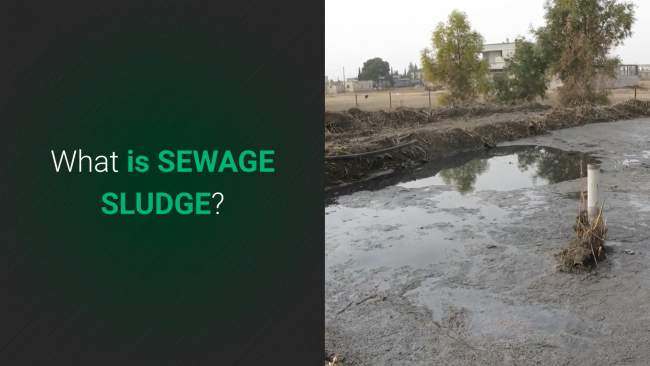
Intro page to the Sewage Sludge video.
...............................................................................................................................................................
Sewage Sludge
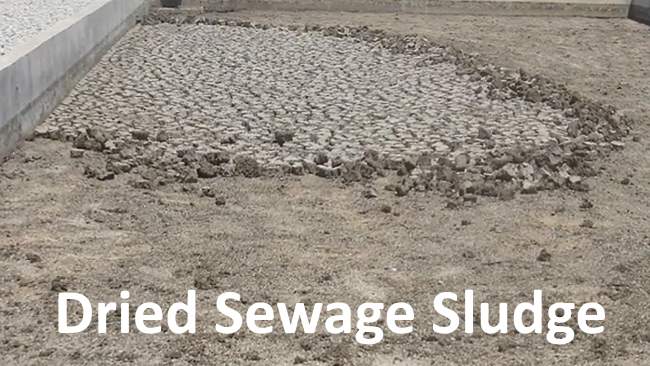
Image shows dried sewage sludge, after drying in the open.What is Sewage Sludge?
Biosolids and Wastewater Treatment Sludge Defined
Anaerobic Digestion Community


If you are asking; “What is Sewage Sludge?” read on and you will find sewage sludge, biosolids and Wastewater Treatment Sludge is defined and explained here.
What does SEWAGE SLUDGE mean?
Sewage sludge is the remaining, semi-solid material that is left over after the cleaned-up water is discharged from a sewage treatment works.
It is the solid material which settles out from municipal or industrial wastewater, when the foul sewage is de-gritted and held in large tanks for between half an hour to one and a half hours.
On arrival at a sewage works (called “WasteWater Treatment Works” by Utility Companies) fresh sewage or wastewater flows first into a grit chamber.
This is a long narrow tank that is designed to slow down the flow so that solids such as sand, and grit, coffee grounds, and eggshells will settle out of the water. It then flows into a “primary settlement tank”.
In the primary settling tank, approximately 50% of the suspended solid matter will settle out in an hour and a half, in which time (on average) the incoming mixture of solid and liquid sewage contaminants stays in the tank.
The water overflows through weirs on the surface and goes on for further cleaning (treatment).
What remains in the “primary settling tank” is a collection of solids known as raw sewage sludge or primary solids.
It is said to be “fresh” at the start, but soon the dissolved air is used up and anaerobic processes (decomposition or rotting without air (oxygen)) become active.
This sludge would start to rot (become putrescent), in a short time once anaerobic bacteria take over, and produce an unpleasant odor.
So, it is removed from the “primary settling tank” (also called a sedimentation tank) before this happens.
Usually, the fresh sewage sludge is continuously extracted from the tank using mechanical scrapers, and is passed on in a number of ways, for further treatment and disposal.
Examples of the ways further treatment is achieved are, Activated Sludge Aeration (Extended Aeration), Imhoff Tanks, Upflow Anaerobic Sludge Blanked (UASB).
Imhoff tanks work in the absence of air (oxygen), and provide a form of anaerobic digestion.
Imhoff tanks are used infrequently now, as the digestion process at the low temperatures of unheated sewage, is quite slow and requires large (and as a result also, “costly to build”) tanks.
UASBs are another method which uses a combination of aerobic and anaerobic treatment zones.
Aeration (Extended Aeration) is what takes place in most sewage works, and aeration itself results in yet more sewage sludge (Return Activated Sludge – RAS) being produced.
So, tell me simply. What is SEWAGE SLUDGE?
Sewage sludge is the general term for all the sludges produced by all the above processes.
Watch the video we made which is based upon the text in this page:

Watch the video we made which is based upon the text in this page:
Are you still reading? Then let’s talk about the history of sewage sludge:
The Recent History of Sewage Sludge
In the 1970s and until recently, fossil fuels were burnt to heat and dry the sludge so that it could be incinerated.
But, with recent improvements in anaerobic digestion technology it has been realized that rather than spend money to incinerate organic sludge, the sludge can be used to make energy in the form of “biogas”.
Biogas production takes place in separate sludge digestion tanks (biogas digesters) that operate at higher temperatures than the lower story of an Imhoff tank and, as a result, digest much more rapidly and efficiently.
In an Imhoff tank, fresh sludge is passed through a slot to the lower story or digestion chamber where it is decomposed by anaerobic bacteria, resulting in liquefaction and reduced volume of the sludge.
After digesting anaerobically for an extended period, the result is called “digested” sludge, or “digestate”.
Historically, sludge was disposed of in rural sewage works by drying and then landfilling.
In the cities and conurbations, the sewage sludge was too great in quantity to dry it in the air (drying beds), so it was tankered out to farms and spread on the land, or put on ships and pumped out into the sea.
Septage is a related term, for the sewage sludge from the simple wastewater treatment that occurs in on-site sanitation systems, such as septic tanks.
Biosolids is a term often used in conjunction with reuse of sewage sludge after sewage sludge treatment.
Biosolids can be defined as organic wastewater solids that can be reused after stabilization processes such as anaerobic digestion and composting.
Opponents of sewage sludge reuse reject this term as a term devised by public relations experts, which is used to disguise the very unappealing source of the material.
Sewage Sludge Treatment by Anaerobic Digestion
Increasingly sewage sludge is being treated using the anaerobic digestion process, with the advantage that the Wastewater Treatment Works operator gains renewable power as electricity, which can then 24/7 power the wastewater treatment works itself.
Press Report (4 December 2018):
At all Wastewater Treatment Works/ Sewage Works it is essential that the operator has reliable equipment, and the most critical requirement is that pumps work reliably when pumping sludges, so we thought we would include the following Press Release
Pulp goes the food waste as ultra-reliable Landia pumps help make AD substrate
Pumps and mixers from Landia are playing a key role in the success of Gemidan Ecogi’s new pre-treatment technology that processes source-separated food waste to into a high-quality pulp-based substrate for AD.
Initially, during a flow test at the KomTek Miljoe waste treatment facility in Jutland, Denmark, an 11kW Landia pump produced much better results than a 22kW model from another manufacturer – despite the challenging raw pulp having a solids content of up to 17%.
With Danish municipalities on a deadline of 2022 to ensure that 50 percent of waste is recycled, AffaldPlus’ Energy Manager, Ole J. Andersen, believes that the decision to challenge the environmental credentials of equipment suppliers is already paying off.
“To truly embrace the circular economy at our waste treatment facility” he said, “we must practice what we preach and look very closely at the lifetime costs of items such as pumps and mixers to make sure, for example that energy and maintenance costs are low. There was never any discussion about buying the cheapest possible plant. Here, we are investing in the future, so it is only right that we choose strong reliable equipment”.
Landia pumps image for article about "What is Sewage sludge".
Energy Manager Ole J. Andersen says that “with Landia’s stainless steel pumps and mixers, we have a very robust and reliable system”.
Gemidan Ecogi’s pre-treatment technology at AffaldPlus’ facility handles waste for six municipalities in South and West Zealand, adding water to collected waste, which is then driven through a centrifuge pulper the waste is dissolved into a viscous, porous mass for use as raw material in an AD/biogas plant. The degassed biomass is dispersed on fields as a fertilizer.
Ole J. Andersen added: “Processing organic household waste with the Gemidan Ecogi process has been a new departure for us, but with Landia’s stainless steel pumps and mixers, we have a very robust and reliable system. Servicing is also easy and safe with everything conveniently located, rather than having to go down into the tank”.
The new plant has met all new requirements for the use of the waste gas pulp on farmland, which recently entered into Danish legislation. In fact, the biopulp from the Gemidan Ecogi plant is up to five times cleaner than the law requires.
Visit the Landia website for more information: www.landiaworld.com
Sewage sludge treatment in the UK has been opened up for the first time to the public market.
Check out the video below to find out about the new opportunity for sewage sludge co-digestion in anaerobic digestion plants by mixing the sludge with other AD feedstocks before feeding it into biogas plants.

Associates, Anaerobic Digestion Community Website offers consultancy services and promotes and develops anaerobic digestion and biogas production.
The production of biogas is now very much a proven technology, and AD Technology is bringing big benefits to the rapidly rising number of people that are investing in it. But, we are still finding that a large number of its potential beneficiaries are not aware of the true potential of the anaerobic digestion process.
Our mission is to spread the word about the benefits of anaerobic digestion and biogas production.
This “Anaerobic Digestion Community Website” is maintained as an independent web site by EurIng Steve Last Bsc CEng MICE MCIWM CEnv.
I have worked as an environmental consultant, for more than 20 years, and for the most of that time I have been providing advice on waste processes, to the Waste Management Industry.
Anaerobic Digestion Consultancy Services
I provide consultancy services on Anaerobic Digestion and Biogas Projects through my consultancy company IPPTS Associates.
We offer consultancy advice on Anaerobic Digestion, including feasibility studies, advice on feedstocks, mass balances, AD Plant infrastructure design, refurbishment of old AD systems etc., and provide free quotations for our services, on request.
Intro page to the Sewage Sludge video.