Showing posts with label Silicon. Show all posts

Friday, September 13, 2019

WHY PHONE CHARGERS HEAT UP - The heating of the charger occurs primarily as a byproduct of the power conversion process. A straightforward way to convert power is to rectify the AC wall power to DC through a diode bridge and a filter and run that into a “linear” regulator. A linear regulator works by using feedback to make a transistor act as a variable resistor. A resistor is a component that turns power into heat. Your phone would get the 5V it needs, but the transistor would have to “consume” the other 105V as heat.

mobile charger
..........................................................................................................................................
Phone Chargers
SmSntWoIcWhy Do Phone Chargers Heat Up?
Venkatesh Vaidyanathan  


If you have a mobile device or a laptop, you obviously need to charge it regularly at frequent intervals.
However, have you ever touched the charger during a charging cycle?
Chances are, if you have, then you undoubtedly noticed that the charger dissipates a lot of heat, which is quite reasonable and nothing to be worried about.
Before we get into the reason as to why the chargers heat up so much, we should provide a technical overview of the inner working of the chargers used for cell phones and laptops.
Switch Mode Power Supply (SMPS)
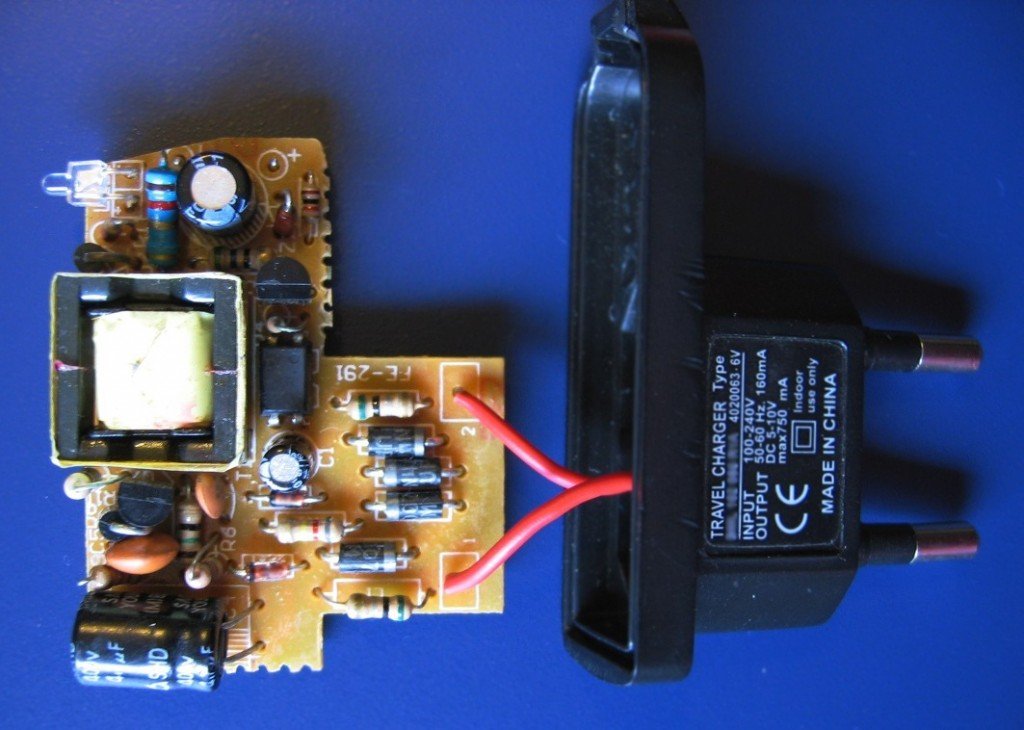
The chargers we use either for a mobile device or laptop are not ordinary wall plugs that provide a connection between the power supply unit and the device.
This device is known as a Switch Mode Power Supply (SMPS), an electronic power supply that incorporates a switching regulator used in converting an electric power supply efficiently.
SMPS are usually used to turn AC or DC power supply into DC loads (e.g., mobile phones and laptops), while changing the voltage and current characteristics.
The way it does this is by continually switching between full on and full off states, hence the name Switch Mode Power Supply.
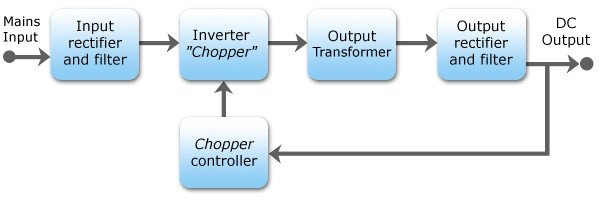
Now, let’s look at the different stages to determine how the SMPS converts AC power into usable DC power for an electronic device.
Input Rectifier and Inverter Stage
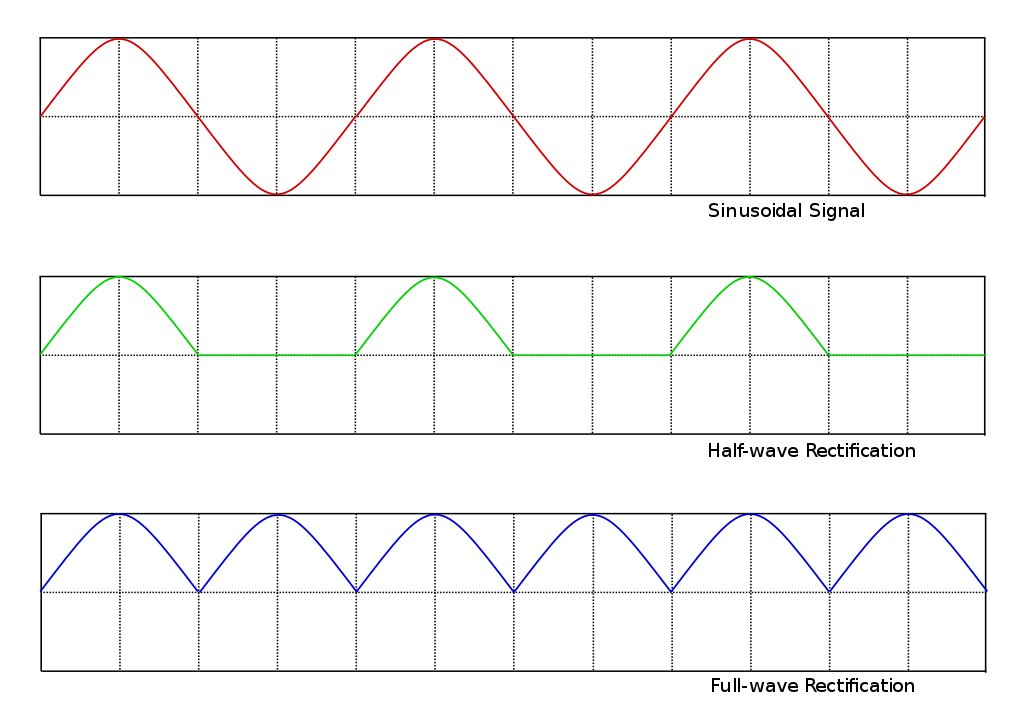
When the SMPS receives an AC input from the wall supply, the primary focus is to convert the input into DC. This process is known as rectitication
The rectifier ends up giving an output that is in the form of unregulated DC voltage. This unrectified DC voltage is then sent to a capacitor.
The current drawn from the main power supply by the rectifier circuit occurs in short pulses around the AC voltage peaks.
An SMPS designed for an AC input can also run from a DC supply, as the DC would pass through the rectifier unchanged.
The inverter stage of the process involves the conversion of DC to AC either directly (if the source is a DC supply) or after the above-mentioned rectifying stage is completed by running it through a power oscillator.
The power oscillator consists of a small output transformer that has very few windings. These windings comprise a frequency of a few tens to hundreds of kilohertz.
The frequency selected by default is primarily over 20 Khz.
The constant switching action is performed by a MOSFET. The metal-oxide-semiconductor-field-effect transistor (MOSFET, MOS-FET, or MOS FET) is a type of field-effect transistor (FET) most commonly fabricated by the controlled oxidation of silicon.
It has an insulated gate, the voltage of which determines the conductivity of the device.
This ability to change conductivity based on the amount of applied voltage can be used for amplifying or switching electronic signals. It is used as a transistor that can handle both low voltages and high currents.
Voltage Converter and Output Rectifier
If the output must be rectified from the input, as is usually the case in main power supplies, the inverted AC is used to drive the primary winding of a high-frequency transformer (present in the power oscillator).
This converts the voltage up or down to the required output level on its secondary winding.
The output transformer in the block diagram serves this purpose. If a DC output is required, the AC output from the transformer (in the power oscillator) must be rectified.
For output voltages above ten volts, ordinary silicon diodes will suffice. For lower voltages, Schottky diodes are used as the rectifier diodes.
Schottky diodes have the characteristic feature of working in low forward voltage and they have a very fast switching action. They also have the unique set of advantages of faster recovery times than silicon diodes and a lower voltage drop when conducting.
For even lower output voltages, MOSFETs may be used as synchronous rectifiers; compared to Schottky diodes, these have even lower conducting state voltage drops.
In the end, the rectified output is then smoothed by a filter that consists of a capacitor and inductors.
The Reason for Heating
The heating of the charger occurs primarily as a byproduct of the power conversion process mentioned above.
A straightforward way to convert power is to rectify the AC wall power to DC through a diode bridge (which always involves some heat loss) and a filter (to smooth the ripples from the AC source), and run that into a “linear” regulator.
A linear regulator works by using feedback to make a transistor act as a variable resistor.
A resistor is a component that turns power into heat. Your phone would get the 5V it needs, but the transistor would have to “consume” the other 105V as heat.
As a result, this is less than 5% efficient, which is totally impractical for phone use.
The next method one could look into is taking the AC power and running that into a transformer, which will output a lower voltage.
That lower voltage can get rectified and sent to the same kind of regulator, which needs to drop only a couple volts.
The transformer is very efficient, while the diodes are a little less so than with the higher voltage, but the big win is going from a 105V drop in the regulator to 2-3V or less.
This may therefore be 60-80% efficient. The primary downside is that transformers can be cumbersome and large if you want them to be productive.
A final way is to use a switching converter. If you put a voltage into a switch and regularly switch that switch on and off with an even period, you’ll find that the average output is half the input.
The only problem is that what you get is a big square wave that goes from full voltage to zero. However, run that through a good filter, and the outcome is half the input voltage as DC.
So, in our case, we rectify the input voltage to DC, pass it through a switch, filter it, and out comes any voltage we want at nearly 100% efficiency, based on the on vs. off time of the switch.
Of course, a real switch would switch too slow, require a large filter circuit, and wear out quickly.
Thus, we use an electronic switch, which is where the SMPS proves to be effective.
Only for a tiny part of the conversion process can a switching supply be 95% efficient or so, but even in this case, there’s some inefficiency, which is why some heat is inevitably produced.

Venkatesh is an Electrical and Electronics Engineer from SRM Institute of Science and Technology, India. He is deeply fascinated by Robotics and Artificial Intelligence. He is also a chess aficionado, He likes studying chess classics from the 1800 and 1900’s. He enjoys writing about science and technology as he finds the intricacies which come with each topic fascinating.
mobile charger
RectificationSMPS_Block_Diagram

Tuesday, May 23, 2017

SOLAR PANELS - How Solar Panels Work - A solar panel can be described as a photovoltaic panel, which is what is used in the professional solar power industry to generate electricity from the rays of the sun. Future solar panels will, hopefully, be much more efficient and supply much of the world’s energy needs.


Solar Panels
How Solar Panels Work       
.


Solar panels are technically any kind of panel that uses solar thermal energy to produce electricity.
There are a variety of panel types, from those used to heat water as with solar hot water panels, to those which are used to store solar energy, such as solar thermal energy panels.
Furthermore, a solar panel can be described as a photovoltaic panel, which is what is used in the professional solar power industry to generate electricity from the rays of the sun.
Despite the type of solar panel being discussed, almost all solar panels are flat. This is due to the fact that the surface needs to be at a 90 degree angle from the sun’s rays for optimal configuration.
Photovoltaic panels, the most common form of solar panels in the professional electrical generation industry, are able to absorb energy from the sun through a variety of smaller solar cells on their surface.
Much like how a plant is able to absorb energy from the sun for photosynthetic purposes, solar cells behave in a similar fashion.
As the photons from the sun’s rays hit the solar cells on a photovoltaic panel, the energy is transferred to a silicon semiconductor.
The photon is then transformed into electricity and then passed through connecting wires to finally enter a power generation facility or battery.
The solar cells on calculators and satellites are photovoltaic (PV) cells or simply a group of cells electrically connected and parceled in one frame.
Photovoltaics, where photo means light and voltaic means electricity, transforms sunlight directly into electricity.
¬Photovoltaic cells are prepared with particular materials called semiconductors such as silicon, which is presently the most generally used.
When light hits the ¬Photovoltaic cell, a specific share of it is absorbed inside the semiconductor material.
This means that the energy of the absorbed light is given to the semiconductor. The energy unfastens the electrons, permitting them to run freely.
¬Photovoltaic cells also have one or more electric fields that act to compel electrons unfastened by light absorption to flow in a specific direction.
This flow of electrons i¬s a current, and by introducing metal links on the top and bottom of the -Photovoltaic cell, the current can be drawn to use it externally.
The Future of Solar Panels
The current generation solar panels are extremely inefficient, and can really only harness as much as thirty percent of a sun ray’s power in the form of usable electricity.
.
The current generation solar panels are extremely inefficient, and can really only harness as much as thirty percent of a sun ray’s power in the form of usable electricity.
.
This problem is partly due to the materials used in the design of the solar panel as well as the size of solar panel itself.
Because of the relatively small range of wavelengths of light that can be harnessed by solar panels, much of the energy which could be gained from the sun’s light is simply left to waste.
Furthermore, if a photon of light hits the solar panel at too high of a speed, the energy will not be properly transferred to the solar panel as usable energy.
Modern materials and new techniques for designing solar panels are on the horizon, but promises of increased efficiency have yet to be delivered.
The newer silicon crystals that are cheaper to manufacture have the downside that they are not as efficient as the original crystal silicon, but larger panels are cheaper to produce giving a similar or better amount electricity for the same investment.

How to Make Solar Panels
Solar panels are rather complicated yet very simple at the same time.This can be shown below.

Silicon
The reason that solar panels are made of silicon is that silicon atoms hold three separate groups of electrons.
One group has two electrons, another has eight electrons, and the third has four electrons. Because the third group only has four electrons, it still has four open spots in which electrons from other atoms can fill.
When this happens, the silicon atom and the other atoms become bonded together to form a crystalline lattice.
Crystalline lattices are important to solar panels because they allow electrons to break away from the structure later on in the process.
Doping

Doping refers to purposely adding impurities to an element, such as silicon.
Doping is a part of the solar panel process because pure silicon is not a very good conductor of electricity. This is because pure silicon forms such a tightly-bound structure that its electrons are no longer able to move freely.
By doping the silicon with an impurity such as phosphorous, which has five electrons in its shell instead of four, there are a lot more free carriers.
Free Carriers
A free carrier is an electron that has been knocked loose from its atom and is able to move to a different atom, carrying its electric charge with it.
Free carriers are caused by overloads from electric forces, such as heat from light energy.
In silicon-phosphorous compounds, the phosphorous atoms provide free carriers as each phosphorous atom has one additional electron that is not connected to the silicon atoms.
Because there is an excess of electrons in a silicon-phosphorous compound, the silicon atom has a negative charge.
As the other side of a solar panel is doped with boron, an element that’s shell only has three electrons (a lack of electrons when compared to silicon), it has a positive charge.
The negative charge then flows to the positive charge, creating an electric current.
Efficiency
The average solar panel used in industrial purposes has an efficiency rate of about 12%.
The most ground-breaking research in the world has invented a solar panel that has a 40% efficiency rate.
While this is good, it is still not as good as scientists would like. That is because 1,000 watts of electricity from the Sun is constantly shining on every square meter on the Earth’s surface.
If scientists could get 100% of that electricity, or close to it, people worldwide would be able to power their homes for free and live much more energy-efficient lifestyles without burning any fossil fuels.
Future Solar Panels
Future solar panels will, hopefully, be much more efficient and supply much of the world’s energy needs.
Future solar panels may cover all roofs, building tops, walls, and cars.
There may also be large “solar farms” where solar energy is collected, such as the vast numbers of solar panels located at Nellis Air Force Base in Nevada.
It is unclear how exactly society will incorporate solar panels into their daily lives but it is clear that solar panels are getting better all the time and they will continue to do so for a long time.

RELATED POSTS:
.
Hydrogen Fuel Cells
Advantages and Disadvantages of Hydrogen Fuel Cells 
CLICK HERE . . .
Graphene and Water 
Treatment  
CLICK HERE . . .
..
Out Of Thin Air: Israeli 
Scientists Harvest Drinking 
Water From Air  
CLICK HERE . . .
.
Multi-Media Filter, Highly-Activated Carbon Filter,
Zeolite-Process Water Softener With Brine Tank,
Fiberglass Ballast-Type Pressure Tank
(fully automatic backwash & regeneration)
PURICARE 
INDUSTRIAL 
ENTERPRISES 
Water 
Treatment 
Systems
.
.
...
Aganan, Pavia, Iloilo, Philippines
...

CLICK HERE . . . to view company profile . . .


.
Ballast-Type
Pressure Tanks
.
.

Houston Water Pump with
Mazaki Automatic Pump Controller
Ultra-Violet Bactericidal Lamps