Monday, July 25, 2016

IRON AND MANGANESE IN GROUNDWATER - Concentrations of iron and manganese in groundwater are often higher than those measured in surface waters. At concentrations found in most natural waters, and at concentrations below the aesthetic objective, iron and manganese are not considered a health risk.


Iron & 
Manganese in
Groundwater

What are iron and manganese?
Iron and manganese are metallic elements present in many types of rocks.
Iron has the symbol “Fe” and manganese has the given symbol “Mn.”
Both are commonly found in water and are essential elements required in small amounts by all living organisms.
Concentrations of iron and manganese in groundwater are often higher than those measured in surface waters.
The Aesthetic Objective (AO) for iron in drinking water is less than or equal to 0.3 milligrams per litre (mg/L) while the Aesthetic Objective for manganese in drinking water is less than or equal to 0.05 mg/L.
The taste and smell of manganese or iron at concentrations above the drinking water guidelines may be noted by some water users.
What are the known sources of iron and manganese?
The most common sources of iron and manganese in groundwater are naturally occurring, for example from weathering of iron and manganese bearing minerals and rocks.
Industrial effluent, acid-mine drainage, sewage and landfill leachate may also contribute iron and manganese to local groundwater.
What are the environmental health concerns?
At concentrations found in most natural waters, and at concentrations below the aesthetic objective, iron and manganese are not considered a health risk.
Water with a high concentration of iron or manganese may cause the staining of plumbing fixtures or laundry.
Manganese solids may form deposits within pipes and break off as black particles that give water an unpleasant appearance and taste.
Similarly, iron can collect and block pipes or fixtures and produce color, taste and rust flakes in water.
Both substances can increase the growth of unwanted bacteria that form a slimy coating in water pipes.
“Should I Get My Well Water Tested?”
Iron and manganese are found naturally in groundwater in all regions.
In local areas, concentrations of iron and manganese can range up to several mg/L.
The concentration of iron and manganese in well water can fluctuate seasonally and vary with the depth and location of the well and the geology of an area.
Iron and manganese naturally occur in groundwater that has little or no oxygen, typically in deeper wells (but not always), in areas where groundwater flow is slow, and in areas where groundwater flows through soils rich in organic matter.
Concentrations that exceed the drinking water guideline can occur locally anywhere.
What well owners and water suppliers do about high levels of iron and manganese within well water.
Pitcher-type carbon filtration units can remove some forms of iron and manganese.
Boiling water is not recommended for removing iron and manganese as it will likely increase their concentration.
Iron and manganese are often removed at the same time, by water treatment with chlorine, ozone or by adding chemicals that cause the metals to form a solid that will settle or be filtered out.
Water treatment methods such as ion exchange, oxidizing filters, and reverse osmosis can also be used but these have variable effectiveness and may be expensive for small water systems or households.
Devices can be certified for treating a range of water quality concerns, so make sure that the device you purchase is explicitly certified for iron and manganese removal.
.
https://www.for.gov.bc.ca/hfd/library/documents/bib106076_iron_manganese.pdf
RELATED POSTS:
.
What affects the quality of surface and groundwater? 
CLICK HERE . . .
.
Pesticides in 
Groundwater


CLICK HERE . . .
.
Lead
Actions You Can Take To Reduce Lead In Drinking Water
CLICK HERE . . .
http://puricare.blogspot.com/2016/07/lead-in-drinking-water-too-much-lead-in.html
..
Multi-Media Filter, Highly-Activated Carbon Filter,
Zeolite-Process Water Softener With Brine Tank,
Fiberglass Ballast-Type Pressure Tank
(fully automatic backwash & regeneration)
.
PURICARE 
INDUSTRIAL 
ENTERPRISES 
Water 
Treatment 
Systems
.
...
Aganan, Pavia, Iloilo, Philippines
...

CLICK HERE . . . to view company profile . . .
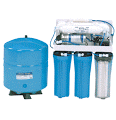
Reverse Osmosis with Steel Tank 
& Cartridge Pre-Filters

Submersible Pumps

Tachmina Solenoid-Driven
Chemical Metering Pump
- ensures regulated dosing
of chlorine into water system
without human intervention


.

.


.
.


Heart disease is the number one killer in America. One in five American's have too high a cholesterol level. Drinking plenty of water will keep your blood ways clean and eliminate excess buildup of cholesterol waste from the body.

High Blood Pressure And Cholesterol
.
The number one killer in America is heart disease.
.
And, two huge health risks that can lead to serious heart conditions are high blood pressure and high cholesterol. But, these can be prevented.
Let's start with high cholesterol.
The American Heart Association says that one in five American's have too high a cholesterol level. But first, just what is cholesterol? 
Cholesterol is a waxy, fat-like substance called a lipid that is found inside cells and blood. It is produced naturally in the liver, but some of the "bad" cholesterol comes from the food we eat, mainly in animal fats.
While too much cholesterol can be harmful, a certain amount is necessary for bodily functions, such as making cell walls and acting as a building block to produce various hormones, bile acids, and Vitamin D.
Having too much cholesterol can block blood flow, resulting in a thickening and hardening of artery walls, a disorder called arteriosclerosis. Since this also narrows the arteries, blood flow can be slowed down, or even blocked.
With less blood, the heart therefore gets less oxygen. That can result in chest pain, heart attack, or something as drastic as death. Lowering your blood cholesterol level is one of the best ways you can decrease your risk of heart disease.
And, even if your cholesterol is close to the desirable range, 200 milligrams per deciliter of blood, you can lower it and reduce your risk of heart disease.
With all this thickening going on, water can play a very important role.
Drinking water can actually thin the blood, making in a natural way to help the blood pump more smoothly. When the body is dehydrated, the blood becomes acidic which can lead to a build-up in LDL levels of cholesterol.
Drinking plenty of water will keep your blood ways clean and eliminate excess buildup of cholesterol waste from the body.
Drinking plenty of water will keep your blood ways clean!
Since exercise, along with a healthy diet, is an important contribution to the lowering of cholesterol, once again, water needs to be drank in order to replenish what was lost. In fact, consumption of water so you are fully hydrated can increase your metabolic rate!
Let's move on to high blood pressure, also known as hypertension.
Blood pressure refers to the force of blood pushing against artery walls as it makes it way through the body. Just like air in a tire, blood fills arteries to a certain capacity, and anything over that capacity can have damaging effects. (Ever have too much pressure in your tires?)
Just like high cholesterol, high blood pressure can threaten healthy arteries and lead to life-threatening conditions such as heart disease and stroke. And what's scary is that there are not any real symptoms until, which is why high blood pressure is known as the silent killer.
Hypertension can be combated in many ways, such as quitting smoking, drinking alcohol or overweight. Water can also help lower this pressure, as blood is mainly comprised of water.
Excessive salt consumption can adversely affect blood pressure, but luckily sodium can be flushed out of the body by drinking clean purified water daily.
Houston Water Pump with
Mazaki Automatic Pump Controller
So, drinking a healthy amount of water each day can maintain a healthy heart but what happens if we don’t drink enough water?
Dehydration will definitely affect your blood pressure adversely. Our kidneys clean our blood. When we are dehydrated and have high blood pressure, the blood flow to our kidneys is reduced which makes our bodies think they are low on water. They will thus react by telling the brain to constrict veins and arteries, which will make the blood pressure even higher.
The quality of the drinking water can also have an effect on our cholesterol levels.
Animal studies have shown that chlorine in drinking water can raise levels of plasma cholesterol. This is something we must be aware of because most tap water is chlorinated.
Therefore, it is a good idea to install a quality water filtration system that can remove chlorine and other harmful chemicals from your drinking water.
Multi-Media Filter, Highly-Activated Carbon Filter,
Zeolite-Process Water Softener with Brine Tank
(automatic backwash & regeneration) 
Heart disease is a serious issue in America today, with two of the top causes being high cholesterol and high blood pressure. Drinking plenty of clean water can help combat both of these.
Remember it is also never too late to improve your heart health with the help of regular exercise, balanced nutrition and a positive outlook on life.
The human body is very resilient and if you treat yourself well, you will be surprised by your body’s own natural ability to heal itself and lower bad cholesterol.
Here’s drinking to your health and achieving your goals. We know you can do it!

RELATED POSTS:

Body PH Can Affect Your Energy, Digestion, & Health
Water And Gout 


.
.
.
.
.
.
.
Water And Gallstones 
http://puricare.blogspot.com/2016/05/gallstones-cholesterol-stones-are-most.html..
.
.
.
.
.
.


.
PURICARE 
INDUSTRIAL 
ENTERPRISES 
Water 
Treatment 
Systems


Ultraviolet Bactericidal System
with Cartridge Pre-Filters


source:  freedrinkingwater.com


Sunday, July 24, 2016

PESTICIDES IN GROUNDWATER - Pesticide contamination of groundwater is a subject of national importance. There's a hidden cost to the benefit we get from pesticides. We've learned that pesticides can potentially harm the environment and our own health.


Pesticides 
in 
Groundwater

Care to guess how many pounds of pesticides the United States used in 1964? How about in 1993?
If you ask your grandparents what life was like when they were kids, the answer will probably be that things were simpler, slower, less automated, and that people did not move around the country so often.
But since your grandparents' time two major things have happened:
(1) the population of the United States has increased greatly, and
(2) technology and scientific innovations have come to play a major role in our lives.
Pesticide use has grown because not only must our exploding population be supplied with food, but crops and food are grown for export to other countries.
The United States has become the largest producer of food products in the world, partly owing to our use of modern chemicals (pesticides) to control the insects, weeds, and other organisms that attack food crops.
But, as with many things in life, there's a hidden cost to the benefit we get from pesticides. We have learned that pesticides can potentially harm the environment and our own health.
Water plays an important role here because it is one of the main ways that pesticides are transported from the areas where they are applied to other locations, where they may cause health problems.

Pesticides can contaminate groundwater

Pesticide contamination of groundwater is a subject of national importance because groundwater is used for drinking water by about 50 percent of the Nation's population.
This especially concerns people living in the agricultural areas where pesticides are most often used, as about 95 percent of that population relies upon groundwater for drinking water.
Before the mid-1970s, it was thought that soil acted as a protective filter that stopped pesticides from reaching groundwater. Studies have now shown that this is not the case.
Pesticides can reach water-bearing aquifers below ground from applications onto crop fields, seepage of contaminated surface water, accidental spills and leaks, improper disposal, and even through injection waste material into wells.

Chemicals can take a long time to appear in groundwater

The effects of past and present land-use practices may take decades to become apparent in groundwater.
When weighing management decisions for protection of groundwater quality, it is important to consider the time lag between application of pesticides and fertilizers to the land and arrival of the chemicals at a well.
This time lag generally decreases with increasing aquifer permeability and with decreasing depth to water.
In response to reductions in chemical applications to the land, the quality of shallow groundwater will improve before the quality of deep groundwater, which could take decades.
Pesticides are mostly modern chemicals. There are many hundreds of these compounds, and extensive tests and studies of their effect on humans have not been completed. That leads us to ask just how concerned we should be about their presence in our drinking water.
Certainly it would be wise to treat pesticides as potentially dangerous and, thus, to handle them with care.
We can say they pose a potential danger if they are consumed in large quantities, but, as any experienced scientist knows, you cannot draw factual conclusions unless scientific tests have been done.
Some pesticides have had a designated Maximum Contaminant Limit (MCL) in drinking water set by the U.S. Environmental Protection Agency (EPA), but many have not.
Also, the effect of combining more than one pesticide in drinking water might be different than the effects of each individual pesticide alone.
It is another situation where we don't have sufficient scientific data to draw reliable conclusions.
RELATED POSTS:
What affects the quality of surface and groundwater?    
.

CLICK HERE . . .
.
.
.
Lead
Actions You Can Take To Reduce Lead In Drinking Water 
.
.

CLICK HERE . . .
.
.
Carcinogenic Chemicals In The Water Supply: Is Your Tap Water Safe? 
.
CLICK HERE . . .
.
.


PURICARE 
INDUSTRIAL 
ENTERPRISES 


GS Series Submersible Pump

https://water.usgs.gov/edu/pesticidesgw.html