Sunday, April 29, 2018

AIRPLANES - The Dynamics of Airplane Flight - Airplane wings are curved on the top which makes air move faster over the top of the wing. The air moves faster over the top of a wing. It moves slower underneath the wing. The slow air pushes up from below while the faster air pushes down from the top. This forces the wing to lift up into the air.


 .
How Airplanes Fly
The Dynamics of Airplane Flight
How Planes Fly and How Pilots Control Them

How does an airplane fly?
How do pilots control the flight of an airplane?
Here are the principles and elements of the aircraft that are involved in flying and controlling flight.

Using Air to Create Flight

Air is a physical substance which has weight. It has molecules which are constantly moving.
Air pressure is created by the molecules moving around. Moving air has a force that will lift kites and balloons up and down.
Air is a mixture of different gasses; oxygen, carbon dioxide and nitrogen. All things that fly need air.
Air has the power to push and pull on the birds, balloons, kites and planes.
In 1640, Evangelista Torricelli discovered that air has weight.
When experimenting with measuring mercury, he discovered that air put pressure on the mercury.
Francesco Lana used this discovery to begin to plan for an airship in the late 1600s.
He drew an airship on paper that used the idea that air has weight.
The ship was a hollow sphere which would have the air taken out of it. Once the air was removed, the sphere would have less weight and would be able to float up into the air.
Each of four spheres would be attached to a boat-like structure, and then the whole machine would float. The actual design was never tried.
Hot air expands and spreads out, and it becomes lighter than cool air.
When a balloon is full of hot air it rises because the hot air expands inside the balloon.
When the hot air cools and is let out of the balloon, the balloon comes back down.

How Wings Lift the Plane

Airplane wings are curved on the top which makes air move faster over the top of the wing.
The air moves faster over the top of a wing. It moves slower underneath the wing.
The slow air pushes up from below while the faster air pushes down from the top. This forces the wing to lift up into the air.

Newton's Three Laws of Motion

Sir Isaac Newton proposed three laws of motion in 1665. These laws help to explain how a plane flies.
1.    If an object is not moving, it will not start moving by itself. If an object is moving, it will not stop or change direction unless something pushes it.
2.    Objects will move farther and faster when they are pushed harder.
3.    When an object is pushed in one direction, there is always a resistance of the same size in the opposite direction.

Four Forces of Flight

The four forces of flight are:
·             Lift - upward
·             Drag - down and backward
·             Weight - downward
·             Thrust - forward 

Controlling the Flight of a Plane

How does a plane fly?
Let's pretend that our arms are wings. If we place one wing down and one wing up we can use the roll to change the direction of the plane.
We are helping to turn the plane by yawing toward one side.
If we raise our nose, like a pilot can raise the nose of the plane, we are raising the pitch of the plane.
All these dimensions together combine to control the flight of the plane.
A pilot of a plane has special controls that can be used to fly the plane.
There are levers and buttons that the pilot can push to change the yaw, pitch and roll of the plane.
·             To roll the plane to the right or left, the ailerons are raised on one wing and lowered on the other. The wing with the lowered aileron rises while the wing with the raised aileron drops.
·             Pitch is to make a plane descend or climb. The pilot adjusts the elevators on the tail to make a plane descend or climb. Lowering the elevators caused the airplane's nose to drop, sending the plane into a down. Raising the elevators causes the airplane to climb.
·             Yaw is the turning of a plane. When the rudder is turned to one side, the airplane moves left or right. The airplane's nose is pointed in the same direction as the direction of the rudder. The rudder and the ailerons are used together to make a turn

How Does a Pilot Control the Plane?

The pilot uses several instruments to control the plane. 
The pilot controls the engine power using the throttle
.
Pushing the throttle increases power, and pulling it decreases power.

Ailerons - The ailerons raise and lower the wings. The pilot controls the roll of the plane by raising one aileron or the other with a control wheel. Turning the control wheel clockwise raises the right aileron and lowers the left aileron, which rolls the aircraft to the right.

Rudder - The rudder works to control the yaw of the plane. The pilot moves rudder left and right, with left and right pedals.

Pressing the right rudder pedal moves the rudder to the right. This yaws the aircraft to the right. Used together, the rudder and the ailerons are used to turn the plane.

The pilot of the plane pushes the top of the rudder pedals to use the brakes. The brakes are used when the plane is on the ground to slow down the plane and get ready for stopping it. The top of the left rudder controls the left brake and the top of the right pedal controls the right brake.

Elevators - The elevators which are on the tail section are used to control the pitch of the plane. A pilot uses a control wheel to raise and lower the elevators, by moving it forward to backward.

Lowering the elevators makes the plane nose go down and allows the plane to go down. By raising the elevators the pilot can make the plane go up.

If you look at these motions you can see that each type of motion helps control the direction and level of the plane when it is flying.

Sound Barrier

Sound is made up of molecules of air that move. They push together and gather together to form sound waves. 
Sound waves travel at the speed of about 750 mph at sea level.
When a plane travels the speed of sound the air waves gather together and compress the air in front of the plane to keep it from moving forward.
This compression causes a shock wave to form in front of the plane.
In order to travel faster than the speed of sound the plane needs to be able to break through the shock wave.
When the airplane moves through the waves, it makes the sound waves spread out and this creates a loud noise or sonic boom.
The sonic boom is caused by a sudden change in the air pressure. When the plane travels faster than sound it is traveling at supersonic speed.
A plane traveling at the speed of sound is traveling at Mach 1 or about 760 MPH. Mach 2 is twice the speed of sound.

Regimes of Flight

Sometimes called speeds of flight, each regime is a different level of flight speed.
General Aviation (100-350 MPH). General aviation is the lowest speed. Most of the early planes were only able to fly at this speed level.
Early engines were not as powerful as they are today. However, this regime is still used today by smaller planes.
Examples of this regime are the small crop dusters used by farmers for their fields, two and four-seater passenger planes, and seaplanes that can land on water.
Subsonic (350-750 MPH). This category contains most of the commercial jets that are used today to move passengers and cargo.
The speed is just below the speed of sound. Engines today are lighter and more powerful and can travel quickly with large loads of people or goods.
Supersonic (760-3500 MPH - Mach 1 - Mach 5). The speed of sound is 760 MPH. It is also called MACH 1.
These planes can fly up to 5 times the speed of sound.
Planes in this regime have specially designed high-performance engines. They are also designed with lightweight materials to provide less drag.
The Concorde is an example of this regime of flight.
Hypersonic (3500-7000 MPH - Mach 5 to Mach 10). Rockets travel at speeds 5 to 10 times the speed of sound as they go into orbit.
An example of a hypersonic vehicle is the X-15, which is rocket powered. The space shuttle is also an example of this regime.
New materials and very powerful engines were developed to handle this rate of speed. 

Mary Bellis has been writing about inventors since 1997. She also loves to tinker (invent) and spends too much time in her workshop developing her ideas.
Experience
Forbes Best of the Web credits Mary for creating the number one online destination for information about inventors and inventions. Her writing has been reprinted and referenced to in numerous educational books and articles. Her opinion and advice is requested by media outlets on a constant basis. In addition, she has produced and directed a number of films, including a documentary on Alexander Graham Bell, the inventor of the telephone, and has worked as a curator specializing in computer generated art.
Education
Mary has two degrees in film and animation from the San Francisco Art Institute. She is a big fan of both history and technology and an avid reader of books and periodicals on those topics.
Mary Bellis
I have a passion for inventing and a deep respect for all inventors. I know firsthand the difficulties that inventors face and I want to help by making the path from idea to marketplace a clearer process.
https://www.thoughtco.com/dynamics-of-airplane-flight-4075424


You might also like:

speedThrilling Speed

Why Do We Feel So Thrilled By Speed?

.
.
.
Multi-Media Filter, Highly-Activated Carbon Filter,
Zeolite-Process Water Softener With Brine Tank,
Fiberglass Ballast-Type Pressure Tank
(fully automatic backwash & regeneration)
.
PURICARE 
INDUSTRIAL 
ENTERPRISES 
Water 
Treatment 
Systems
.
...

Aganan, Pavia, Iloilo, Philippines
...

CLICK HERE . . . to view company profile . . .
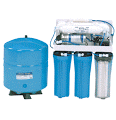
Reverse Osmosis with Steel Tank 
& Cartridge Pre-Filters

Submersible Pumps

Tachmina Solenoid-Driven
Chemical Metering Pump
- ensures regulated dosing
of chlorine into water system
without human intervention


Saturday, April 28, 2018

JUNGLE SURVIVAL - How to Survive in the Jungle - A wild tiger is just one example of what could kill you in a jungle survival scenario. You could also die from a mosquito bite carrying malaria, bacteria in collected water or a poisonous plant you ate for dinner. The good news about the jungle is that water and food are plentiful -- you just need to know what to look for and where. The bad news is the jungle's thick overhead canopy makes it nearly impossible for anyone to spot you, so you'll probably need to hike to your rescue.

. 
Jungle Survival

How to Survive in the Jungle

In the 1979 Francis Ford Coppola film "Apocalypse Now," a young Martin Sheen learns a valuable lesson as Capt. Ben Willard: "Never get out of the boat."
The dense canopy of the jungle
doesn't let much light reach into the forest floor.
 
In that movie, Capt. Willard and Chef, a fellow soldier, disembark from their PT boat and venture into the jungles of Vietnam in search of mangoes.
What they're greeted with instead is a wild tiger with designs to eat them.
Luckily, Willard and Chef make it back to the boat safe, and Willard is able to complete his mission. Just ask Col. Kurtz.
A wild tiger is just one example of what could kill you in a jungle survival scenario.
You could also die from a mosquito bite carrying malaria, bacteria in collected water or a poisonous plant you ate for dinner.
The good news about the jungle is that water and food are plentiful -- you just need to know what to look for and where.
The bad news is the jungle's thick overhead canopy makes it nearly impossible for anyone to spot you, so you'll probably need to hike to your rescue.
Weather in a jungle environment is harsh. One thing you'll get plenty of is rain. Lots and lots of rain.
The dry season in a jungle means it rains once a day. Monsoon season means a nearly constant rain.
The temperatures are generally very high, along with the humidity.
Low altitude jungles average about 95 degrees Fahrenheit (35 degrees Celsius) with nearly 100 percent humidity.
The rain will cool things down, but it's brief. After a storm rolls in, it gets even hotter and steamier.
It'll also get dark much quicker in the jungle because of the thick canopy. Your days won't be shorter, but they'll seem like they are.
Jungles, or rainforests, are lush, green areas teeming with life of all shapes and sizes.
They only cover about 2 percent of the Earth’s 's surface, but they account for 50 percent of all plants and animals.
If that doesn't describe how flourishing they are, consider this: A 4-square-mile (10-square-km) area of a rainforest can contain as many as 1,500 flowering plants, 750 species of trees, 400 species of birds and 150 species of butterflies [source: The Nature Conservancy].
All that life makes it both easier and more difficult to survive in the jungle.
On the next page, you'll find out what dangers lurk under the dense, green canopy.
Welcome to the jungle.
Dangers of the Jungle: Jungle Animals and Plants
If you focus on any one spot in a jungle, chances are you'll see something crawling, slithering, slinking, flying or walking.
The mosquito may be a nuisance in the suburbs, but it can kill you in the jungle.
Jungles are vibrant and alive, which helps when you're foraging for food. But that life can also be deadly.
Here are just a few things in the jungle that can make you ill or kill you.
Poisonous plants: Plant life can be a valuable source of food energy and nutrition in any survival scenario. This is especially true in the jungle.
But eating the wrong kind of vegetation can make you sick or even lead to your demise.
The list of inedible plants is long, so if you're the adventurous type you should own a manual that lists edible and inedible plants in the areas you'll be exploring.
Most poisonous plants will only get you sick if you ingest them, but some, like poison  and sumac, are poisonous to the touch.
Animals: In the jungle, you can take your pick from thousands of creatures that could harm or kill you. If you're into mammals, everything from wild boars to jaguars and cougars can pose a threat.
If insects are your thing, you've got scorpions, brown recluse spiders and fire ants to consider.
And, if there's one thing the jungle has plenty of, it's snakes . Coral snakes, pit vipers, cobras and the dreaded anaconda, a massive constrictor snake, are just a few of the deadly serpents you can come across.
How about a nice dip in the river? Just watch out for the carnivorous piranhas.
See that cute yellow tree frog? Would you like to pick it up and get a closer look? Don't do it -- it's the golden poison dart frog and has enough toxins (1 mg) in it to kill 10 to 20 humans [source: Planet Science].
Water-related illness: Jungles are wet places, and sometimes being wet can be dangerous.
If your feet stay wet for a prolonged period, you can develop trench foot, or immersion foot. This happens when your feet are constantly waterlogged, and infection sets in.
If left untreated, this infection can lead to gangrene and eventually amputation. So keep your feet as dry as possible.
You can also get sick from drinking the water in a jungle. Creeks and streams contain parasites that can make you extremely ill.
All over the world, 6,000 children die each year from water-born illnesses, and many of these children live in jungles and rainforests [source: United Nations].
Mosquito-related illness: Mosquitoes in the jungle can infect you with malaria, West Nile virus, Dengue fever or yellow fever. 
Malaria is the worst of the bunch, killing more than 1 million people per year [source: CDC].
The most common strain of this parasitic infection, Plasmodium Falciparum, is also the most deadly. 
Dengue fever is a potentially deadly viral disease with more than 50 million cases reported each year. It's characterized by a high fever, rash and muscle pain. 
Yellow fever is another viral disease, but only found in Africa and South America. It's nearly 10 times as deadly to visitors as it is indigenous people.
You'll experience fever, nausea, and stomach and muscle pain with yellow fever.
West Nile virus (WNV) can spread from mosquitoes to many kinds of mammals, but is mostly found in birds. WNV isn't limited to the jungle though -- in 2003, the disease killed more than 250 people in the United States.
On the next page, we'll find out how you can find fresh drinking water in the jungle.
Jungle Survival: Finding Water
Because jungles are so wet, collecting rainwater is probably the easiest part of survival.
You can fashion a water filter if you have a plastic bag. 
Leaves on the rainforest floor are large because of the limited amount of sunlight they get.
The larger the leaf, the more of the sun’s rays it can soak up. Large leaves are useful in collecting dew and rainwater.
If you have a container to store water, simply angle a leaf into it overnight or during a rainstorm and you have some fresh drinking water in no time.
If you have a poncho, tie it to a tree on a slant to allow the rain to collect and drain.
If it tastes a little funny, it's because rainwater lacks certain minerals found in groundwater or streams.
You'll fare even better if you can find a running water source. Animals need water, so look for wildlife or animal tracks to lead you to a stream.
If you find a stream, don't just start drinking; it could contain parasites that can make you seriously ill.
You should purify the water by boiling it over a fire -- 10 minutes is a good rule of thumb. Boiling water means you need fire and a container of some kind.
If you don't have a container, you can probably find an aluminum or tin can in most any natural environment.
Believe it or not, plastic bottles also work for boiling. One method is to completely fill the bottle with water, cap it and drop it into some hot coals.
The lack of air in the bottle should keep it from melting. If you don't have enough water to fill the bottle, suspend it above the fire with rope or vine so the flames just touch the bottom.
The risk of boiling in a plastic bottle is that your collection device could melt.
Green bamboo has clear and odorless water inside it that you can drink. To access it, bend the top of a tree down about a foot off the ground and tie it off.
Cut a few inches off the tip, put a container underneath and leave it overnight. The next day, you should have some drinkable water.
A solar still can help you collect drinking water.
Another way to collect water is to make a solar still. To do this, you'll need some plastic sheeting or a poncho, a digging tool, a container and a rock.
·        Choose a moist area that gets sunlight for most of the day.
·        Dig a bowl-shaped hole about 3 feet across (91 centimeters) and 2 feet deep (60 centimeters), with an additional sump, or deeper pit, in the center.
·        Place the container into the sump.
·        Place the plastic over the hole and cover the sides with rock and soil to keep it secure.
·        Put your rock in the center of the sheet and let it hang down about 18 inches (45 centimeters), directly over the container, to form an inverted cone.
The moisture from the ground reacts with the heat from the sun to produce condensation on the plastic.
The sag in the plastic forces the condensation to run down and into your container. A successful still can produce up to 1 quart of drinking water per day.
These are just a few methods you can use. But first, skip ahead to the next page and learn about what edible plants and animals you can find in the jungle.
Survive the Jungle: Finding Food
Besides water, the other thing you'll need to survive in the jungle is food. Your dining choices largely revolve around edible plants, fruit, insects and fish.
Insects are eaten all over the world
by children of all ages.
Unless you have a guidebook on edible plant varieties, you'll need to figure it out on your own.
It can be deadly to eat a plant you're unsure of, so it's better to try and find food elsewhere than to risk eating a toxic plant.
You can follow these general rules when foraging for plants:
·        Avoid plants with white or yellow berries.
·        Don't eat mushrooms. Some are safe, but many are highly toxic and even deadly, so it's not worth the risk.
·        Avoid plants with thorns.
·        If it tastes bitter or soapy, spit it out.
·        Steer clear of shiny leaves.
·        Stay away from plants with leaves in groups of three.
·        Stay away from plants with umbrella-shaped flowers.
·        Avoid beans or plants with seeds inside a pod.
·        Milky or discolored sap is a warning sign.
·        Avoid anything with an almond smell.
You can also use the universal edibility test to check whether a plant is edible.
It involves steps like rubbing the plant on your skin and lips and holding it in your mouth to see if there's an adverse reaction.
Fruit can be found throughout the jungle. Depending on where you are, you can find everything from mangoes and bananas to wild yams and sugarcane.
Coconuts are a good food source in tropical jungles, as is sugarcane, figs, papaya and taro root.
Familiarize yourself with local edible fruits before you travel to any jungle or rainforest.
Insects are another good source of protein. More than 1,400 varieties are eaten regularly everywhere on Earth aside from the United States, Canada and Western Europe [source: IRIN News].
The practice is called  entomophagy, and it's been around for centuries.
Unfortunately, there isn't a dead giveaway to tell if a bug is edible unless you know what you're doing.
But there are some general guidelines you can use to help you decide:
·        Steer clear of brightly colored insects.
·        Avoid insects that are extremely pungent.
·        Don't eat hairy critters or bugs that bite or sting.
Worms, grubs and termites are everywhere in the jungle and are all a great protein source.
If you had fresh water, you could survive for months on insects alone. Beetles can also make for a hearty meal, but some carry parasites.
A good way to make sure you're safe is to cook it. A good boiling or slow roast will usually negate the effect of harmful toxins.
So you don't fancy plants and insects? You're more of a meat-and-potatoes man? OK then, Rambo, grab that spear and we'll go fishing on the next page.
Survival Fishing in the Jungle
Plants, fruits and insects are a valuable survival commodity, but if you really want a good source of protein you're going to have to test your mettle as a fisherman.
With a little practice, you can catch fish using a spear,
just like your favorite jungle tribesman.
Hunting for meat is possible, but it's very difficult and can be dangerous. There aren't many mammals in the jungle you'd want to eat anyway.
In fact, more protein can be found in the desert than on the floor of a rainforest [source: The Nature Conservancy].
Hunting techniques like stalking and spearing, using a sling or a homemade blow gun are passed down for generations in native tribes and are very difficult to master.
They'd likely just lead to wasted energy and no food. Then there's the fact that you can't keep meat fresh for very long.
All in all, unless you're an experienced survivalist, your energy is better spent fishing than hunting.
The Amazon River is home to more than twice the number of fish species than the Atlantic Ocean. One of these is the Piranha.
They're edible, but don't really have much meat on them, so try to focus on other fish.
Despite their reputation, piranhas don't typically bother humans, but avoid getting into the water if you have an open wound -- they're attracted to the scent of blood.
There's also a species of catfish called the pirarucu. It's the largest freshwater fish in the world, and just one of these giants can yield as much as 150 pounds (70 kg) of meat.
Unless you have a survival kit with some fishing gear, spear fishing is probably your best bet. Bamboo is plentiful in the jungle and makes a great spear.
After you find a 6- to 8-foot (1.8- to 2.4-meter) piece of bamboo,
·        make two intersecting crosscuts at one end about 6 inches (15 cm) deep, creating four prongs.
·        separate the prongs by wedging vine into the crevices.
·        sharpen the prongs with a knife or sharp rock.
Just like that, you have a four-pronged fishing spear. Now comes the tricky part -- spearing the fish.
Once you're at the river or stream, find a rock to stand on or wade into knee-deep water. Move slowly and deliberately to avoid scaring away the fish.
Hold the spear with both hands, with the sharp end a couple of feet from the surface. This allows you to strike fast when you see your prey.
Once you spot a fish, stand still and wait for it to swim close to you. Once it's within range, jab quickly and forcefully and try to pin the fish either on a rock or the bed of the stream.
Just remember that practice makes perfect. You may not land one on your first go-round, but keep at it and you'll eventually get the hang of it.
Once you have your fish, cook it to improve the taste. You don't need a skillet or deep fryer -- all you need is a fire and some rocks for a primitive oven:
·        Heat 6 to 8 medium-sized rocks in the fire for two to three hours.
·        Dig a hole in the dirt 1 foot deep and 2 feet across (30 and 60 cm).
·        Carefully move the hot rocks into the hole using a tree branch.
·        Wrap your fish several times over in large, non-toxic green leaves and tie it off with vine. Banana tree leaves are large and safe to use.
·        Sit the wrapped fish on top of the rocks and cover it all with dirt.
·        After about an hour, dig up the fish and enjoy your cooked meal.
Now that you have some fresh water and a nice 200-pound catfish roasting on the fire, why don't you get a little civilized and build a home for yourself? Find out how on the next page.
Building a Shelter in the Jungle
A good shelter is important for many reasons. It shields you from the elements, hides you from wildlife intruders and provides the psychological comfort needed to remain calm and in control -- a survival necessity.
A simple A-frame tent can protect you from the elements.
But who will protect you from yourself?
When choosing a place to build your shelter, stay near a source of water if possible and avoid natural hazards like dead trees and cliffs.
Make use of anything you find or already have with you. A length of rope and some ripped plastic sheeting or poncho can be of great use in the jungle.
For a basic rain shelter, simply tie the poncho or plastic between four trees to form a canopy.
You can fashion a tent shelter by running rope down the center of the poncho between two trees and staking the sides into the ground using sticks to create an A-frame.
Another simple lean-to shelter can be made by tying two opposite corners of the poncho to trees.
The other end slants diagonally to the ground and can be secured with stick stakes or heavy rocks.
If you don't have any rope, build a one-person tent from tree branches:
·        Take a forked tree branch and wedge it into the ground about a foot deep, with the "Y" pointing up.
·        The ridgepole is the center ceiling support and should be straight and sturdy. Run it from the ground to the fork, resting in the "Y."
·        Create an "A" for the tent door by resting sturdy diagonal branches opposite each other that meet at the fork.
·        Use vine to lash together all three support points.
·        Create a ribbed frame with branches set diagonally along the ridgepole, wide enough so you have room inside.
·        Once you have your frame built, drape your cover over the top and stake it down with sharp sticks.
There's no snow in the jungle, but that won't stop us
from showing you every possible shelter option.
·        If you don't have a poncho or any kind of plastic sheeting, build one from natural items. It's basically the same method, but you use foliage to cover the frame. Natural materials can be effective insulators and rain shields.
After you build the frame, use branches, palm fronds and any other large leaves for your roof. Think of your shelter roof as being shingled like a house.
Work in layers from the ground up and keep the branches pointed down for rainwater runoff.
·        You can read more about other sheltering techniques in How to Build a Shelter. On the next page, you'll learn how to travel through the jungle.
Moving Through the Jungle
So you're stuck in the jungle and you have food, water and shelter. Life is pretty good.
Reading may be fundamental, but if this guy doesn't pay attention
he'll get his face mauled by a hungry puma.
The only problem is that you aren't Mowgli from "The Jungle Book," so eventually you want to get out and back to the warm confines of your living room.
In order to do this, you need to be able to move through the jungle terrain without getting hurt.
The jungle's undergrowth is thick, thorny and difficult to get through. With some practice, you'll be moving through it like an anaconda.
If you have the option of wearing long sleeves, do so even though it's hot and humid.
Avoiding cuts and scratches means you're avoiding potential infection. When making a path where there is none, don't look directly in front of you.
Look 10 to 20 feet (3 to 6 meters) ahead for natural breaks in the foliage and stay on that course. Common survival advice is to try and look "through" the jungle instead if at it.
Also keep an eye on the ground, as it may expose a slightly covered trail.
To avoid walking in circles, pick out a fixed object like a tree about 100 feet (30 meters) in front of you and walk to it. Then pick out another behind you. This will keep your course nice and straight.
Keep your eyes peeled for wildlife danger – snakes, jaguars and anything else that can be a threat.
Move slowly and steadily and make sure to listen as well. If you have a machete, you're in good shape.
But cut only what you need to get through the vegetation or you'll tire out. Remember, you aren't establishing a trail for everyone else to follow, just yourself.
Find a long walking stick to part the vegetation directly in front of you or to move any varmints you might encounter. Using a stick will also help move biting ants, spiders or snakes.
There may be natural trails made by animals that you can follow. These trails often lead to water or clearings that will improve your chances of getting spotted.
But only use these trails if they're heading in the direction you want to go.
Now that you've braved the jungle, why not take on other survival scenarios? Browse some interesting links on the next page.
DOWN IN JUNGLELAND
Here a few more survival tips if you find yourself lost in the jungle:
·        If you don't have any mosquito repellent, tie a t-shirt over your head and let it hang down over your neck.
·        Rub mud on your exposed skin. Once it dries, it will form a crusty barrier against mosquitoes.
·        Use campfire smoke at dawn and dusk to help repel insects.
·        Shake out your shoes or boots before you put them on each day. Scorpions and spiders like to hide inside them.
·        Rivers and streams often lead to human settlements.
·        Look to monkeys for advice on what kinds of fruits and plants are safe to eat.
·        Leave piles of rocks along your trail as a rescue signal.
·        Break branches at eye-level on your path to let rescuers know which direction you're traveling.
·        Use a smoke signal to alert rescuers. Find an open spot for the smoke to rise, then cover the fire with wet palm fronds for several seconds at a time in bursts of three, the signal for distress.

About Charles W. Bryant
Charles W.(Chuck) Bryant co-hosts the 'Stuff You Should Know' podcast along with his trusty sidekick, Josh Clark. He was born in Atlanta in the early 1970s under the sign of Pisces. Twenty-four years later, he earned an English degree at the University of Georgia. He spent the next decade traveling, pursuing creative endeavors and getting street smart. He and his wife-to-be moved back to Atlanta in 2004, with four pets in tow. He hooked up with HowStuffWorks.com shortly after co-host Josh was hired, and the pair bonded immediately over their love of Hunter S. Thompson, the fight-or-flight response and dive bars. In his off-time, Chuck enjoys hanging out with his wife, cooking and playing in his old-man band. He loves his neti pot and hates cold bathroom floors. You can find Chuck on Twitter at @SYSKPodcast and on Facebook at the official Stuff You Should Know page.
https://adventure.howstuffworks.com/survival/wilderness/jungle-survival.htm
.
Multi-Media Filter, Highly-Activated Carbon Filter,
Zeolite-Process Water Softener With Brine Tank,
Fiberglass Ballast-Type Pressure Tank
(fully automatic backwash & regeneration)
PURICARE 
INDUSTRIAL 
ENTERPRISES 
Water 
Treatment 
Systems
.
.
...
Aganan, Pavia, Iloilo, Philippines
...

CLICK HERE . . . to view company profile . . .


-----------
outdoors