Saturday, May 5, 2018

THE JET STREAM - Weather Systems And Jet Streams - Named for their similarity to fast moving jets of water, jet streams are bands of strong winds in the upper levels of the atmosphere. Jet streams form at the boundaries of contrasting air masses. When warm and cold air meet, the difference in their air pressures as a result of their temperature differences (recall that warm air is less dense, and cold air, more dense) causes air to flow from higher pressure (the warm air mass) to lower pressure (the cold air mass), thereby creating high winds.


 .
Weather Systems And Jet Streams
The Jet Stream: What It Is and How It Affects Our Weather
by Tiffany Means 


You've probably heard the words "jet stream" many times while watching weather forecasts on TV.
That's because the jet stream and its location is key to forecasting where weather systems will travel.
Without it, there would be nothing to help "steer" our daily weather from location to location.

Rivers of Rapidly Moving Air

Named for their similarity to fast moving jets of water, jet streams are bands of strong winds in the upper levels of the atmosphere.
Jet streams form at the boundaries of contrasting air masses.
When warm and cold air meet, the difference in their air pressures as a result of their temperature differences (recall that warm air is less dense, and cold air, more dense) causes air to flow from higher pressure (the warm air mass) to lower pressure (the cold air mass), thereby creating high winds.
Because the differences in temperature, and therefore, pressure, are very large, so too is the strength of the resulting winds.

Jet Stream Location, Speed, Direction

Jet streams "live" at the tropopause (about 6 to 9 miles off the ground) and are several thousand miles long.
Jet stream winds range in speed from 120 to 250 mph, but can reach more than 275 mph.
Oftentimes, the jet houses pockets of winds that move faster than the surrounding jet stream winds.
These "jet streaks" play an important role in precipitation and storm formation.
(If a jet streak is visually divided into fourths, like a pie, its left front and right rear quadrants are the most favorable for precipitation and storm development. If a weak low pressure area passes through either of these locations, it will quickly strengthen into a dangerous storm.)
Jet winds blow from west to east, but also meander north to south in a wave-shaped pattern.
These waves and large ripples (known as planetary, or Rossby waves) form U-shaped troughs of low pressure that allow cold air to spill southwards, and upside-down U-shaped ridges of high pressure that bring warm air northwards.  

Discovered by Weather Balloons

One of the first names associated with the jet stream is Wasaburo Oishi.
A Japanese meteorologist, Oishi discovered the jet stream in the 1920s while using weather balloons to track upper level winds near Mount Fuji.
However, his work went unnoticed outside of Japan.
In 1933, knowledge of the jet stream increased when American aviator Wiley Post began exploring long-distance, high-altitude flight.
Despite these discoveries, the term "jet stream" was not coined until 1939 by German meteorologist Heinrich Seilkopf.

Meet the Polar and Subtropical Jets

While we typically talk about the jet stream as if there was only one, there are actually two: a polar jet stream and a subtropical jet stream.
The Northern Hemisphere and the Southern Hemisphere each have both a polar and a subtropical branch of the jet.
·        The Polar Jet: In North America, the polar jet is more commonly known as "the jet" or the "mid-latitude jet" (so-called because it occurs over the mid-latitudes).
·        The Subtropical Jet: The subtropical jet is named for its existence at 30°N and 30°S latitude—a climate zone known as the subtropics. It forms at the boundary temperature difference between air at mid-latitudes and warmer air near the equator. Unlike the polar jet, the subtropical jet is only present in the wintertime—the only time of year when temperature contrasts in the subtropics are strong enough to form jet winds.
The subtropical jet is generally weaker than the polar jet. It is most pronounced over the western Pacific.

Jet Position Changes With the Seasons

Jet streams change position, location, and strength depending on the season.
In the winter, areas in the Northern Hemisphere may get colder than normal periods as the jet stream dips "lower" bringing cold air in from the polar regions.
Although the height of the jet stream is typically 20,000 feet or more, the influences on weather patterns can be substantial as well.
High wind speeds can drive and direct storms creating devastating droughts and floods. A shift in the jet stream is a suspect in the causes of the Dust Bowl.
In spring, the polar jet starts to journey north from its winter position along the lower third of the U.S., back to its "permanent" home at 50-60°N latitude (over Canada).
As the jet gradually lifts northward, highs and lows are "steered" along its path and across the regions where it's currently positioned.
Why does the jet stream move? Well, jet streams "follow" the Sun, Earth's primary source of heat energy.
Recall that in spring in the Northern Hemisphere, the Sun's vertical rays go from striking the Tropic of Capricorn (23.5° south latitude) to striking more northerly latitudes (until it reaches the Tropic of Cancer, 23.5° north latitude, on the summer solstice).
As these northerly latitudes warm, the jet stream, which occurs near boundaries of cold and warm air masses, must also shift northward to remain at the opposing edge of warm and cool air.

Locating Jets on Weather Maps

On surface maps: Many news and media that broadcast weather forecasts show the jet stream as a moving band of arrows across the U.S., but the jet stream isn't a standard feature of surface analysis maps.
Here's an easy way to eyeball the jet position: since it steers high and low pressure systems, simply note where these are located and draw a continuous curved line in-between them, taking care to arch your line over highs and underneath lows.
On upper level maps: The jet stream "lives" at heights of 30,000 to 40,000 feet above Earth's surface. At these altitudes, atmospheric pressure equals around 200 to 300 mb; this is why the 200 and 300 mb level upper air charts are typically used for jet stream forecasting.
When looking at other upper level maps, the jet position can be guessed by noting where pressure or wind contours are spaced close together.

Tiffany Means is a meteorologist, science writer, and avid cloud watcher/photographer.
Experience
Tiffany has been finding beauty skyward and sharing it with others since the age of 5. By twelve, she knew she wanted to pursue weather professionally—thanks in part to the release of the blockbuster film Twister. Since those days, Tiffany has interned with the domestic and international weather departments at CNN, written monthly climate reports for NOAA’s National Centers for Environmental Prediction, and participated in a number of science outreach events (such as the Science Olympiad Competition). She has personally experienced such weather greats as the Blizzard of 1993, and the floods of Hurricane Francis (2004) and Ivan (2004).
Education
Tiffany holds a bachelor’s degree in Atmospheric Science with a concentration in weather forecasting from the University of North Carolina at Asheville.
Tiffany is a proud member of the American Meteorological Society (AMS).
Tiffany Means
"Weather affects us all. We check it on a daily basis, and talk about it with complete strangers...but it is so much more than 5-day forecasts and small talk! Through my enthusiasm for and expertise in the weather sciences, I hope to spark your curiosity about our atmosphere, create an awareness that will keep you weather ready and safe, and strengthen your environmental responsibility to our atmosphere, water, and earth."
Contact Tiffany: Tiffany can be reached at aboutweatherexpert@gmail.com with questions, comments, reprint requests, or suggestions. You can also connect with her via the social links below.
https://www.thoughtco.com/jet-stream-and-weather-3444495

Multi-Media Filter, Highly-Activated Carbon Filter,
Zeolite-Process Water Softener With Brine Tank,
Fiberglass Ballast-Type Pressure Tank
(fully automatic backwash & regeneration)
.
PURICARE 
INDUSTRIAL 
ENTERPRISES 
Water 
Treatment 
Systems
.
...

Aganan, Pavia, Iloilo, Philippines
...

CLICK HERE . . . to view company profile . . .
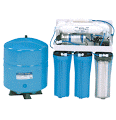
Reverse Osmosis with Steel Tank 
& Cartridge Pre-Filters

Submersible Pumps

Tachmina Solenoid-Driven
Chemical Metering Pump
- ensures regulated dosing
of chlorine into water system
without human intervention


Friday, May 4, 2018

MATHEMATICS - How Math Works - For many individuals, mathematical anxiety begins with inadequate teaching from non-mathematicians who have trouble relaying enthusiasm and practicality. Factor in overcrowded classes, and it's little wonder that so many students fail to latch onto math's logical core. The ramifications of mathematical illiteracy are very real. A world without math is unimaginable. It's a part of who we are.


.
Mathematics
Don't fear the math.

How Math Works

BY ROBERT LAMB

It's easy to think of mathematics as a kind of storybook sorcery -- a powerful secret language known to few, mastered by inhuman agents (such as your calculator) and underpinning the very fabric of the universe.
Even if we avoid such hyperbole, the fact remains: Many of us are mathematically illiterate in a world that runs on math.
When was the last time you seriously crunched some numbers with only pen and paper?
In his book "The Geometry of Paradise," Mark A. Peterson described the people of medieval Europe as a non-mathematical culture in possession of sophisticated mathematics.
Mathematicians of the day certainly honed their skills but mostly out of love for mathematical abstractions.
They perused few practical applications with it and, according to Peterson, didn't really grasp what math was.
Today, the mathematics field is far more vibrant than it was in the Middle Ages, but it still eludes an alarming number of those who depend on it.
On one hand, math certainly has a way of solving itself these days through calculators and hastily keyed-in Google searches.
Yet for many individuals, mathematical anxiety begins with inadequate teaching from non-mathematicians who have trouble relaying enthusiasm and practicality.
Factor in overcrowded classes, and it's little wonder that so many students fail to latch onto math's logical core.
In fact, only 40 percent of 4th graders and 34 percent of 8th graders in the U.S. are proficient in math, according to Arne Duncan, U.S. education secretary speaking at the National Council of Teachers of Mathematics in April 2011.
The ramifications of mathematical illiteracy are very real.
In 2005, the United States National Academies identified the country's decline in mathematics education as having a severe detrimental effect on its scientific, technological and economic prowess [source: Mullich].
So let's demystify the world of mathematics.
A world without math is unimaginable. It's a part of who we are.
It's the analytical juice of our left brain and, in the words of physicist Richard Feynman, even a fool can use it.
Here's a quote from the late great scientist's book "The Pleasure of Finding Things Out":
“What we've been able to work out about nature may look abstract and threatening to someone who hasn't studied it, but it was fools who did it, and in the next generation, all the fools will understand it. There's a tendency to pomposity in all this, to make it deep and profound.”
In this article, we'll take a very wide-angle look at the world of numbers.
Just what are they, and what does math really do?
.
What Are Numbers?
Mathematics boils down to pattern recognition.
We identify patterns in the world around us and use them to navigate its challenges.
A boxing referee administers the count.
To do all this, however, we need numbers -- or at least the information that our numbers represent.
What are numbers?
As we'll explore more later, that's a deceptively deep question, but you already know the simple answer.
A number is a word and a symbol representing a count.
Let's say you walk outside your home and you see two angry dogs.
Even if you didn't know the word "two" or know what the corresponding numeral looks like, your brain would have a good grasp of how a two-dog encounter compares with a three-, one- or zero-dog situation.
We owe that innate comprehension to our brain (specifically, the inferior parietal lobe), which naturally extracts numbers from the surrounding environment in much the same way it identifies colors [source: Dehaene].
We call this number sense, and our brains come fully equipped with it from birth.
Studies show that while infants have no grasp of human number systems, they can still identify changes in quantity.
Neuroimaging research has even discovered that infants possess the ability to engage in logarithmic counting, or counting based on integral increases in physical quantity.
While a baby won't see the difference between five teddy bears and six teddy bears in a lineup, he or she will notice a difference between five and 10 [source: Miller].
Number sense plays a vital role in the way animals navigate their environments -- environments where objects are numerous and frequently mobile.
However, an animal's numerical sense becomes more imprecise with increasingly larger numbers.
Humans, for instance, are systematically slower to compute 4 + 5 than 2 + 3 [source: Dehaene].
At some point in our ancient past, prehistoric humans began to develop a means of augmenting their number sense. They started counting on their fingers and toes.
This is why so many numerical systems depend on groups of five, 10 or 20.
Base-10 or decimal systems stem from the use of both hands, while base-20 or vigesimal systems are based on the use of fingers and toes.
So ancient humans learned to externalize their number sense and, in doing so, they arguably created humanity's most important scientific achievement: mathematics.  
The Tower of Math: Numbers
Numbers pose a difficulty for humans.
Sure, some of us have more of a gift for math than others, but every one of us reaches a point in our mathematical education where things become hard.
Learning your multiplication tables is difficult because the human brain never evolved to handle such advanced computations as 17 x 32 = 544.
After a certain point, our mathematical education is largely an exercise in rejiggering ill-adapted brain circuits [source: Dehaene].
Number sense may come naturally to us, but mathematical literacy comes only with time.
Likewise, humanity's use of mathematics has steadily grown over the ages.
Like science itself, math isn't the product of one mind but rather a steady accumulation of knowledge throughout human history.
Think of math as a tower. Natural human height is finite, so if we're to reach higher into the air and see out farther across the landscape, we'll need to build something external to ourselves.
Our mental abilities to understand math are equally finite, so we build a great tower of number systems and climb upward to the stars.
To break down the basic structure of this tower, let's first look at the raw materials. These are the basic types of numbers:
Integers: You probably know these as whole numbers, and they come in both positive and negative forms. Integers include the basic counting numbers (1-9), negative numbers (-1) and zero.
Rational numbers include integers but also encompass simple fractions that can be expressed as a ratio of two integers. For example, 0.5 is rational because we can also write it as 1/2.
Irrational numbers: These numbers can't be written as a ratio of two integers. Pi (the ratio of the circumference of a circle to its diameter) is a classic example, as it can't be written accurately as a ratio of two integers and has been calculated to trail off decimal points into the trillions.
Rational and irrational numbers both fall under the category of real numbers or complex numbers. And yes, there are also imaginary numbers that exist outside the real number line, and transcendental numbers, such as pi.
There are many other different numbers types as well, and they, too, play a part in the structure of our tower.
On the next page, we'll look at some of the core branches of mathematics.
.
The Tower of Math: Branches of Mathematics
Who would you hire to build a tower?
Circa 100 B.C., Greek astronomer Hipparchus,
inventor of trigonometry, studies the heavens.
After all, several different systems converge in modern construction: steel framework, stone foundation, woodwork, plumbing, roofing, electrical wiring, telecommunications heating and air conditioning.
Likewise, many branches of mathematics play a part in the tower of math. Here are just a few.
Arithmetic: This is the oldest and most basic form of mathematics. Arithmetic chiefly concerns the addition, subtraction, multiplication and division of real numbers that aren't negative.
Algebra: The next level of mathematics, algebra, is essentially arithmetic with unknown or abstract quantities thrown in with the real numbers. We represent the abstracts with symbols, such as X and Y.
Geometry: Remember what we said about math helping us navigate a world of numerous and movable objects? This is where geometry comes into play, dealing chiefly with the measurements and properties of points, lines, angles, surfaces and solids.
Trigonometry: Trigonometry concerns the measurements of triangles and the relationships between their sides and angles. While the historical origins of arithmetic, algebra and geometry are lost in the fog of ancient history, trigonometry originates with second century astronomer Hipparchus of Nicaea.
Calculus: Independently developed by both Isaac Newton and Gottfried Leibniz in the 17th century, calculus deals with the calculation of instantaneous rates of change (known as differential calculus) and the summation of infinite small factors to determine some whole (known as integral calculus). As such, it has proven a vital scientific tool in a number of disciplines.
The tower of mathematics has enabled human culture to rise and flourish, to understand both the inner mysteries of the cells to the outer mysteries of space.
But did we truly build this tower out of our own ingenuity? Did we invent mathematics or merely discover it?
.
Math: Human Discovery or Human Invention?
So just what, in essence, is this thing called math?
Does the universe conform to math, or math to the universe?
In developing these numbers and systems of numbers, did we discover the hidden coding of the universe?
Is mathematics, in the words of Galileo, the language of God?
Or is math just a human-created system that happens to correspond with natural laws and structures?
There is no definitive answer to this question, but mathematicians tend to side with one of several compelling theories.
First, there is the Platonic theory. Greek philosopher Plato argued that math is a discoverable system that underlines the structure of the universe.
In other words, the universe is made of math and the more we understand this vast interplay of numbers, the more we can understand nature itself.
To put it more bluntly, mathematics exists independent of humans -- and will continue on long after we're extinct.
The opposing argument, therefore, is that math is a man-made tool -- an abstraction free of time and space that merely corresponds with the universe.
Just consider elliptical planetary orbits. While such an elliptical trajectory provides astronomers with a close approximation of the planet's movement, it's not a perfect one [source: Dehaene].
Several theories expand on this idea.
·        The logistic theory, for instance, holds that math is an extension of human reasoning and logic.
·        The intuitionist theory defines math as a system of purely mental constructs that are internally consistent.
·        The formalist theory argues that mathematics boils down to the manipulation of man-made symbols. In other words, these theories propose that math is a kind of analogy that draws a line between concepts and real events.
·        The fictionalist theory, while less popular, even goes so far as to equate mathematics with fairy tales: scientifically useful fictions. In other words, 1 + 1 = 2 might enable us to understand how the universe works, but it isn't a "true" statement.
Who's right? Who's wrong?
There's ultimately no way to know, but on the next page we'll look at two examples of what each possibility could mean to our understanding of the universe.
.
The Mathematical Universe
The history of mathematics is a history of humanity seeking to understand the universe.
Can math explain it all?
Therefore, many consider the holy grail of mathematics to be the same as that of physics: a theory of everything, a unified theory that explains all physical reality.
Math generally plays a vital role in any theory of everything, but contemporary cosmologist Max Tegmark even goes so far as to theorize that the universe itself is made of math.
In his mathematical universe hypothesis, he proposes that math is indeed a human discovery and that the universe is essentially one gigantic mathematical object.
In other words, mathematics no more describes the universe than atoms describe the objects they compose; rather math is the universe.
Tegmark even goes so far as to predict that a mathematical proof for a theory of everything could eventually fit on a T-shirt.
More than 60 years earlier, however, Austrian mathematician Kurt Gödel put forth a theory that argues quite the opposite. 
Gödel's first incompleteness theorem concerns axioms, logical mathematical statements that we assume to be true but can't be proven with a mathematical proof.
A simple example of this would be the axiom of equality (X = X). We assume this to be a true statement, but we can't actually back it up with a mathematical proof.
Gödel's theorem states that any adequate axiomatizable theory is incomplete or inconsistent.
The implication, according to theoretical physicist and mathematician Freeman Dyson, is that mathematics is inexhaustible.
No matter how many problems we solve, we'll inevitably encounter more unsolvable problems within the existing rules [source: Feferman].
This would also seem to rule out the potential for a theory of everything, but it still doesn't relegate the world of numbers to either human invention or human discovery.
Regardless, mathematics could stand as humanity's greatest invention.
It composes a vital part of our neural architecture and continues to empower us beyond the mental limits we were born with, even as we struggle to fathom its limits.

About Robert Lamb
As a child, Robert Lamb dreamed of becoming a mad scientist when he grew up. As this profession proved to be largely fictional, however, he swallowed his heartbreak and turned his attention to the written word instead. He earned his bachelor's degree in creative writing from the University of Tennessee in Knoxville, which launched him on a career path through high school English classrooms, small-town newsrooms and finally into the offices of HowStuffWorks.
As a senior writer and podcaster for Stuff to Blow Your Mind, Robert now spends his days sifting through all the scientific wonders that make the world so mad and amazing. He currently lives in Atlanta with his lovely wife and their beautiful one-eyed cat. When he's not researching the apocalypse or the miracle we call a space toilet, he enjoys listening to electronic music, painting the odd miniature and writing fiction.