Friday, October 9, 2020

GREENHOUSE EFFECT - What Is the Greenhouse Effect? - The greenhouse effect is what keeps our planet warm enough to support life. Earth is said to be in a perfect "Goldilocks zone" away from the sun (not too cold, and not too hot), which enables life to thrive on the planet's surface. But Earth's balmy temperatures would not be possible without the greenhouse effect, which traps solar energy on Earth's surface and keeps the planet warm. The greenhouse effect arises from Earth's atmosphere. Visible light from the sun, as well as invisible ultraviolet and infrared wavelengths, can penetrate the gaseous layer that blankets our world. Roughly 70% of these energetic rays are absorbed by Earth's oceans, land and atmosphere, while the remaining 30% are immediately reflected back into space. As the planet's surface heats up, it releases some of the infrared energy that it had absorbed, but that energy doesn't make it back out of Earth's gaseous atmosphere. Instead of shooting back out into space, the infrared energy closely hugs our planet and, therefore, raises Earth's overall temperature. This is similar to how a human-built glass greenhouse works, trapping heat from the sun to keep plants warm in the winter. Without an atmosphere, our world would be as cold as the lifeless moon, which has an average temperature of minus 153 degrees Celsius on its far side. Because of the greenhouse effect, Earth maintains an overall average temperature of around 15 C.


.....................................................................................................................................................

Greenhouse Effect

What Is the Greenhouse Effect?

By Adam Mann


The greenhouse effect is what keeps our planet warm enough to support life.

Earth is said to be in a perfect "Goldilocks zone" away from the sun (not too cold, and not too hot), which enables life to thrive on the planet's surface.

But Earth's balmy temperatures would not be possible without the greenhouse effect, which traps solar energy on Earth's surface and keeps the planet warm.

The greenhouse effect arises from Earth's atmosphere.

Visible light from the sun, as well as invisible ultraviolet and infrared wavelengths, can penetrate the gaseous layer that blankets our world.

Roughly 70% of these energetic rays are absorbed by Earth's oceans, land and atmosphere, while the remaining 30% are immediately reflected back into space, according to NASA Earth Observatory.

Diagram depicting how the greenhouse effect works on Earth.

As the planet's surface heats up, it releases some of the infrared energy that it had absorbed, but that energy doesn't make it back out of Earth's gaseous atmosphere.

Instead of shooting back out into space, the infrared energy closely hugs our planet and, therefore, raises Earth's overall temperature.

This is similar to how a human-built glass greenhouse works, trapping heat from the sun to keep plants warm in the winter.

Without an atmosphere, our world would be as cold as the lifeless moon, which has an average temperature of minus 243 degrees Fahrenheit (minus 153 degrees Celsius) on its far side.

Because of the greenhouse effect, Earth maintains an overall average temperature of around 59 F (15 C).

Greenhouse gases and climate change

Greenhouse gases include several naturally occurring molecules — like water vapor, carbon dioxide, methane, nitrous oxide and ozone — as well as several manufactured ones, like chlorofluorocarbons, according to the Australian Department of the Environment and Energy.

Over the past century or so, human activities — such as the burning of fossil fuels, intensive agriculture, livestock raising and land clearing — have dramatically increased the concentrations of greenhouse gases in Earth's atmosphere, to the point where it's changing our planet's climate.

Factory smoke stacks releasing clouds of greenhouse gases.

Greenhouse gases produced by human activity are the most significant driver of climate change. 

Since the middle of the 20th century, greenhouse gases produced by humans have become the most significant driver of climate change, according to the U.S. Environmental Protection Agency.

Carbon dioxide levels in the atmosphere have increased by more than 40% since the start of the Industrial Revolution, from roughly 280 parts per million (ppm) to more than 400 ppm today. 

Fossils show that forests grew in the Canadian Arctic during the Pliocene, and savannas and woodlands spread over what's now the Sahara desert.

While some people still doubt the reality of human-induced climate change, the evidence for it is overwhelming.

Since the 1850s, the average global surface-air temperature has risen by around 1.4 F (0.8 C), and ocean temperatures are now at the highest levels ever recorded.

Increases in greenhouse gases in the coming decades are expected to harm human health, increase droughts, contribute to sea level rise, and decrease national security and economic well-being throughout the world. 

The greenhouse effect on other planets

Because the greenhouse effect is a natural process, it affects other bodies in the solar system, too.

And, in some cases, that provides a warning about how things can go awry.

A perfect example of this is Venus, which is roughly the same size as Earth and not that much closer to the sun. 

Billions of years ago, when the sun was cooler and dimmer, Venus may have had a temperate climate that could have allowed for liquid water oceans on its surface.

Simulations suggest that the planet's average temperatures ranged from a low of 68 F (20 C) to a high of 122 F (50 C) for about 3 billion years, potentially even allowing Venus to support life.

But as the sun aged and grew brighter, excess water vapor would have entered Venus' atmosphere.

This potent greenhouse gas trapped heat and raised the planet's surface temperature, leading to a vicious feedback cycle in which hotter temperatures led to more water vapor in the atmosphere, further heating the world — a process known as the runaway greenhouse effect.

When Venus' oceans vaporized, its planetary plate tectonics would have ground to a halt, as there was no water left to help lubricate the shifting of geological plates.

The increasingly thick atmosphere might have created a drag on Venus' rotation period, leading to its bizarrely slow spin, in which a year goes by with only two days passing.

The dense cloud cover also led to hellish surface temperatures on present-day Venus, with an average of 700 F (370 C) — hot enough to melt lead.

"I think Venus is an important warning: Greenhouse atmospheres are not theoretical," Ellen Stofan, director of the Smithsonian's National Air and Space Museum and former chief scientist at NASA, previously told Space.com.

On Mars, greenhouse gases such as water and carbon dioxide might have been released during ancient impact events.

Some scientists speculate that such wallops could have raised Mars' overall temperature enough for the planet to have liquid water on its surface for significant lengths of time.

However, because Mars is smaller than Earth, it's gravitational pull is weaker. Therefore, these gases drifted away, and eventually, the Red Planet reverted back to the cold and dry world it is today.

Saturn's distant moon Titan, which has a thick nitrogen atmosphere with about a thousand times greater concentration of methane as Earth, is also subject to the greenhouse effect.

With data from the European Space Agency's Huygens probe, which landed on Titan in 2005, researchers are getting a better understanding of how methane absorbs short-wavelength infrared radiation and are using that information to develop climate change models of our planet.

The greenhouse effect is also expected to warm the worlds of other star systems.

Many astronomers speak of a narrow habitable zone around a star — the area where a planet would be at the perfect distance to maintain liquid water on its surface, between 0.95 and 1.4 times the Earth-sun distance.

However, others have argued that such models need to be broadened.

A thick atmosphere of molecular hydrogen, which is a potent greenhouse gas, could potentially give a world clement temperatures even if it were 15 times farther from the sun than Earth is.

Adam Mann is a journalist specializing in astronomy and physics stories. His work has appeared in the Wall Street Journal, Wired, Nature, Science, New Scientist, and many other places. He lives in Oakland, California, where he enjoys riding his bike. Follow him on Twitter @adamspacemann.

https://www.space.com/greenhouse-effect.html

Thursday, October 8, 2020

AN INCH OF WATER WHAT'S IT WORTH? - An extra inch of water depth in a port = larger ships, millions of dollars worth of additional cargo. deeper ports, deeper pockets - One more inch of water in a port means larger ships can enter, bringing millions of dollars worth of additional cargo. And, carrying more goods in one trip means fewer total trips to ship the same amount of stuff. That’s good for the safety of our waterways, it’s good for the environment, and it’s good for your wallet. Our nation’s ports are the lifelines of our economy. When goods travel through ports, it means they are traveling via ship. NOS is in the business of making sure that mariners — and the goods they are transporting — make it to their destinations safely and quickly. Just as airplane pilots need to know current weather and ground conditions, ship captains need to know exactly what's going on in the water and in the air. NOS monitoring systems supply mariners with the real-time data they need, providing information such as water levels, wind and current speeds and directions, and water temperature. But what does this have to do with that inch of water? A ship needs a certain amount of water in order to float and not touch bottom. This water depth is called the ship’s “draft.” The more cargo a ship carries, the more the ship will weigh, meaning it will sink more and require more draft. Even a slight decrease in the depth of a waterway will require a ship to reduce the amount of cargo it is carrying.

.....................................................................................................................................................

An Inch of Water

What's it Worth?

An extra inch of water depth in a port = larger ships, millions of dollars worth of additional cargo.

The National Ocean Service


Deeper Ports, Deeper Pockets

One more inch of water in a port means larger ships can enter, bringing millions of dollars worth of additional cargo.

And, carrying more goods in one trip means fewer total trips to ship the same amount of stuff.

That’s good for the safety of our waterways, it’s good for the environment, and it’s good for your wallet. 

Our nation’s ports are the lifelines of our economy.

In 2017, foreign trades through U.S. ports were valued at $1.6 trillion — $527 billion exports and $1.1 trillion imports were moved by vessels.

When goods travel through ports, it means they are traveling via ship.

NOS is in the business of making sure that mariners — and the goods they are transporting — make it to their destinations safely and quickly.

Just as airplane pilots need to know current weather and ground conditions, ship captains need to know exactly what's going on in the water and in the air.

NOS monitoring systems supply mariners with the real-time data they need, providing information such as water levels, wind and current speeds and directions, and water temperature.

But what does this have to do with that inch of water?

A ship needs a certain amount of water in order to float and not touch bottom.

This water depth is called the ship’s “draft.”

The more cargo a ship carries, the more the ship will weigh, meaning it will sink more and require more draft.

Even a slight decrease in the depth of a waterway will require a ship to reduce the amount of cargo it is carrying.

On the flipside, more water means more cargo. This, in turn, translates into fewer trips needed to transport goods.

Accurate data provided by NOS are crucial to making decisions regarding ship draft and cargo loads.

In the absence of this information, mariners would need to be much more conservative in their draft estimates, or risk additional maritime accidents.

Consider that carrying more cargo on a single trip means fewer trips overall to transfer the same amount of materials.

That’s good for the safety of our waterways, it’s good for the environment, and, because it saves money, it’s good for your wallet.

One more inch of water in a port means larger ships can enter, bringing millions of dollars worth of additional cargo.

And, carrying more goods in one trip means fewer total trips to ship the same amount of stuff.

With one more inch of depth in a port, a cargo ship could carry about 50 more tractors, 5,000 televisions, 30,000 laptops, or 770,000 bushels of wheat.

Below, see about how much cargo a ship can carry — and what it's worth — with one more inch of depth in a port.

57 tractors, worth more than $3.8 million

31,552 laptop computers, worth more than $21.8 million

772,900 bushels of wheat, worth more than $60,000

5,144 55-inch televisions, worth approximately $3 million

In 2017, the Port of Los Angeles/Long Beach increased the draft for incoming ships from 65 feet to 66 feet as a direct result of NOAA's Precision Navigation Project, with a future goal of a 69-foot draft.

Each additional foot of draft allows carriage of 40,000 additional barrels of crude oil, and 69 feet would eliminate the need for lightering.

The increase was made possible, in part, by the expansion of the physical observing infrastructure at the port, including forecasts for wave and swell conditions from the National Weather Service, water level data from the Center for Operational Oceanographic Products and Services, wave buoy data from the U.S. Integrated Ocean Observing System, shoreline data from the National Geodetic Survey, and high resolution bathymetry from the Office of Coast Survey.

The project showcases how NOAA supports the increasingly complex decisions mariners make as they navigate ever-larger ships through U.S. ports, especially decisions related to underkeel clearance.

This flagship project integrates private-sector innovation and NOAA data streams for safe navigation of deep-draft ships.

The National Ocean Service provides data, tools, and services that support coastal economies and their contribution to the national economy

Ships move $1.5 trillion worth of products in and out of U.S. ports every year. Every ship moving in and out of U.S. ports relies on navigation charts and water level information that NOS alone provides. All mapping, charting, and transportation activities and infrastructure are founded on a reliable, accurate national coordinate system. NOS is solely responsible for maintaining that system, which provides more than $2.4 billion in potential annual benefits to the U.S. economy. Businesses in the maritime community rely on NOS for a range of decisions, from how much cargo to load to choosing the safest and most efficient route between two points. They use NOS data, tools, and services to plan seasonally for ship schedules to service global trade more safely and efficiently as significantly larger vessels transit through U.S. ports as a result of the Panama Canal expansion.

https://oceanservice.noaa.gov/economy/inch-water/

LOAD BEARING MASONRY CONSTRUCTION - Load bearing masonry construction was the most widely used form of construction for large buildings from the 1700s to the mid-1900s. It is very rarely used today for large buildings, but smaller residential-scale structures are being built. It essentially consists of thick, heavy masonry walls of brick or stone that support the entire structure, including the horizontal floor slabs, which could be made of reinforced concrete, wood, or steel members. Most construction today is not load-bearing masonry but frame structures of light but strong materials, that support floor slabs and have very thin and light internal and external walls. The key idea with this construction is that every wall acts as a load carrying element. In a load bearing structure, you cannot punch holes in a wall to connect two rooms - you would damage the structure if you did so. The immense weight of the walls actually helps to hold the building together and stabilise it against external forces such as wind and earthquake. The floor slabs were made of horizontal wooden beams, joists, and planks. A joist is a smaller wooden beam that rests on two larger beams. The buildings were covered with sloping wooden roofs, that could be finished with clay tile, wood or stone shingles, or metal plating such as thin sheets of copper. Every wall had a simple continuous strip foundation below it. Most classic buildings in Europe are built with load bearing masonry construction.

...................................................................................................................................................

Load Bearing Masonry Construction

understandconstruction.com


A modern example of load bearing masonry construction
for a residential building. Note the absence of concrete columns
and beams. The walls are the main load carrying elements.

Load bearing masonry construction was the most widely used form of construction for large buildings from the 1700s to the mid-1900s.

It is very rarely used today for large buildings, but smaller residential-scale structures are being built.

It essentially consists of thick, heavy masonry walls of brick or stone that support the entire structure, including the horizontal floor slabs, which could be made of reinforced concrete, wood, or steel members.

In contrast, most construction today is not load-bearing masonry but frame structures of light but strong materials, that support floor slabs and have very thin and light internal and external walls.

The key idea with this construction is that every wall acts as a load carrying element.

In a load bearing structure, you cannot punch holes in a wall to connect two rooms - you would damage the structure if you did so.

The immense weight of the walls actually helps to hold the building together and stabilise it against external forces such as wind and earthquake.

In traditional European loadbearing masonry structures, the floor slabs were made of horizontal wooden beams, joists, and planks.

A joist is a smaller wooden beam that rests on two larger beams.

The buildings were covered with sloping wooden roofs, that could be finished with clay tile, wood or stone shingles, or metal plating such as thin sheets of copper.

Other such buildings had flat terraces, that were built by pouring a concrete layer over a wooden floor, and then finishing with some form of tile or stone to provide a strong, waterproof finish.

Every wall had a simple continuous strip foundation below it.

Most classic buildings in Europe are built with load bearing masonry construction.

The American architect Louis Kahn famously used load bearing construction for the Indian Institute of Management, Ahmedabad.

His structures clearly express the construction system rather than conceal it under decorative skins.

In this structure, concrete is used exclusively for members in tension, which are ties that tie together the two ends of the brick arches.

WHY IS LOAD BEARING WALL CONSTRUCTION NOT USED TODAY?

IIM Ahmedabad, India, by architect Louis Kahn

Load bearing masonry construction is not used today for a number of reasons:

It does not perform very well in earthquakes.

Most deaths in earthquakes around the world have occurred in load bearing masonry buildings.

Earthquakes love heavy buildings, because that is where they can wreak the greatest havoc.

It is extremely labor-intensive, as it is built mainly of masonry, which is made by hand.

Humans have still not developed a machine that produces masonry!

This also makes for very slow construction speeds in comparision with modern methods that are far more mechanised.

It is extremely material-intensive. These buildings consume a lot of bricks, and are very heavy.

This means that they are not green, as all this material has to be trucked around from where it is produced to the site.

THE HISTORY AND DEVELOPMENT

OF LOAD BEARING MASONRY BUILDINGS

Load Bearing Structures

Load bearing construction has a very long, bright and interesting history.

To start with, masonry structures were large and solid, like the pyramids.

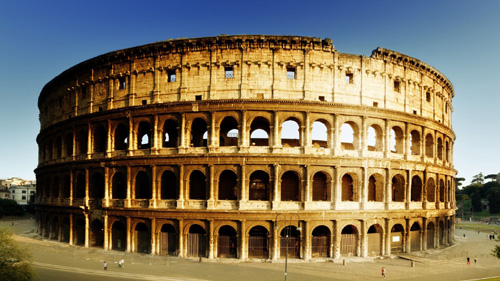
With the development of the arch, openings were created in these structures, and large structures like the colosseum in Rome were built.

The arch was first developed in Mesopotamia (modern-day Iran-Iraq-Turkey-Syria) and was then picked up by the Romans.

Load Bearing Buildings

Taj is an example of load bearing construction

In India, builders started using horizontal slabs of stone to construct floor plates. This is called trabeate construction.

The Taj is built of red sandstone masonry walls faced with white marble. Its walls are 6ft (1.8m) thick in some places.

Europeans built fine stone walled buildings with floor slabs made of wood beams and planks.

The buildings had elaborate arched openings and very finely crafted domes.

These buildings have lasted hundreds of years, with limited repair in many cases, testifying to the quality of the craftsmanship and the brilliance of the design.

Load Bearing Wall Construction

High-rise load bearing masonry construction.

And then, the Americans came in and super-sized things.

At left is the Mondadnock Tower, a 16-storey office building built in 1893 in Chicago.

It was made of brick walls 6 feet thick at the base and about 18" thick at the top. It still exists - you can rent an office space in it by clicking here.

It was built to be the world's largest office building at the time by architects Burnham & Root.

They said their design was inspired by an Egyptian pylon, which is a kind of monumental gateway to a temple, built with massive sloping masonry walls.

This is a site that explains the art and science of building construction in great clarity and detail.  Our goal is to make you understand concepts in building construction.
Written by architects and engineers, the content on the site is actually a result of accumulated years of work experience at building construction sites and design offices.  This expert knowledge of building construction is not available in textbooks!
We also take great pains to ensure that our quality of writing is of a high standard.  We aim to take complicated situations and make them simple and clear, as well as to provide content that is interesting to industry experts and newcomers alike.  Do let us know where we succeed - and where we fail - in this task.

http://www.understandconstruction.com/load-bearing-masonry-construction.html

Wednesday, October 7, 2020

TEFLON NON-STICK COOKWARE - Are non-stick pans safe? - Spending each morning at the kitchen sink scraping at the charred remains of breakfast gets tedious after a while. Non-stick cookware may seem like an appealing alternative — but is it safe? Usually when people inquire about the safety of their non-stick cookware, they're talking about Teflon, said Suzanne Fenton, a reproductive endocrinologist at the National Institutes of Environmental Health Sciences in North Carolina. Also known as polytertrafluoroethylene (PTFE), this clear plastic is used to coat metal pots and pans, giving them a waxy, easy-to-clean surface — and for decades, scientists have debated whether it's safe for cooking. Experts tend to agree that Teflon itself isn’t a problem. The coating itself is considered non-toxic. Even if you ingest small flakes of it, it passes right through you. But some experts are concerned about what happens when Teflon gets too hot. When pans are overheated, that PTFE coating begins to disintegrate. As Teflon breaks down, it releases a host of toxic gases. Breathing in these chemical fumes can cause polymer fume fever, a condition characterized by a high fever, shortness of breath and weakness. These gases also deadly to birds — lightbulbs coated in Teflon have wiped out poultry houses. Of particular concern is perfluorooctanoic acid (PFOA), one of the chemicals released when Teflon pans heat up.

It might be time to ditch your old Teflon cookware.


.......................................................................................................................................................

Teflon Non-stick Cookware

Are non-stick pans safe?

By Isobel Whitcomb-LiveScience Contributor


Spending each morning at the kitchen sink scraping at the charred remains of breakfast gets tedious after a while.

Non-stick cookware may seem like an appealing alternative — but is it safe?

Usually when people inquire about the safety of their non-stick cookware, they're talking about Teflon, said Suzanne Fenton, a reproductive endocrinologist at the National Institutes of Environmental Health Sciences in North Carolina.

Also known as polytertrafluoroethylene (PTFE), this clear plastic is used to coat metal pots and pans, giving them a waxy, easy-to-clean surface — and for decades, scientists have debated whether it's safe for cooking.

Experts tend to agree that Teflon itself isn’t a problem. The coating itself is considered non-toxic.

Even if you ingest small flakes of it, it passes right through you.

But some experts are concerned about what happens when Teflon gets too hot.

"When pans are overheated, that PTFE coating begins to disintegrate," Fenton told Live Science.

As Teflon breaks down, it releases a host of toxic gases.

In rare instances, breathing in these chemical fumes can cause polymer fume fever, a condition characterized by a high fever, shortness of breath and weakness.

These gases also deadly to birds — lightbulbs coated in Teflon have wiped out poultry houses.

Of particular concern is perfluorooctanoic acid (PFOA), one of the chemicals released when Teflon pans heat up.

Long-term exposure to PFOA is linked to a host of conditions from cancer to thyroid disease, Fenton said. 

Not all researchers think that people need to worry about their Teflon pans breaking down.

Some point out that no studies have specifically analyzed the long-term effects of Teflon pans on humans.

Instead, these studies focus on the health-effects of Teflon’s chemical byproducts, like PFOA.

Much of the data on these toxins come from cases of environmental exposure — such as drinking water or factory settings, where exposure levels are much higher than they would be from non-stick cookware.

"Generally speaking, nonstick pans are not dangerous," said Kyle Steenland, a professor of environmental health at Emory University in Atlanta.

Steenland and other scientists also argue that people don't cook at high enough temperatures for these chemical reactions to take place.

"Now, if you burn your pans for an hour at high heat, it [Teflon] will break down, but that will be the least of your problems because your house will be on fire." 

However, research suggests pans can easily reach a temperature hot enough to disintegrate Teflon.

One group of researchers in Canada published a 2001 study in the journal Nature, in which Teflon broke down at 680 degrees Fahrenheit (360 degrees Celsius).

For context: a Teflon-coated pan can reach 750 F (399 C) if left for eight minutes at high heat on a stovetop, according to a 2017 article published in Environmental Science and Pollution Research.

And at lower temperatures, Teflon coating still breaks down over time, according to a 1998 article published in the journal Polymer Degradation and Stability. 

If you consistently heat your pan to 500 F (260 C; the temperature at which we sear steak), the pan should last around 2.3 years, according to the 2001 Nature study. 

Taking good care of non-stick pans can help keep your kitchen safe.

"It's really important that you use the pans on low-to-medium heat, and you don't use utensils that will scratch it," Fenton said. 

But in some cases, it's best to ditch Teflon pans altogether, Fenton added — especially if you're pregnant, breastfeeding or have young children.

PFOA in particular is tied to problems with kids' development.

That's because this chemical is considered an endocrine disruptor, meaning it interferes with the body's hormone system.

PFOA exposure causes elevated estrogen in male rats and delayed mammary-gland development in female mice, according to a 2012 article published in The Journal of Steroid Biochemistry and Molecular Biology.

In humans, the chemical is linked to obesity, diabetes, low sperm quality and irregular menstrual cycles — potential signs of endocrine disruption.

Luckily, there's a wealth of other options for those averse to scrubbing pans.

Cookware made of anodized aluminum (a product that protects against corrosion and scratches) and ceramic is non-stick and perfectly safe, Fenton said.

If cared for correctly, a cast-iron skillet can also serve as another non-toxic, non-stick pan, while enriching food with blood-building iron

"Non-stick pans come in many forms," Fenton said, "one can certainly safely cook healthy meals in them."

Isobel Whitcomb

Live Science Contributor

Isobel Whitcomb, a contributing writer for Live Science, covers the environment, animals and health. Her work has appeared in Scholastic, Fatherly, Atlas Obscura, and Hakai Magazine. Isobel's roots are in science. She studied biology at Scripps College in Claremont, California while working in two different labs, and completing a fellowship at Crater Lake National Park. She completed her master's degree in journalism at NYU's Science, Health, and Environmental Reporting Program. She lives in Brooklyn, where you can find her riding her bike or running in Prospect Park.

https://www.livescience.com/are-nonstick-pans-toxic.html?utm_source=notification


You might also like:


Teflon

The Invention of Teflon

CLICK HERE . . . to view . . . 

https://puricare.blogspot.com/2017/10/teflon-history-of-teflon-colorless.html

.....................................................................................................................................................


Teflon Pans

ARE YOU BEING POISONED BY YOUR TEFLON PAN?

CLICK HERE . . . to view . . . 

https://puricare.blogspot.com/2017/06/teflon-pans-are-you-being-poisoned-by.html

 ....................................................................................................................................................

 Safest Cookware

What Type of Cookware Is Safest for Cooking?

CLICK HERE . . . to view . . . 

https://puricare.blogspot.com/2019/06/safest-cookware-stainless-steel-is.html