Wednesday, October 7, 2020

CONFIDENT DRIVING - Increase Your Confidence While Driving - Learning how to drive and to do it well, takes time and practice. There isn’t a magic wand you can wave to instill confidence in yourself, but there are actionable steps you can take over time to improve your confidence while driving. Practice Often. To really embody confident driving, you’ve got to invest time and effort into getting behind the wheel. Log those hours! The cliche phrase “practice makes perfect” really does ring true. Ask an experienced driver (that you are comfortable with) to accompany you on your practice runs. This is a time for you to listen to their suggestions and for them to support you in your good driving habits. Drive in all weather. One of the most important skills a driver can have is the ability to analyze the driving environment. There are only two types of driving environments we can encounter, ideal and adverse. As someone looking to practice more confident driving, you must prepare for all weather conditions — even less than ideal conditions. Remember to analyze your space, traction and visibility. Become familiar with as many environments as you can so that you can. Drive on multiple terrains. Hills, dirt roads, highways, narrow streets, busy streets and parking lots are all areas you should be comfortable and confident with driving on. Start small and rank each in order of how you feel about each of them — most confident to least confident.


Confident Driving

6 Tips to Increase Your Confidence While Driving

Top Driver Driving School


Learning how to drive and to do it well, takes time and practice.

There isn’t a magic wand you can wave to instill confidence in yourself, but there are actionable steps you can take over time to improve your confidence while driving.

Here are 6 tips to assist you in confident driving.

1.    Practice Often. To really embody confident driving, you’ve got to invest time and effort into getting behind the wheel. Log those hours! The cliche phrase “practice makes perfect” really does ring true.

2.    Bring an Experienced Driver Along. Ask an experienced driver (that you are comfortable with) to accompany you on your practice runs. This is a time for you to listen to their suggestions and for them to support you in your good driving habits. Top Driver offers quality training and coaching to assure even the most timid driver is equip to handle the road.

3.    Drive in All Weather. One of the most important skills a driver can have is the ability to analyze the driving environment. There are only two types of driving environments we can encounter, ideal and adverse. As someone looking to practice more confident driving, you must prepare for all weather conditions — even less than ideal conditions. Remember to analyze your space, traction and visibility (S-T-V). Become familiar with as many environments as you can so that you can.

4.    Drive On Multiple Terrains. Hills, dirt roads, highways, narrow streets, busy streets and parking lots are all areas you should be comfortable and confident with driving on. Start small and rank each in order of how you feel about each of them — most confident to least confident. Tackle the easier terrains first and work up to conquering the more difficult topographies as you move along.

5.    Mix Up Your Practice Vehicles. Try something a little new. Have you been practicing in the same vehicle the entire time? If you’re up for it, consider switching your practice sessions to another vehicle for a short time. If you’re in a small car, practice confident driving in a truck and vise versa. Maybe switch from an 8-cylinder to a 4-cylinder or front-wheel drive to all-wheel drive. It’s important to know how other vehicles handle and how comfortable you are with each scenario.

6.    Complete Refresher Driving Courses. There is always something fun and new to learn. Don’t stop honing your driving skills just because you pass your driving exam. Continue to practice and take online refresher courses to stay current with law changes and driving best practices. Even just a few lessons can provide tips and tricks to calm your nerves. Do all of this and your well on your way to becoming a confident driver.

Confident Driving is Within Your Reach

After you become proficient in the basic handling of your vehicle it will be easier to become more confident and comfortable while driving.

The key to building confidence while driving is practice. Continue to practice, ask questions, take things step by step and make sure your environment promotes calmness.

Reduce your nerves by playing some of your favorite songs while you drive. Another quick tip is to run through your pre-driving checklist.

Don’t be too hard on yourself either. Every driver has made mistakes at some point while driving — the key is to not dwell on your mistakes.

Assess what went wrong and come up with a plan to solve the issue should you encounter a similar situation again.

If you’re interested in sharpening your knowledge and becoming a more proactive driver, contact Top Driver today! Consider signing up for an online refresher driving course. Each of our drivers improves their driving skill set considerably after completion of a refresher course.

Top Driver Driving School offers more driver education classes and driving lessons than any other driving school in the Midwest (Chicagoland, Illinois, and Michigan).  We give you the flexibility to choose the driver education classes that best fit your schedule, from teen driving to adult driving school to driver education online.

https://www.topdriver.com/education-blog/confident-driving-6-tips-to-increase-your-confidence-while-driving/

Tuesday, October 6, 2020

TEMPERATURE GUNS - An infrared thermometer commonly called temperature gun, may be called for anytime the surface temperature of an object needs to be determined. Since the infrared beam is only bounces off of the surface, this is not a suitable method to measure the interior temperature of an object. This technology is already used in a wide range of industries. Checking the level of heat coming from a piece of equipment is a good way to check for trouble that may be occurring on the inside. If the equipment is hotter than it should be on the surface, there is a good chance that something is going wrong internally. Considering the various infrared thermometer models available today, and how accurate they have become, it is easy to see why they are a popular choice. While the technology that makes these thermometers work is certainly complex, the concept itself is rather simple. Everything that has mass emits some amount of energy in the form of heat. An infrared thermometer can use the difference between the IR rays coming off of the object and the surrounding environment to determine the surface temperature of the object. The IR thermometer works by focusing light that is coming from the object in the form of IR rays and funneling that light into a detector – which is also known as a thermopile. In the thermopile the IR radiation is turned into heat which is then turned to electricity and measured.

...................................................................................................................................................

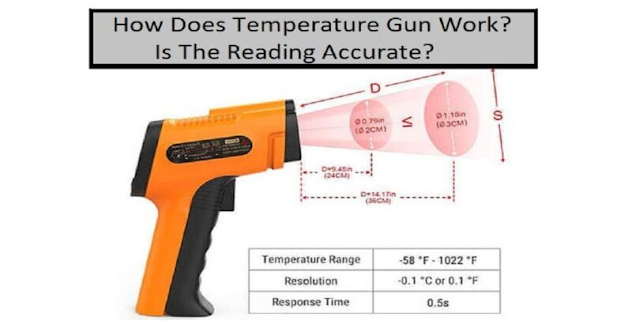
How Does Temperature Gun Work?

Is The Reading Accurate?

Vikas Shukla

engineeringinsider.org


When you think about a thermometer, you probably picture a device with some kind of probe that is placed into the object being measured.

Whether it is a thermometer that you place under your tongue to take your own temperature, or a food thermometer that you push into a piece of meat to make sure it is done, probe-style thermometers have long been a standard.

However, there are plenty of other options on the market today, and infrared thermometers are among the most exciting and useful styles to consider.

Offering ease of use and accurate readings, there is a lot to like about an infrared option.

An infrared thermometer commonly called temperature gun these days, may be called for anytime the surface temperature of an object needs to be determined.

Obviously, since the infrared beam is only bouncing off of the surface, this is not a suitable method of measurement when the interior temperature of an object needs to be found.

There are nearly countless applications, and this technology is already used in a wide range of industries.

Checking the level of heat coming from a piece of equipment, for instance, is a good way to check for trouble that may be occurring on the inside.

If the equipment is hotter than it should be on the surface, there is a good chance that something is going wrong internally.

Considering how many various infrared thermometer models are available today, and how accurate they have become, it is easy to see why they are a popular choice in a number of industries.

A SIMPLE PRINCIPLE

While the technology that makes these thermometers work is certainly complex, the concept itself is rather simple.

Everything that has mass emits some amount of energy, and that energy is emitted in the form of heat.

Since there is heat being emitted by any object, an infrared thermometer can use the difference between the IR rays coming off of the object and the surrounding environment to determine the surface temperature of the object itself.

The IR thermometer works by focusing light that is coming from the object in the form of IR rays and funneling that light into a detector – which is also known as a thermopile.

It is in the thermopile that the IR radiation is turned into heat which is then turned to electricity, which is then measured.

It is ultimately the amount of electricity that is generated by the rays being put out by the object in question that will provide a reading that is displayed on the thermometer.

The reading will be generated in a manner of seconds, meaning an infrared thermometer is a quick way to gather a temperature reading in a number of different scenarios.

WHY INFRARED?

There are a number of reasons why you should consider choosing infrared technology for your temperature reading needs.

When shopping for a thermometer to add to your stable of equipment, consider purchasing a quality infrared thermometer for some of the following reasons.

1. Accuracy. Obviously, you need to be confident that you are getting an accurate reading from your thermometer when you put it to use, and infrared models have a great reputation for accuracy. The technology used in these products is simple yet advanced, and you should be able to rely on the information that you receive – provided that the thermometer is used in the right way.

2. Safety. One of the great things about being able to check on temperature remotely is that you don’t actually need to touch the object in question.

    If you are trying to take the temperature of a particularly hot item, you won’t need to place your hand, or even another piece of equipment, onto the hot surface.

    Just by aiming your IR thermometer at the object you wish to measure, you can get all of the information you need without putting yourself at risk.

3. Contamination prevention. Another benefit to the remote measuring system is avoidance of contamination.

    This is particularly important within the food service world, but it applies in other applications as well.

    Since you don’t need to touch the item that you are measure, you won’t need to worry about contaminating that product with the probe of a thermometer.

    Rather than having to make sure that all of your temperature measuring equipment is properly sterilized prior to each use, you can simply point the IR gun at the item being measured and forget any worries about contamination problems.

4. Durability. You want an Infrared Thermometer that is tough enough to stand up to the demands of the jobsite, workshop or just being bounced around in your toolbox.

    There are certainly more than three advantages to using infrared, but the three listed above are some of the most important.

    Additionally, the cost of this technology has come down in recent years, meaning you can access this great method of temperature measurement for a significantly lower cost than it would have required just a few short years ago.

GETTING IN RANGE

It is important to pick an infrared thermometer that is rated to measure items within the temperature range that will be applicable to your uses.

Every IR unit on the market today is rated for a specific range of temperatures, and it will not be accurate if you are trying to measure items that fall outside of that range.

Therefore, before picking out an infrared thermometer, you are going to need to think carefully about what you will be measuring and the expected temperature ranges for those items.

As an example, you may find one unit that is capable of measuring temperatures from as low as -40F all the way up to 428F while another unit ranges from -4F all the way up to 626F.

Most units will be suitable for covering moderate temperatures, but you need to carefully check the specs on any infrared thermometer that is being purchased for the purpose of measuring extremely cold or extremely hot items.

DISTANCE-TO-SPOT RATIO

Another important element of IR thermometers is the distance-to-spot ratio that they offer.

Commonly available ratios include 4:1, 8:1, 30:1, and even 50:1.

What does the distance-to-spot ratio mean?

It refers to the distance you can be from the object that is being measured while still receiving an accurate reading.

So, the bigger the ratio, the farther away you can stand from the target object while still getting a good reading.

For example, with a 30:1 ratio you can be standing 30 inches away from your target and still accurately measure an area of 1 square inch.

To measure that same area with an 8:1, you would need to be standing 8 inches away.

Higher distance-to-spot ratios are usually found on models with very high temperature ranges, allowing you stand a safer distance away from the heat source.

Naturally, this is another element that needs to be factored in when you are picking out an IR thermometer model.

Are you going to be right next to the objects that you are measuring, or will you need to keep your distance for safety reasons?

If you are going to be back a significant distance, make sure the model you pick out is capable of remaining accurate thanks to a large distance-to-spot ratio.

Although infrared thermometers are limited to taking surface temperature readings, they remain a valuable tool that is used by professionals in a variety of industries.

When you are picking out your own IR unit, be sure to pay close attention to both the distance-to-spot ratio, as well as the temperature range that is offered by that model.

Once you do receive your thermometer, read all of the instructions carefully and use the unit in accordance to the manufacturer’s recommendations in order to get the most accurate readings possible.

While not the perfect tool for every temperature measuring job, there is a good chance you will find plenty of occasions to put an IR thermometer to work for you.

Does Temperature Gun Give Accurate Temperature?

Research has shown that, when used correctly, infrared or no-contact thermometers (temperature gun) are just as accurate as oral or rectal thermometers.

No-contact thermometers are popular among pediatricians, as kids often squirm around when trying to get a temperature read, but it also holds true in mass temperature screenings.

The device offers safety to both parties while providing a quick and accurate read.

Of course, when available, an internal thermometer is the gold standard in healthcare.

But due to COVID-19 and the need to quickly mass test, a no-contact thermometer has become the standard.

The operator needs to follow the device’s protocol and it won’t pick up a fever on someone who has taken fever-reducing medication.

But with many establishments now requiring temperature checks, these hand-held thermometers are proving to be safe, quick and accurate while helping to reduce the spread of coronavirus.

https://engineeringinsider.org/how-does-temperature-gun-work-is-the-reading-accurate/

Monday, October 5, 2020

ODORS IN DRINKING WATER - Smells can indicate problems with the water supply, some of which could lead to serious health effects. There are many different possible causes for odor, and the cause of the odor can be difficult to determine. The odor may come from the water itself, or it may come from where the water is obtained, such as a sink. To determine if the odor comes from the water itself, you can pour the water into a glass and test its smell away from the sink. If the water does not smell, the odor may come from the sink drain. Odors in sink drains may be caused by bacteria that feed on the food, hair and soap particles that accumulate in the drain. These bacteria can be killed by disinfecting and flushing the drain. Odors can also originate in the plumbing system. Organic matter can become trapped inside pipes, which can cause sulfurous odors. This organic matter can also react with chlorine, which produces odors. If the odor goes away after a few minutes of running the water, then the source of the odor is probably in the household plumbing system. If the odor persists and occurs in all faucets, then the odor is likely coming from the water supply rather than the household plumbing. If the odor only occurs in some faucets, then the source of the odor may be in that part of the plumbing system. Odor in well water may indicate contamination from an improperly located septic tank

.............................................................................................................................................

Odors in Drinking Water

filterwater.com


People are naturally uneasy about drinking water that has a strange smell.

This is a good thing, because strange smells can indicate problems with the water supply, some of which could lead to serious health effects.

However, there are many different possible causes for odor, and the cause of the odor can be difficult to determine.

The odor may come from the water itself, or it may come from where the water is obtained, such as a sink.

To determine if the odor comes from the water itself, you can pour the water into a glass and test its smell away from the sink.

If the water does not smell, the odor may come from the sink drain.

Odors in sink drains may be caused by bacteria that feed on the food, hair and soap particles that accumulate in the drain.

These bacteria can be killed by disinfecting and flushing the drain.

Odors can also originate in the plumbing system. Organic matter can become trapped inside pipes, which can cause sulfurous odors.

This organic matter can also react with chlorine, which produces odors.

If the odor goes away after a few minutes of running the water, then the source of the odor is probably in the household plumbing system.

If the odor persists and occurs in all faucets, then the odor is likely coming from the water supply rather than the household plumbing.

If the odor only occurs in some faucets, then the source of the odor may be in that part of the plumbing system.

“Odor in well water may indicate contamination from an improperly located septic tank”

In well water, odors can come from contamination from surface runoff, sewage or septic systems, or leaky underground storage tanks.

Odors in well water can also be caused by bacteria growing in the well. In this case, you can shock chlorinate the well and then pump until the odor disappears.

Odor in well water may also indicate contamination from an improperly located septic tank.

This may be fixed by relocating the septic tank, drilling a new well, or tapping a different aquifer using the existing well.

Odors in Hot Water

If the odor only occurs in hot water, the source of the odor may be the hot water heater.

Odors can originate in hot water heaters if they are unused for too long or if the temperature is set too low, which allows bacteria to grow.

This problem can often be fixed by flushing water through the tank.

If the tank has not been recently unused and the temperature has not been set too low, the magnesium rod in the hot water tank may be the cause of the odor.

This can be fixed by replacing the rod.

Identifying the Source of Other Odors

The sources of some other odors may be interpreted according to their smell.

“A turpentine-like odor may indicate contamination with MTBE (methyl tertiary butyl ether), a common gasoline additive that is notorious for its ability to move quickly through groundwater and contaminate aquifers.”

Bleach, medicinal or chemical smells can be caused by chlorine in the water supply. These smells should go away after the water stands for several minutes.

Sometimes, extra chlorine is added to a water supply for a short time if extra disinfection is needed.

This is known as shock chlorination, which usually produces a strong bleach odor, but it should go away after the water runs for several minutes.

Musty, moldy, earthy, grassy or fishy smells may indicate bacteria growth in the drain or contamination of the well with surface runoff.

Bacteria growth in a sink drain is the most common cause of these types of odors.

In the home plumbing system, bacteria growing in a reservoir or pressure tank can also cause these odors. Cleaning and maintenance of the tank can often fix this problem.

Growth of algae, fungi or bacteria in the water supply can also produce these odors.

If the amount of chlorine in a municipal water supply is insufficient, then bacteria may be able to grow in the water pipes, which can cause these types of odors.

Fuel-like or solvent-like odors (petroleum, gasoline, turpentine, etc.) may indicate contamination from a leaky underground storage tank or pollution from factories, landfills, or agricultural runoff.

A turpentine-like odor may indicate contamination with MTBE (methyl tertiary butyl ether), a common gasoline additive that is notorious for its ability to move quickly through groundwater and contaminate aquifers.

Contamination with these types of odors may lead to serious health effects, so an investigation of the nature of the contamination is advised.

Water with this type of odor should not be used until either the source has been taken care of or the water has been adequately treated.

If the cause of the problem cannot be eliminated, then the water can be treated using activated carbon filtration.

Detergent odor (sometimes accompanied by foaming water) is usually associated with contamination from a septic system.

 In this case, the source of contamination should be eliminated, and the well should be treated with shock chlorination.

Sharp chemical odors may indicate contamination by pesticides or other chemicals.

Cucumber-like odors are often associated with iron-loving bacteria.

These bacteria often appear as an orange slime in toilet tanks, which can also produce a sewage-like smell.

Other microbes such as protozoa can also produce a cucumber smell in water.

“Rotten egg” (sulfurous), sewage-like or decayed odors are usually caused by bacterial activity.

This may occur in a sink drain, water pipes, or the water supply.

Interesting fact: Humans can detect trillions of distinct smells.

Is the Smell Real or My Imagination?

Everyone has a different sense of smell, so water may smell differently to different people, and people also differ in their ability to sense smells.

If only one person senses a smell, this may be because of a health problem with that individual rather than a problem with the water.

However, it is still a good idea to check out potential water quality problems associated with smells, even if only one person notices it.

Treating Drinking Water for Odors

If the source of the odor cannot be eliminated, persistent odors can be treated using activated carbon filters, automatic chlorination followed by an activated carbon filter, or ozonation.

Granulated activated carbon (GAC) filters are simple to use and inexpensive.

These filters remove contaminants that stick to small particles of material such as coal or charcoal.

They can take the form of point-of-use systems (such as at a kitchen sink) or pitchers manually filled with water.

GAC filters should be replaced or regenerated periodically so that they remain effective.

A chlorination system oxidizes substances that can cause odors, in addition to chemically killing microorganisms.

This type of system adds chlorine (in liquid or solid form) to the water through a continuous feed system.

Because sediment in the water could interfere with the chlorination, a filter should be placed before the chlorine injector.

Chlorine is consumed as it reacts with impurities in the water (such as iron, microbes or organic matter).

To ensure adequate disinfection and neutralization of odors, enough chlorine needs to be added so that there is a small amount left over after it is consumed.

However, this residual chlorine can cause a noticeable chlorine taste in the water, so it may be desirable to remove it before drinking.

Chlorination also requires a certain amount of contact time in the water for it to kill microorganisms and neutralize odors (usually 30 minutes).

This is why water is usually stored in a large holding tank or run through a series of coiled pipes after being chlorinated.

Chlorine systems must be maintained to make sure that they function properly, and the chlorine supply must be periodically replenished.

Ozonation is similar to chlorination in that ozone is injected into the water, neutralizing odors and killing microorganisms.

Ozone is produced using electricity and then injected into the water.

Ozonation systems are more expensive than chlorination systems, but they can treat water for multiple contaminants, such as viruses, bacteria, iron and manganese, in addition to odors.

"Rotten egg" smell, which can also be sulfur or hydrogen sulfide in well water, can be treated by an oxidation-reduction medias such the one used in our iron and hydrogen sulfide removal systems.

Our company was created with the goal to provide clean drinking water along with best overall customer experience, and promote healthy lifestyle and clean water supply. We are happy to offer our customers best water testing and water purification products on the market at a guaranteed low price.

We are proud to be partnered with an ISO-9001 certified manufacturer where we have an ability to custom-build residential and commercial Water Filter Systems for most water problems.

http://www.filterwater.com/t-odors-in-drinking-water.aspx