Thursday, May 3, 2018

WATER TOWERS - How Water Towers Work - The water tower must be tall enough to supply that level of pressure to all of the houses and businesses in the area of the tower. So water towers are typically located on high ground, and they are tall enough to provide the necessary pressure. In hilly regions, a tower can sometimes be replaced by a simple tank located on the highest hill in the area. A water tower's tank is normally quite large.


Water Towers

How Water Towers Work 


Have you ever experienced a "water failure"? That is, have you ever turned on your faucet and found that no water came out of it?
If you get your water from a municipal water system, the answer is probably "no."
We have power failures all the time. Cable TV goes out fairly frequently.
Although less common, the phone system goes down every so often, and it is now common to get an "all circuits busy" message when making long-distance calls.
But the water in any city or suburb is always there. Water pressure is very reliable.
A big reason for that level of reliability is the water tower. 
You see water towers everywhere, especially if you live in a flat area full of small towns.
Each water system has one or more towers.
In this article, we will look at how water towers work. The next time you drive by a water tower, you will know exactly what it is doing.

Tower, Tank and Pump

A water tower is an incredibly simple device.
Although water towers come in all shapes and sizes, they all do the same thing: A water tower is simply a large, elevated tank of water.
For example, take the water tower shown at the right. This tower is located in Kill Devils Hill, near Kitty Hawk, NC. It is about 165 feet (50 meters) tall.
Water towers are tall to provide pressure. Each foot of height provides 0.43 PSI (pounds per square Inch) of pressure.
A typical municipal water supply runs at between 50 and 100 PSI (major appliances require at least 20 to 30 PSI).
The water tower must be tall enough to supply that level of pressure to all of the houses and businesses in the area of the tower.
So water towers are typically located on high ground, and they are tall enough to provide the necessary pressure.
In hilly regions, a tower can sometimes be replaced by a simple tank located on the highest hill in the area.
A water tower's tank is normally quite large.
A normal in-ground swimming pool in someone's backyard might hold something like 20,000 or 30,000 gallons (that's a lot of water!), and a typical water tower might hold 50 times that amount!
Typically, a water tower's tank is sized to hold about a day's worth of water for the community served by the tower.
If the pumps fail (for example, during a power failure), the water tower holds enough water to keep things flowing for about a day.
One of the big advantages of a water tower is that it lets a municipality size its pumps for average rather than peak demand. That can save a community a lot of money.
Say that the water consumption for a pumping station averages 500 gallons of water per minute (or 720,000 gallons over the course of a day).
There will be times during the day when water consumption is much greater than 500 gallons per minute.
For example, in the morning, lots of people wake up at about the same time (say 7:00 a.m.) to go to work.
They go to the bathroom, take a shower, brush their teeth, etc.
Water demand might peak at 2,000 gallons per minute at 7 a.m. -- there is a big cost difference between a 500-gallon-per-minute pump and a 2,000-gallon-per-minute pump.
Because of the water tower, the municipality can purchase a 500-gallon-per-minute pump and let the water tower handle the peak demand.
At night, when demand normally falls to practically zero, the pump can make up the difference and refill the water tower.
In most towns, the water people drink comes from either a well, a river or a reservoir (normally a local lake).
The water is treated in a water treatment plant to remove sediment (by filtration and/or settling) and bacteria (typically with ozone, ultraviolet light and chlorine).
The output from the water treatment plant is clear, germ-free water.
A high-lift pump pressurizes the water and sends it to the water system's primary feeder pipes.
The water tower is attached to the primary feeders quite simply, as shown in this diagram:
If the pump is producing more water than the water system needs, the excess flows automatically into the tank.
If the community is demanding more water than the pump can supply, then water flows out of the tank to meet the need.

Form and Function

Water towers come in all shapes and sizes.
Take, for example, this giant peach along I-85 in Gaffney, South Carolina.
Water towers on top of buildings are a common feature in many cities.
In a city, tall buildings often need to solve their own water pressure problems.
Because the buildings are so tall, they often exceed the height that the city's water pressure can handle.
So a tall building will have its own pumps and its own water towers.
In the following picture, taken from the Empire State Building in New York City, there are at least 30 small water towers visible on the tops of these buildings.
Another interesting fact about water towers -- they can affect your insurance rates!
During a fire, the water demand increases significantly and may greatly exceed the capacity of the pumps at the water plant.
A water tower guarantees that there will be enough pressure to keep water flowing through the fire hydrants.
Fire insurance rates are normally lower in a community in which the water system has water towers.
The next time you are out driving around, especially if you are driving through a series of small towns, take the time to notice the water towers.
Now that you know how they work, you will be amazed by how many you see and by all the different forms they take!
FUN WATER TOWER FACT
For pilots of small, private aircraft, water towers are a huge help because:
·        They are large.
·        They are elevated, making them easy to see from an airplane.
·        All small towns have them.
·        Small towns are nice enough to paint the town's name on nearly every tower!
If you have ever been in a small airplane flying cross-country, you know that from the air, all small towns look the same; it is very easy to get confused.
When you don't have a GPS receiver, water towers make navigation a LOT easier!

Marshall Brain, Founder 
Marshall Brain is the founder of HowStuffWorks. He holds a bachelor's degree in electrical engineering from Rensselaer Polytechnic Institute and a master's degree in computer science from North Carolina State University. Before founding HowStuffWorks, Marshall taught in the computer science department at NCSU and ran a software training and consulting company. Learn more at his 
site.


Wednesday, May 2, 2018

SOUND WAVES - Can a sound wave kill you? - If you sit in front of a subwoofer with the frequency at 19 Hz, even with the volume turned up to 100 dB, you won't hear anything - but you'll feel the vibrations. In fact, at 19 Hz, your eyes start to go all wonky because that happens to be the resonant frequency of the human eyeball. If you're exposed to 177 dB sound waves at 0.5 to 8 Hz, it can start messing with your lungs, making your breathing erratic and literally shaking your bones around. Short-term exposure can damage your joints, but the effects of chronic exposure can include nausea and visual impairment [source: Horowitz]. The European Space Agency (ESA) claims that if you somehow got accidentally locked inside their Large European Acoustic Facility (LEAF) for testing the acoustic resiliency of their satellites, you wouldn't survive the sonic onslaught. A key factor here is that you'd be in an enclosed space. Outside, sound waves disperse and dissipate too quickly to reach lethal levels.

 
.

Sound Waves

Can a sound wave kill you?

In "The Calculus Affair," one of the volumes in Hergé's classic Tintin comic book series, the brilliant Professor Calculus invents a sonic device so destructive he's kidnapped by a hostile government that intends to coerce him into building acoustic weaponry.
The malevolent military strategists behind the kidnapping are plotting to destroy whole cities with intense blasts of sound.
Luckily, of course, Calculus's good friends, the adventurous reporter Tintin and his sidekick Captain Haddock, rescue the professor and foil the evil plot in the nick of time.
But is there any science behind this storyline? Can sound really kill?
And if so, how?
Sound is made by waves of pressure moving through a medium, like air.
Those waves can also move through solids and liquids, which means they can move through bodies, too. Theoretically, if you can build up enough pressure, you can do some damage.
The two key measurements when it comes to sound are decibels (dB) and hertz (Hz).
A decibel is a unit of sound intensity, while hertz refers to the frequency at which the sound waves are moving.
Normal conversation occurs between 50 and 65 dB.
A lawnmower runs around 85 to 90 dB, while a jackhammer ratchets the noise up to 110 dB, and a nearby jet engine gets you up into the 140 dB range [source: NIH].
Humans can only hear sound waves between 20 and 20,000 Hz, but sound waves can still affect us below that threshold.
If you sit in front of a subwoofer with the frequency at 19 Hz, even with the volume turned up to 100 dB, you won't hear anything - but you'll feel the vibrations.
In fact, at 19 Hz, your eyes start to go all wonky because that happens to be the resonant frequency of the human eyeball.
If you're exposed to 177 dB sound waves at 0.5 to 8 Hz, it can start messing with your lungs, making your breathing erratic and literally shaking your bones around.
Short-term exposure can damage your joints, but the effects of chronic exposure can include nausea and visual impairment [source: Horowitz].
The European Space Agency (ESA) claims that if you somehow got accidentally locked inside their Large European Acoustic Facility (LEAF) for testing the acoustic resiliency of their satellites, you wouldn't survive the sonic onslaught.
A key factor here is that you'd be in an enclosed space. Outside, sound waves disperse and dissipate too quickly to reach lethal levels.
That hasn't stopped researchers from investigating the use of sound as a weapon.
It's been calculated, for instance, that it would require 240 dB to make a human head explode.
That's a whole lot of decibels. It would be next to impossible to generate this level of noise.
Even when the ESA's LEAF cranks its sound up to peak intensity, it's only putting out around 154 dB [source: ESA].
But for non-lethal purposes, sound weaponry can really come in handy.
Say, for instance, you want to dissuade a boatload of Somalian pirates from joining your cruise.
Try turning on your trusty $30,000 long-range acoustic device (LRAD) and hammering them with a beam of 150 dB of bone-jarring noise, which can cause permanent hearing loss for its targets even at distances of 1,000 feet (300 meters) [source: Blenford].


Oisin Curran

CONTRIBUTING WRITER
Oisin Curran is a freelance writer, editor and researcher, as well as regular contributor to HowStuffWorks. He writes on subjects ranging from the Antikythera Mechanism and the Fermi Paradox to Tardigrades and the Dead Sea Scrolls. Oisin also is the author of two novels, including his debut novel, Mopus.

You might also like:
.
Piano/
Orchestra 
Hymns
Greg Howlett

Multi-Media Filter, Highly-Activated Carbon Filter,
Zeolite-Process Water Softener With Brine Tank,
Fiberglass Ballast-Type Pressure Tank
(fully automatic backwash & regeneration)
.
PURICARE 
INDUSTRIAL 
ENTERPRISES 
Water 
Treatment 
Systems
.
...

Aganan, Pavia, Iloilo, Philippines
...

CLICK HERE . . . to view company profile . . .
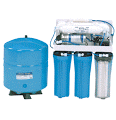
Reverse Osmosis with Steel Tank 
& Cartridge Pre-Filters

Submersible Pumps

Tachmina Solenoid-Driven
Chemical Metering Pump
- ensures regulated dosing
of chlorine into water system
without human intervention


AURORA BOREALIS COLORS - What Causes the Aurora Borealis Colors? - The light you see comes from photons released by oxygen and nitrogen in the upper atmosphere. Energetic particles from the solar wind strike the layer of the atmosphere called the ionosphere, ionizing the atoms and molecules. When the ions return to the ground state, energy released as light produces the aurora. Each element releases specific wavelengths, so the colors you see depend on the type of atom that is excited, how much energy it received, and how the wavelengths of light blend with each other.


Aurora Borealis
What Causes the Aurora Borealis Colors?
Aurora Borealis Color Science
The aurora is the name given to the bands of colored lights seen in the sky at the higher latitudes.
The aurora borealis or Northern Lights are seen mainly near the Arctic Circle.
The aurora australis or Southern Lights are seen in the southern hemisphere.
The light you see comes from photons released by oxygen and nitrogen in the upper atmosphere.
Energetic particles from the solar wind strike the layer of the atmosphere called the ionosphere, ionizing the atoms and molecules.
When the ions return to the ground state, energy released as light produces the aurora.
Each element releases specific wavelengths, so the colors you see depend on the type of atom that is excited, how much energy it received, and how the wavelengths of light blend with each other.
Scattered light from the sun and moon may affect the colors, too.

Aurora Colored - From Top to Bottom

You can see a solid-colored aurora, but it’s possible to get a rainbow-like effect through the bands.
Scattered light from the sun can impart a violet or purple to the top of an aurora.
Next, there may be red light atop a green or yellow-green band.
There may be blue with the green or below it. The base of the aurora may be pink.

Solid Colored Aurora

Solid green and solid red auroras have been seen.
Green is common at the upper latitudes, while red is rare.
On the other hand, aurora viewed from the lower latitudes tend to be red.

Element Emission Colors

Oxygen
The big player in the aurora is oxygen.
Oxygen is responsible for the vivid green (wavelength of 557.7 nm) and also for a deep brownish red (wavelength of 630.0 nm).
Pure green and greenish yellow aurorae result from excitation of oxygen.
Nitrogen
Nitrogen emits blue (multiple wavelength) and red light.
Other Gases
Other gases in the atmosphere become excited and emit light, although the wavelengths may be outside of the range of human vision or else too faint to see.
Hydrogen and helium, for example, emit blue and purple.
Although our eyes can't see all of these colors, photographic film and digital cameras often record a wider range of hues.

Aurora Colors According to Altitude

above 150 miles -- red                  --  oxygen
up to 150 miles  -- green               -- oxygen
above 60 miles   -- purple or violet -- nitrogen
up to 60 miles    -- blue                 -- nitrogen

Black Aurora?

Sometimes there are black bands in an aurora.
The black region can have structure and block out starlight, so they appear to have substance.
The black aurora most likely results from electric fields in the upper atmosphere that prevent electrons from interacting with gases.

Aurora on other Planets

The Earth is not the only planet that has aurorae.
Astronomers have photographed the aurora on Jupiter, Saturn, and Io, for example.
However, the colors of the aurora are different on different worlds because the atmosphere is different.
The only requirement for a planet or moon to have an aurora is that it have an atmosphere that is bombarded by energetic particles.
The aurora will have an oval shape at both poles if the planet has a magnetic field.
Planets without magnetic fields still have an aurora, but it will be irregularly shaped.


Anne Marie Helmenstine, Ph.D.

Anne Helmenstine, Ph.D., is an author and consultant with a broad scientific and medical background.
Experience
Anne has taught chemistry, biology, and physics at the high school, college, and graduate level. In her doctoral work, Anne developed ultra-sensitive chemical detection and medical diagnostic tests. She has worked abstracting/indexing diverse scientific literature for the Department of Energy. She presently works as a freelance writer and scientific consultant. She enjoys adapting lab-based science projects so that they can be performed safely at home.
Education
Dr. Helmenstine has bachelor of arts degrees in physics and mathematics with a minor in chemistry from Hastings College in Nebraska and a doctorate of philosophy in biomedical sciences from the University of Tennessee at Knoxville.
Anne Marie Helmenstine, Ph.D.
Chemistry is part of everyone's life, from cooking and cleaning to the latest computer chip technology and vaccine development. It doesn't have to be intimidating and it doesn't have to be hard to understand.
You can read more about Anne's current and past work on her Google Profile: Anne Helmenstine. Find Anne's printable periodic tables and science projects at Science Notes.

Multi-Media Filter, Highly-Activated Carbon Filter,
Zeolite-Process Water Softener With Brine Tank,
Fiberglass Ballast-Type Pressure Tank
(fully automatic backwash & regeneration)
PURICARE 
INDUSTRIAL 
ENTERPRISES 
Water 
Treatment 
Systems
.
.
...
Aganan, Pavia, Iloilo, Philippines
...

CLICK HERE . . . to view company profile . . .


.
Bladder-Type
Pressure Tanks
.
.

Houston Water Pump with
Mazaki Automatic Pump Controller
Ultra-Violet Bactericidal Lamps