Showing posts with label Mayday Mayday Mayday. Show all posts

Wednesday, March 11, 2020

MAYDAY MAYDAY MAYDAY - Why Do Ships And Airplanes Use The Term ‘Mayday’ When They’re In Danger? - Mayday calls are transmitted in life-threatening situations. Mayday is a special word used as a distress signal in radio communication by mariners and aviators all over the world. If a ship/aircraft faces immediate danger that could be life-threatening to the crew and passengers, the radio operators onboard will broadcast a Mayday signal to request help. Although it’s typically known to be used by the crew of ships and aircraft, there are some countries whose local government organizations, such as police, fire safety department, and transportation authorities also use Mayday as a distress signal to express an imminent threat to life. The word ‘Mayday’ must be said loud and clear three times in a row, followed by the call sign and type of ship/aircraft, location details, type of emergency and its severity, the number of persons onboard and any other vital piece of information that the transmitter considers to be important enough to be relayed. Note that it’s necessary to repeat the word Mayday three times in a row so that it cannot be confused with a similar-sounding phrase by the receiver.

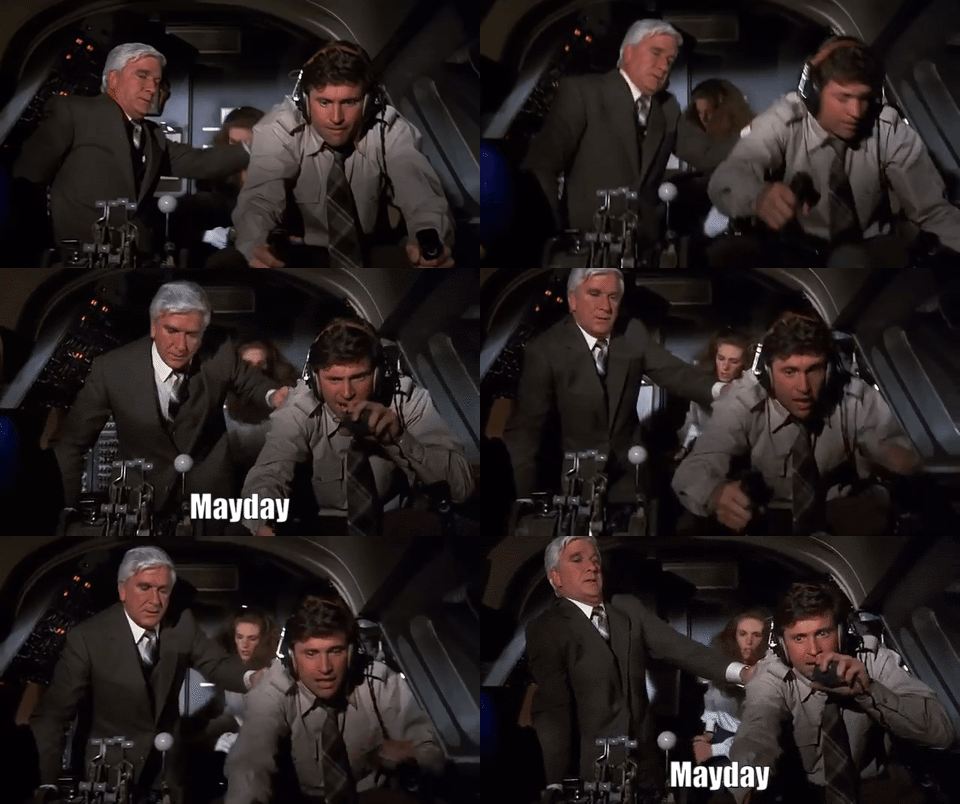
Mayday Science Abc Movie Scene GIF
..............................................................................................................................................................
Mayday Crashing plane explosion fire smoke trail dying movie plane scienceabc
Mayday calls are transmitted in life-threatening situations.
Mayday Mayday Mayday
Why Do Ships And Airplanes Use The Term ‘Mayday’ When They’re In Danger?


Unless you’ve been living under a rock for years, you’ve likely heard the term Mayday, especially in critical situations involving ships and aircraft.
Have you ever wondered what the story is behind this unusual word? I mean, it’s not even a proper English word, right?
Why do sailors/pilots use this word when their ship is about to sink or when their aircraft has experienced a critical technical snag that could bring them down?
What’s wrong with using English words like ‘help’ or ‘danger’ instead?
Does it have anything to do with a day in the month of May, or is it just another term in aviation/maritime jargon without a definite meaning that just stuck?
Short answer: The term Mayday is derived from a French term ‘m’aidez‘, which basically means ‘help me’.
What is ‘Mayday’?
Mayday is a special word used as a distress signal in radio communication by mariners and aviators all over the world.
If a ship/aircraft faces immediate danger that could be life-threatening to the crew and passengers, the radio operators onboard will broadcast a Mayday signal to request help.
Although it’s typically known to be used by the crew of ships and aircraft, there are some countries whose local government organizations, such as police, fire safety department, and transportation authorities also use Mayday as a distress signal to express an imminent threat to life.
What’s the story behind the word ‘Mayday’?
The word ‘Mayday’ might, quite understandably, lead one to believe that it has something to do with a particular day in the month of May, but let me assure you that it’s not even distantly related to springtime.
The word Mayday is actually an anglicization, or in simple words, the English approximation of a French phrase “m’aidez” or “m’aider”, which literally means ‘help me’.
It’s said to have originated with a senior radio officer at Croydon Airport in London named Frederick Stanley Mockford in 1923.
He was asked to come up with a word that could be used in distress signals that could easily be understood by all pilots and support staff at airports.
Since much of the air traffic at that point was between Croydon and Le Bourget Airport in Paris, he proposed the word “m’aider”, which is actually a shortened version of “venez m’aider”.
The term was well-received by users and was consequently adopted as the standard voice call in place of SOS (an international Morse code distress signal that was previously in use) by the International Radiotelegraph Convention of Washington in 1927.
Today, the term ‘Mayday’ has become synonymous with imminent peril or a life-threatening situation.
How is a Mayday call transmitted over radio?
Have you ever noticed in movies/TV shows depicting a ‘Mayday situation’ in a ship or plane that they never just say “Mayday, our ship has developed a major leak” or “Mayday, both our main engines have failed”?
This is because there’s a particular, predefined way in which a Mayday signal needs to be transmitted.
The word ‘Mayday’ must be said loud and clear three times in a row, followed by the call sign and type of ship/aircraft, location details, type of emergency and its severity, the number of persons onboard and any other vital piece of information that the transmitter considers to be important enough to be relayed.
For more clarification, here is a distress message format released by the US Coast Guard.
Note that it’s necessary to repeat the word Mayday three times in a row so that it cannot be confused with a similar-sounding phrase by the receiver.
Also, it helps any potential receivers to confidently know that it’s an actual Mayday call and not a message about a Mayday call.
If a ship cannot send a Mayday signal due to problems with its radio system, a Mayday relay can also be transmitted by another ship on its behalf.
Here’s a real-life example of a mayday call made by MV Summit Venture when it collided with the Sunshine Skyway Bridge in 1980, resulting in its collapse.
A very important thing to remember about making a Mayday call is that it could land you in prison and burn a large hole in your pockets if it’s not a legitimate emergency!
Yes, that’s right. Making a false Mayday call is a federal crime in the US and could result in you being incarcerated for 6 six years and/or having to pay a fine of up to $250,000, as well as restitution to the Coast Guard.
In other words, don’t radio a Mayday signal just because a tap in the kitchenette onboard your boat stopped working; doing that might land you in some real trouble!

Ashish is a Science graduate (Bachelor of Science) from Punjabi University (India). He spends a lot of time watching movies, and an awful lot more time discussing them. He likes Harry Potter and the Avengers, and obsesses over how thoroughly Science dictates every aspect of life… in this universe, at least.

 shocked mr bean GIF
 mayday-has-nothing-to-with-may-the-month-meme

Thursday, May 9, 2019

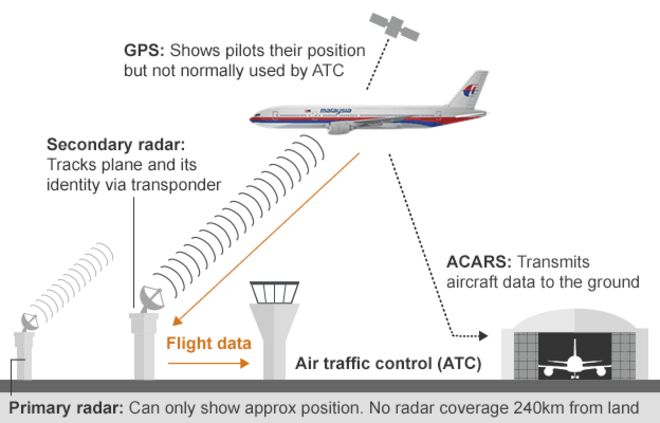
TRACKING A PLANE - Standard international practice is to monitor airspace using two radar systems: primary and secondary. Primary radar detects and measures the approximate position of aircraft using reflected radio signals. Secondary radar, which relies on targets being equipped with a transponder, also requests additional information from the aircraft - such as its identity and altitude. All commercial aircraft are equipped with transponders (an abbreviation of "transmitter responder"), which automatically transmit a unique four-digit code when they receive a radio signal sent by radar. Once an aircraft is more than 240km (150 miles) out to sea, radar coverage fades and air crew keep in touch with air traffic control and other aircraft using high-frequency radio.

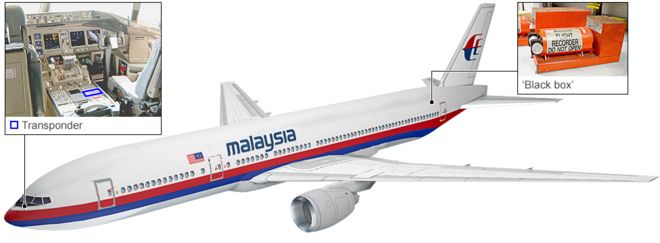
Graphic: Malaysia Airlines Boeing 777-200ER
...................................................................................................

Tracking A Plane
Graphic: How planes can be trackedHow do you track a plane?


The disappearance of Malaysia Airlines flight MH370 has raised the disturbing question of how a modern aircraft packed with communications equipment can apparently vanish without trace.
Evidence has emerged to suggest that the Boeing 777-200ER aircraft flew on for hours after being reported missing.
The plane, with 239 people on board, disappeared from air traffic control screens at approximately 01:20 local time on Saturday 8 March - just an hour after leaving Kuala Lumpur bound for Beijing.
The investigation is now focusing on the actions of the air crew, as officials believe that the plane was deliberately diverted, with key communications systems switched off.
So, how do you track a plane and what do we know about the movements of flight MH370?
Air traffic control - standard international practice is to monitor airspace using two radar systems: primary and secondary.
Primary radar -based on the earliest form of radar developed in the 1930s, detects and measures the approximate position of aircraft using reflected radio signals. It does this whether or not the subject wants to be tracked. 
Secondary radar, which relies on targets being equipped with a transponder, also requests additional information from the aircraft - such as its identity and altitude.
All commercial aircraft are equipped with transponders (an abbreviation of "transmitter responder"), which automatically transmit a unique four-digit code when they receive a radio signal sent by radar.
The code gives the plane's identity and radar stations go on to establish speed and direction by monitoring successive transmissions. This flight data is then relayed to air traffic controllers.
However, once an aircraft is more than 240km (150 miles) out to sea, radar coverage fades and air crew keep in touch with air traffic control and other aircraft using high-frequency radio.
How did flight MH370 vanish?
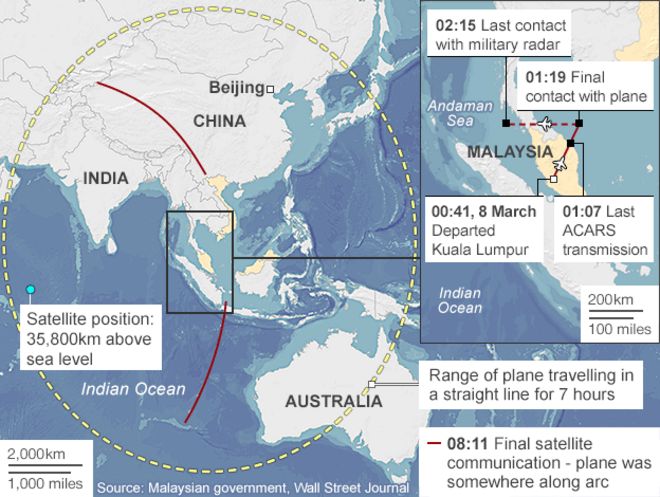
The Boeing 777 disappeared from air traffic control screens when its transponder signal stopped. The last definitive sighting on civilian radar showed the aircraft flying north east across the Gulf of Thailand.
The final radio message received by air traffic control - "Alright, goodnight" - suggested everything was normal on board.
Military radar shows that the plane then turned and headed west across Malaysia towards the Andaman Sea.
On 15 March, satellite data emerged to suggest the plane could be somewhere on an arc stretching either north up to to central Asia, or south, to the Indian Ocean and Australia.
Can't planes be tracked with GPS?
Yes, but while GPS (Global Positioning System) is a staple of modern life, the world's air traffic control network is still almost entirely radar-based.
Aircraft use GPS to show pilots their position on a map, but this data is not usually shared with air traffic control.
Some of the most modern aircraft are able to "uplink" GPS data to satellite tracking services, but handling large volumes of flight data is expensive and such systems are usually only used in remote areas with no radar coverage.
The satellite data which suggests flight MH370 flew on for several hours are basic 'pings' sent by the plane, and so far only help to identify two very approximate flight corridors north and south.
Over the next decade, a new system called ADS-B (Automatic Dependent Surveillance Broadcast) is expected to replace radar as the primary surveillance method for air traffic control
ADS-B will see aircraft work out their position using GPS and then relay data to the ground and other planes.
But, as with existing secondary radar, ADS-B coverage does not extend over the oceans.
ADS-B is already used by flight-tracking websites, but the Malaysian aircraft disappeared from these at the same time it vanished from air traffic control screens.
Could other data systems provide clues?
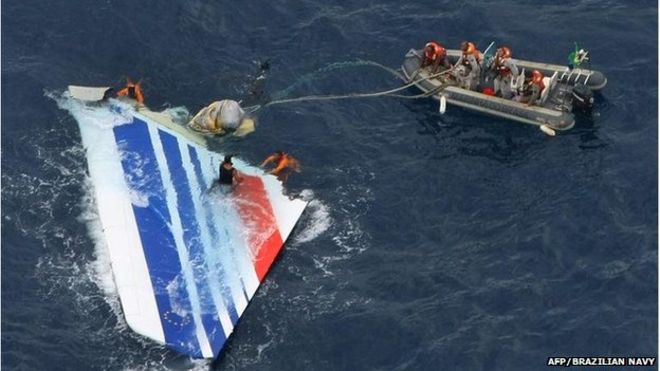
When Air France flight 447 crashed into the mid Atlantic in 2009, its onboard data system - Aircraft Communications Addressing and Reporting System (ACARS) - gave investigators an early insight into what had gone wrong.
ACARS is a service that allows computers aboard the plane to "talk" to computers on the ground, relaying in-flight information about the health of its systems.
Messages are transmitted either by radio or digital signals via satellites, and can cover anything from the status of the plane's engines to a faulty toilet.
This provides ground crews with vital diagnostic information, allowing maintenance to be carried out more quickly.
In the Air France case, ACARS highlighted faulty speed readings, which caused the air crew to become disorientated.
The final message from the ACARS onboard the Malaysian plane came at 01:07 and investigators believe the system was then deliberately shut down.
Turning off ACARS is no easy feat, requiring a person with technical knowledge to climb down through a trapdoor into the plane's hull to remove circuit breakers.
What about the 'black boxes'?
The mystery of flight MH370 may only ever be solved when the aircraft's "black box" flight recorders are recovered.
However, retrieving them from the sea is not easy. In the case of Air France flight 447, it took nearly two years.
If under water, the boxes emit ultrasonic signals - but these signals have a limited range, and search crews may not detect them unless close to the crash site.
Black boxes - described by aviation reporter Stephen Trimble in The Guardian as "one of the most galling anachronisms of modern aviation technology" - are not currently equipped with any form of GPS location transmitter.

https://www.bbc.com/news/world-asia-pacific-26544554
Wreckage of Flight 447, floating in the Atlantic
Map: Last reported position of flight MH370Getty